
Lieferung heute & morgen

Qualitätsgarantie

Willkommens-Angebote freischalten: KOSTENLOSE Lieferung | Bis zu 80 % RABATT | Kostenlose 30-Tage-JoyPlus-Testphase
App herunterladen
A child's room is often much more than just a place to sleep. It's a playground, a study area, and a personal retreat all in one. Meeting these diverse needs within a limited space presents a challenge for many parents. A functional bed in a child's room can be a smart solution, as it combines multiple pieces of furniture into one, freeing up valuable space.
This article introduces various models and explains the key criteria to help you with your selection. The goal is to provide you with an objective basis for your decision, so you can find a suitable and long-lasting solution that meets your child's needs.
Before you make a decision, it's helpful to consider a few fundamental aspects. The following points can serve as your guide.
The durability and safety of a children's bed depend heavily on the material and its construction. A solid wood children's bed made from pine or beech is typically very robust and stable. Models made from MDF (medium-density fibreboard) or particleboard can be a more cost-effective alternative.
Regardless of the material, the following safety features are important:
Functional beds come in numerous designs. Consider which features would be most beneficial in your child's daily life.
Measure the available space in the room carefully. Consider not only the bed's footprint but also the space needed to pull out drawers or to sit comfortably at the desk. A well-planned space-saving children's bed can significantly optimise the use of the room.
The most common size for a single bed for a child is 90x200 cm. This size offers ample space for children and teenagers and is a future-proof choice that can be used for many years. Some models have different dimensions, such as 90x190 cm, which should be noted when selecting a compatible mattress.
Manufacturers often specify a recommended maximum mattress height. This is particularly important for beds with raised sides to ensure the effectiveness of the safety guardrail.
Here is a selection of functional beds that cater to different needs—from an all-in-one solution for school children to a convertible bed for the little ones.

Why It Stands Out This model is a well-designed, all-in-one solution that combines a sleeping area, workspace, and storage within a compact footprint. The direct integration of the desk makes it a central hub for sleeping, learning, and creativity.
Advantages
Who Is It For? This bed is an excellent choice for school-aged children. It provides a dedicated spot for homework while promoting organisation, making it ideal for small to medium-sized children's rooms where there is no space for a separate desk.
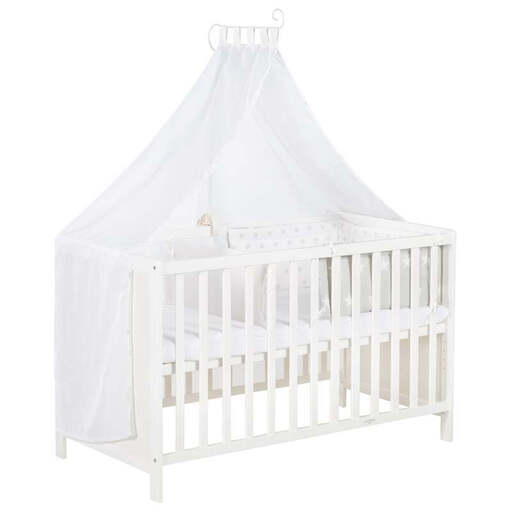
Why It Stands Out This bed is distinguished by its adaptability. It accompanies the child from birth and can be converted from a co-sleeper to a cot and finally to a junior bed.
Advantages
Who Is It For? Ideal for parents looking for a long-lasting initial furniture set. Its use as a co-sleeper, cot, and later as an open children's bed makes it a flexible solution for the 0 to 5-year-old age group.

Why It Stands Out This bed is consistently designed to maximise storage space. With drawers, shelves at the headboard and footboard, and an integrated bench, every available centimetre is utilised.
Advantages
Who Is It For? This model is perfect for children's rooms with a high demand for storage for toys, books, and clothes. The design appeals to children, while the functionality convinces parents who value a tidy room.
The models presented here offer a glimpse into the possibilities that functional beds provide. However, every child's room and every child has individual needs. If you are looking for other designs, specific storage solutions, or different sizes, you may find the right alternative in our broader selection.
Browse our entire collection of toy storage beds to find the ideal solution for your child's room.
A functional bed, also known as a multi-functional bed, is a bed frame that integrates at least one additional function besides sleeping. This typically includes storage in the form of drawers or shelves (storage bed) or a pull-out or attached workspace (children's bed with a desk). The main goal is the efficient use of space.
A bed with an integrated desk is generally recommended from the time a child starts school, around the age of six. It establishes a fixed routine and a dedicated place for homework and crafts from the beginning. For younger, preschool-aged children, functional beds focused on toy storage are often the more practical choice.
The stability of a bed depends on its construction and the materials used, not on whether it is a functional bed. A well-constructed solid wood bed with sturdy joints offers high stability, regardless of any additional features. It is always advisable to check the manufacturer's specified maximum weight capacity and ensure the bed is assembled correctly.