
Lieferung heute & morgen

Qualitätsgarantie

Willkommens-Angebote freischalten: KOSTENLOSE Lieferung | Bis zu 80 % RABATT | Kostenlose 30-Tage-JoyPlus-Testphase
App herunterladen
When a family member, especially a child, is sick, a reliable clinical thermometer is essential. But the market is flooded with models whose marketing promises often create more confusion than clarity. The result is inaccurate readings, complicated operation in stressful moments, and ultimately, a purchase you'll regret. As your Joybuy Product Recommendation Officer, I'll help you separate the wheat from the chaff and find a device that truly fits your needs.
Many buyers fall into two common traps:
Before you make a decision, you should consider three core aspects. These determine whether a clinical thermometer is reliable and practical for daily use.
The measurement method is the most important factor. Each method has specific pros and cons that you should be aware of.
Many devices today combine forehead and ear measurement, offering maximum flexibility.
Some features are more than just gimmicks and offer real value, especially for families.
A thermometer is a medical device, and its hygiene is crucial. Look for a measuring tip that is easy to clean. Some ear thermometers require disposable protective caps, which adds extra cost and waste. Models with a smooth, wipeable probe are often more practical. An ergonomic design and a clear, backlit display complete a user-friendly device.
Here are some recommendations tailored to different needs and households.

Why This Fits Their Persona: Ideal for anyone looking for a simple, reliable, and affordable device for basic temperature measurement. It focuses on the essentials without complicated extra features.
This thermometer bypasses the "feature trap" with its simple one-button operation. It provides a clear reading and a fever alarm—often, that's all you need for a quick and reliable assessment.
The flexible measuring tip ensures a more comfortable and safer measurement. The waterproof tip allows for straightforward and hygienic cleaning.

Why This Fits Their Persona: Perfect for parents who need a fast, hygienic, and stress-free measurement method for their children. The silent mode and contactless measurement are ideal for nighttime use.
It addresses the "inaccuracy trap" with its PositionCheck technology. A targeting light and a proximity sensor help you find the correct distance and position for a precise measurement.
The Age Precision technology with a color-coded display interprets the temperature based on age (0-3, 3-36, 36+ months), providing a reliable assessment. It can also measure the temperature of liquids and food.
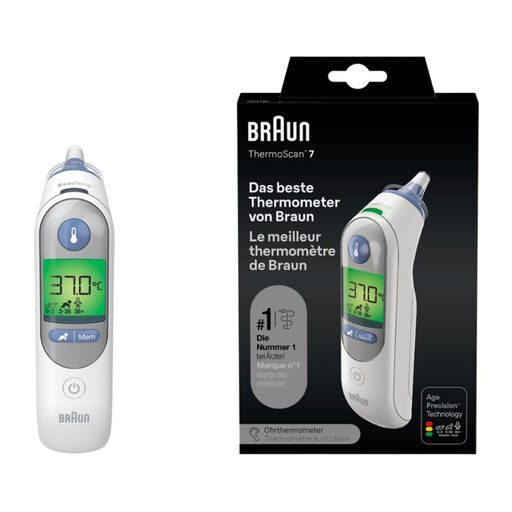
Why This Fits Their Persona: For users who value clinically proven precision and are willing to learn the correct technique for using an ear thermometer to achieve the highest possible accuracy.
It actively combats the "inaccuracy trap" with two technologies: The pre-warmed tip minimizes the cooling effect in the ear, and the ExacTemp positioning aid confirms correct placement in the ear canal with a light and a beep.
The combination of precise ear measurement technology and the age-adjustable Age Precision fever interpretation delivers reliable and easy-to-understand results for the whole family.
We have compiled a complete, up-to-date list of products that fully meet these strict selection criteria and German safety regulations.
Both technologies can deliver very accurate results when used correctly. Ear thermometers measure temperature closer to the source of core body temperature (the eardrum), making them potentially very precise, but they require exact positioning in the ear canal. Contactless forehead thermometers are extremely convenient and hygienic, but their readings can be slightly influenced by external factors like sweat on the forehead or a cool room temperature. For a quick, indicative measurement, especially on sleeping children, a forehead thermometer is often the more practical choice.
A visual fever alarm translates the measured temperature value into a simple, instantly understandable color scheme. Typically, Green means a normal temperature, Yellow an elevated temperature, and Red a fever. Some advanced devices, like those from Braun, even adjust these color thresholds based on the person's age, as the definition of a fever in a newborn is different from that in an adult.
Proper cleaning is crucial for hygiene and measurement accuracy. Always follow the manufacturer's instructions. Generally, the infrared sensor is the most important and sensitive component. It should be gently cleaned with a soft, dry cloth or a cotton swab lightly moistened with medical alcohol. The body of the thermometer can be wiped with a slightly damp cloth. Never fully submerge the device in water.