
Lieferung heute & morgen

Qualitätsgarantie

Willkommens-Angebote freischalten: KOSTENLOSE Lieferung | Bis zu 80 % RABATT | Kostenlose 30-Tage-JoyPlus-Testphase
App herunterladen
A lack of clothing storage is a common problem, especially in rented flats, shared apartments, or homes with limited space. A bulky wardrobe isn't always the most practical solution. A clothes rack provides a flexible and often more space-saving alternative. Whether used to supplement your bedroom storage, as an open wardrobe in a dressing room, or as a mobile garment rack, the possibilities are endless.
This guide is here to help. We'll introduce various types of clothes racks, explain key criteria for choosing one, and showcase a selection of models to simplify your decision-making process.
Choosing the right model depends on your individual needs, the space you have available, and the amount of clothing you need to hang. Three key criteria will help guide your choice.
The most fundamental decision is the type of construction. Both options offer distinct advantages:
Stability is a critical factor, especially if you plan to hang heavy items like winter coats or multiple suits.
A good clothes rack should adapt to your needs—not the other way around.
Based on the criteria above, we've curated a selection of different models to meet a variety of needs.

Why it stands out: This compact telescopic system is designed for use in smaller rooms or alcoves. It uses a tension mechanism to fit between the floor and ceiling without any drilling, protecting your home's structure.
Advantages:
Who it's for: Ideal for those who need a narrow yet tall storage solution for a moderate amount of clothing, such as in student accommodation, small bedrooms, or as a supplement to an existing wardrobe.
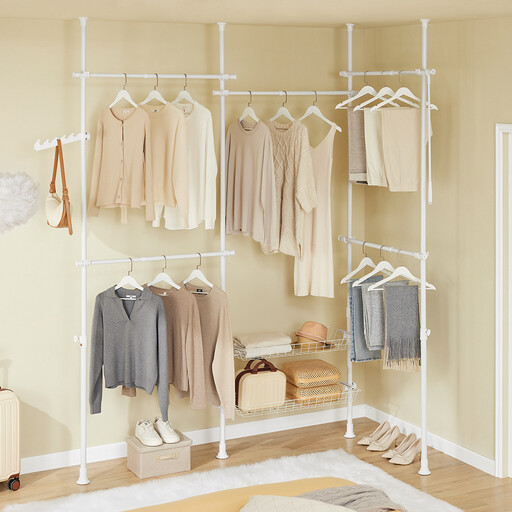
Why it stands out: This extensive clothes rail system is designed to function as a complete open wardrobe. With five clothes rails and two wire baskets, it provides a comprehensive organisational solution.
Advantages:
Who it's for: Perfect for users who want to transform an entire wall into an open wardrobe, for instance in a dressing room or bedroom. It offers enough space for one or two people's wardrobes.

Why it stands out: This model is designed as a mobile, heavy-duty clothes rack. Its steel frame and robust castors are built to handle a significant amount of weight.
Advantages:
Who it's for: Perfect for anyone needing an extremely sturdy and mobile solution. This includes use in a basement for storing seasonal clothing, in a utility room, or for individuals with a very large wardrobe.
Didn't find the perfect model for your needs? There are countless other options available, from minimalist garment racks to complex systems. Find the solution that perfectly matches your living space and style.
Discover Our Full Range of Sturdy Clothes Rails
The load capacity varies significantly depending on the model and construction. Simple racks often hold only 10–20 kg, while sturdy telescopic systems can support 25–65 kg, and designated heavy-duty models can handle up to 150 kg or more. It is essential to check and adhere to the manufacturer's specified maximum load capacity to prevent overloading.
Assembly is generally straightforward. Telescopic systems that work without drilling use a tension mechanism. The poles are wedged between the floor and ceiling and secured by spring force or twisting mechanisms. An illustrated assembly manual is typically included with the product and should be followed for a smooth setup.
Yes, a modular clothes rail system, in particular, can serve as a fully-featured open wardrobe. The advantages include good air circulation, which keeps clothes fresh, and a quick overview of your entire collection. A potential downside is that clothes are exposed to dust, and the open look requires a certain level of tidiness.