
Lieferung heute & morgen

Qualitätsgarantie

Willkommens-Angebote freischalten: KOSTENLOSE Lieferung | Bis zu 80 % RABATT | Kostenlose 30-Tage-JoyPlus-Testphase
App herunterladen
In regions with hard water, limescale buildup is a common problem that can significantly impair the performance and lifespan of a coffee machine. Over time, it not only clogs the internal pipes and increases energy consumption but also compromises the flavour of your coffee. Regular and proper descaling is therefore not optional—it's essential to preserve the value of your appliance.
This article serves as a comprehensive guide. It introduces different types of descalers and explains their specific properties to help you make an informed decision for the care of your coffee maker or super-automatic espresso machine.
Selecting the right product depends on several factors, including the type of machine and your personal preferences for application. Here are some objective criteria to consider.
The choice between descaling tablets and a liquid descaler often comes down to ease of use and the manufacturer's specifications.
Both forms are effective at removing limescale from the coffee machine when used correctly.
Many manufacturers, such as Jura or Philips, offer their own descaling products with formulas precisely tailored to the materials and functionality of their machines.
The composition of the descaler is crucial for a gentle yet effective cleaning process. Modern formulas are often based on acids like sulfamic acid or citric acid, in a concentration that effectively dissolves limescale without damaging internal components like hoses, seals, or the thermoblock. Products with additional care components can also form a protective film on surfaces to prevent corrosion. Look for information on material compatibility and eco-friendly properties, such as a phosphate-free formula.
Based on objective product features and use cases, we have compiled a selection of descalers suitable for various needs.
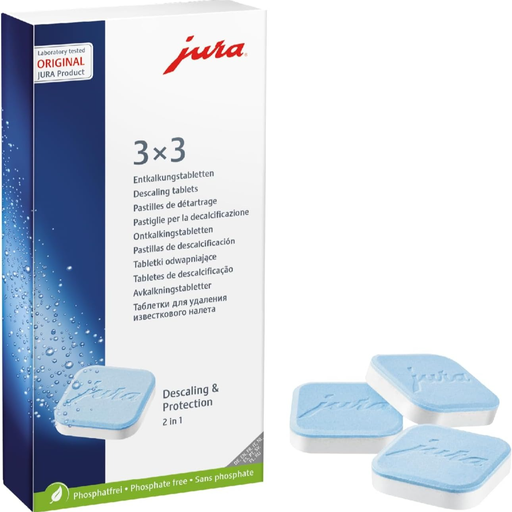
Why it stands out: These tablets were developed specifically for JURA super-automatic coffee machines and offer a 2-phase action. According to the manufacturer, the first phase removes limescale deposits, while the second phase seals the fluid system, providing long-lasting corrosion protection for pipes and the thermoblock. The formula is phosphate-free, and its hygiene is T?V-certified.
Pros:
Who is it for? This product is the ideal solution for owners of JURA super-automatic coffee machines who want to maintain the value and functionality of their appliance with the manufacturer-recommended care product.
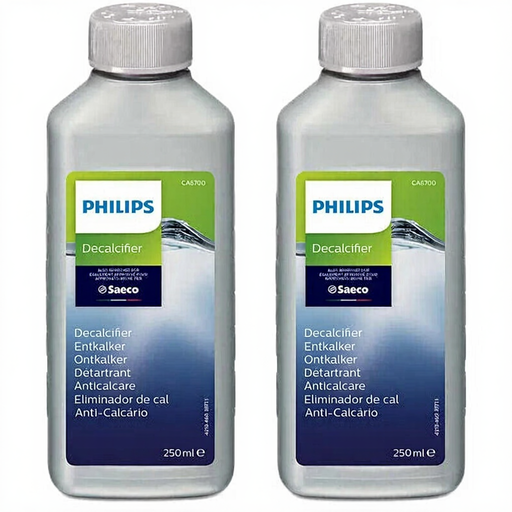
Why it stands out: The Philips CA6700/22 is a liquid descaler designed for use in all Philips and Saeco espresso machines. Its liquid form allows for simple and quick application. The formula, based on citric acid and sodium citrate, is engineered to effectively remove limescale, thereby preserving machine performance and coffee taste.
Pros:
Who is it for? Users of Philips or Saeco espresso machines who prefer a straightforward, liquid descaling solution and trust the original manufacturer's product.
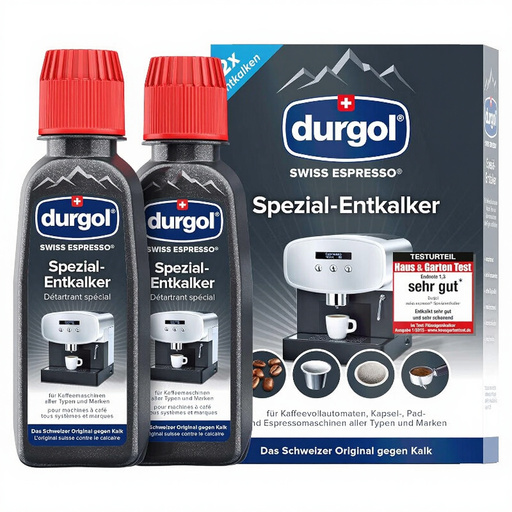
Why it stands out: The durgol Swiss Espresso is a universal special descaler for coffee machines of all types, including super-automatics, portafilter machines, and capsule systems. It is distinguished by its high descaling power, which the manufacturer claims can be up to 10 times faster than citric acid-based products. The formula is gentle on materials, food-safe, and leaves no residue. The bottles are also made from 100% recycled plastic.
Pros:
Who is it for? For quality-conscious owners of various coffee machine types who are looking for a powerful yet safe universal solution for regular maintenance.
This selection covers common use cases. If the right product for your specific needs or machine model isn't here, other alternatives are available.
If you are looking for other specialised cleaning products or need a different type of limescale remover, you can find a broader selection in our comprehensive category.
The frequency depends on two main factors: the water hardness in your area and how often you use the machine. Many modern super-automatic coffee machines have a built-in indicator that automatically reminds you when descaling is due. As a general guideline, with average use and medium water hardness, descaling every one to three months is advisable. Always follow the recommendations in your device's user manual.
Using pure home remedies like vinegar essence or citric acid is not recommended for modern coffee machines. The concentration of these acids can be uncontrolled and may damage materials such as seals, aluminium parts, or delicate hoses. Additionally, vinegar can leave a strong residual taste in the system. Commercial descalers are tested for material compatibility and often contain additional care components that protect the machine.
A liquid descaler is ready to use and only needs to be diluted with water, which simplifies preparation. Descaling tablets, on the other hand, are very compact, easy to store, and allow for precise dosage without measuring. Both versions achieve an equivalent result when used correctly. The choice is ultimately a matter of personal preference and the manufacturer's recommendation.