
Lieferung heute & morgen

Qualitätsgarantie

Willkommens-Angebote freischalten: KOSTENLOSE Lieferung | Bis zu 80 % RABATT | Kostenlose 30-Tage-JoyPlus-Testphase
App herunterladen
Finding the right construction toy for kids can be a challenge. The market is filled with sets that promise to foster creativity and learning, but not every product lives up to the claims on its packaging. As a Joybuy Product Recommendation Officer, I see daily which features make a toy durable and educationally valuable, and which ones often lead to disappointment in the playroom. This guide will help you avoid common purchasing pitfalls and make an informed decision.
Before deciding on a set, it's helpful to know the most common issues that can quickly put an end to the fun.
To avoid a bad purchase, you should check three essential criteria. These will give you an objective basis for your decision and ensure long-term enjoyment.
The most important criterion is your child's safety. Always look for the CE marking. This symbol confirms that the product meets the requirements of the EU safety standard EN 71. This includes tests for mechanical properties, flammability, and the absence of harmful chemical substances. High-quality educational toys are characterized by robust, non-toxic ABS plastic and carefully rounded edges to prevent injuries.
A good building set for kids grows with the child's skills and interests. Before buying, check if the system is expandable. Many manufacturers offer additional sets that can be combined with a starter set. This is especially true for marble runs and magnetic systems. An expandable system is a sustainable investment in years of fun, whereas closed, one-off products quickly lose their appeal.
The complexity of the toy must match the child's developmental stage.
Here are some recommendations tailored to different age groups and interests that meet the quality criteria mentioned above.
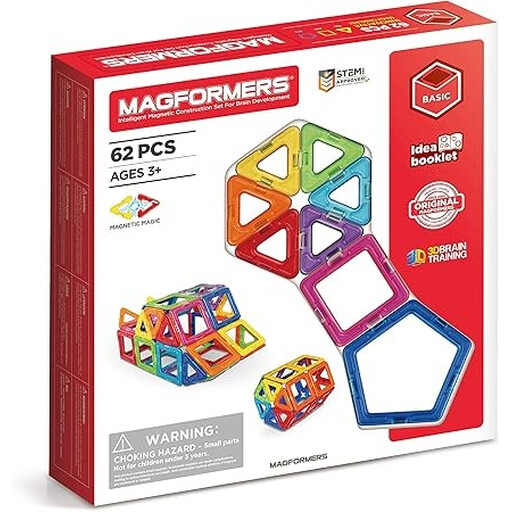
Why This Fits Their Persona: Ideal for an introduction to the world of three-dimensional building. The magnetic pieces are easy to connect, fostering creativity and spatial awareness without complex instructions. A perfect gift for kindergarten-aged children.
The strong magnets, securely encased in plastic, ensure stable constructions and bypass the problem of constant collapsing. The set focuses on versatile geometric shapes instead of useless filler pieces.
Playfully promotes an understanding of geometry and magnetism (STEM). The 62-piece set offers a good balance of variety and manageability.

Why This Fits Their Persona: For older children looking for a real challenge. This vertical marble run requires planning, precision, and an understanding of physical laws like gravity and momentum. Ideal for tinkerers who love to experiment.
The system is explicitly designed for expandability, thus avoiding the trap of a closed, one-off toy. The attachment to smooth surfaces with nano-adhesive pads is an innovative and functional solution, not an empty marketing promise.
Space-saving, vertical building on doors or windows. Promotes concentration and an understanding of physical principles. Made in Germany from sustainable materials.
Why This Fits Their Persona: Perfect for kids who love to take things apart and put them back together. This set introduces them to basic mechanical principles with child-safe tools and is an ideal gift for dinosaur fans.
The set comes with a practical storage box, which prevents the problem of lost small parts. The tools are precisely matched to the screws, ensuring smooth operation without moments of frustration.
Includes four different dinosaurs as well as one electric and two manual screwdrivers for varied fun. Promotes fine motor skills, hand-eye coordination, and logical thinking.
We have compiled a complete, up-to-date list of products that fully meet these strict selection criteria and German safety regulations.
Construction toys are beneficial for children as young as 18 months, provided they are age-appropriate. For the youngest children, simple plug-in or stacking games that train motor skills are suitable. From the age of 3, magnetic building blocks and simple screw-together sets become interesting. For primary school-aged children, more complex building sets for kids and technical STEM toys that require concentration and logical thinking are appropriate.
Most plastic parts without electronics or stickers can be cleaned under running water with mild soap. For magnetic building blocks or parts with electronic components, water should be avoided. Wiping them with a slightly damp cloth is recommended here. Always follow the manufacturer's cleaning instructions to avoid damaging the materials.
A higher price often correlates with objective quality features. More expensive sets typically use stronger neodymium magnets, which ensure more stable structures and thus reduce frustration during play. Additionally, the plastic used is often of higher quality (e.g., food-grade ABS plastic), better finished (no sharp edges), and certified to be free of harmful substances, which increases safety.