A functional kitchen is the heart of many homes. But intense cooking fumes and odours can quickly spoil the atmosphere. The right cooker hood provides a solution by ensuring clean air. However, choosing the right model can be a challenge given the variety of designs, functions, and performance specs.
As your Joybuy Product Recommendation Officer, I'm here to help you understand the technical features and differences. This guide provides an objective basis for making an informed decision that is perfectly tailored to your kitchen and cooking habits.
What to Look for When Buying a Cooker Hood
Three key criteria determine which appliance is right for you: the operating mode, the design, and the technical performance specifications.
The choice between extraction and recirculation mode is fundamental and depends on the structural conditions of your flat or house.
- Extraction Mode: The hood draws in cooking vapours, filters out grease, and expels the cleaned air outside through a ducting system. This method is highly effective at removing moisture and odours. However, it requires an external wall vent and is therefore primarily an option for homeowners.
- Recirculation Mode: A recirculating cooker hood also draws in air but cleans it using a grease filter and an additional activated carbon filter that neutralises odours. The purified air is then released back into the room. This solution is ideal for rental properties or kitchens without the option for an external vent.
2. The Right Design for Every Kitchen
The design of the hood should be based on the layout and size of your kitchen.
- Wall-Mounted Hood: The classic version, visibly mounted on the wall above the hob. It often serves as a design statement in the kitchen. Models like a cooker hood in black can add a modern touch.
- Under-Cabinet & Telescopic Hoods: These models are mounted underneath a wall cabinet. An under-cabinet hood is always visible, while a telescopic hood has a retractable visor and disappears almost invisibly into the cabinet when not in use. Both are very space-saving.
- Downdraft & Portable Cooker Hoods: Innovative solutions for kitchen islands or flexible living situations. A downdraft extractor is integrated directly into the worktop next to or behind the hob. A portable cooker hood is a freestanding device that can be set up as needed—ideal for small apartments, camper vans, or for cooking at the dining table (e.g., raclette).
3. Understanding Performance, Efficiency, and Noise Level
Objective metrics help you compare the performance of different models.
- Airflow Rate (in m?/h): Indicates how much air the hood can circulate per hour. A rough formula to calculate your needs is: Kitchen Volume (Length × Width × Height in m) × 10. A higher value should be used for open-plan kitchens.
- Energy Efficiency Class: As with other household appliances, the scale from G to A+++ provides information about power consumption. An energy-saving A+++ cooker hood reduces running costs and is better for the environment.
- Noise Level (in dB): A quiet hood is especially important in open-plan kitchens. Values below 60 decibels (dB) on the highest setting are considered relatively low-noise.
Our Top Range Hood Picks
Based on the criteria mentioned, we have compiled a selection of models that cater to different requirements and kitchen concepts.
Ciarra 60cm Ultra-Slim Wall-Mounted Hood
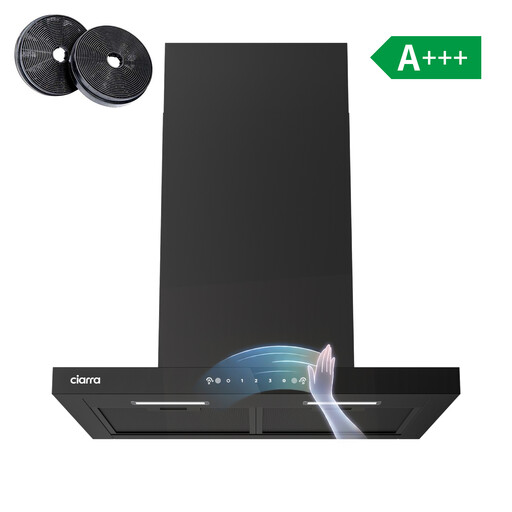
Why it stands out: This model combines a minimalist design with high functionality. The ultra-slim 40 mm panel made of black glass integrates seamlessly into modern kitchens. The gesture control (Wave Control) allows for hygienic, fingerprint-free operation.
Advantages:
- High Performance: With a maximum airflow rate of 650 m?/h, even intense cooking fumes are effectively removed.
- Highly Energy-Efficient: The A+++ energy efficiency class ensures a low annual energy consumption of just 12 kWh/a, according to the manufacturer.
- Flexible Installation: The appliance is suitable for both extraction and recirculation mode.
- Modern Controls: Can be operated via a touch display or touchless gestures.
- Low Noise Level: The maximum noise level is 59 dB.
Who is it for? For users looking for a powerful and energy-efficient 60cm cooker hood who value a modern, unobtrusive design. Ideal for open-plan kitchens where aesthetics and a low noise level are important.
View Product
Ciarra 60cm Under-Cabinet Telescopic Hood
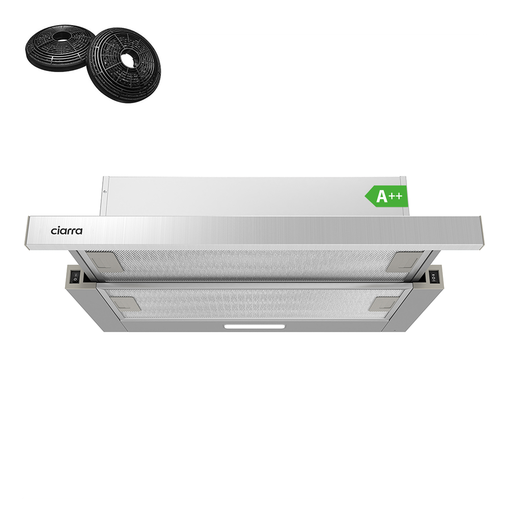
Why it stands out: This telescopic hood is a practical solution for kitchens with limited space. When retracted, it is discreetly concealed under the wall cabinet. Pulling out the visor automatically activates the last selected fan speed and lighting.
Advantages:
- Space-Saving Design: The telescopic function makes it ideal for small kitchens or minimalist interiors.
- Solid Performance: An airflow rate of 370 m?/h is sufficient for standard hobs and smaller kitchens.
- High Efficiency: With an A++ energy efficiency class, it is very economical to run.
- Dual Mode: Supports both extraction and recirculation modes (activated carbon filter included).
- Integrated Lighting: A 1.5W LED light provides excellent illumination for the cooking area.
Who is it for? For people in apartments or homes with compact kitchens who need a functional and discreet under-cabinet hood. The simple operation and memory function offer added everyday convenience.
View Product
Ciarra Portable Tabletop Cooker Hood
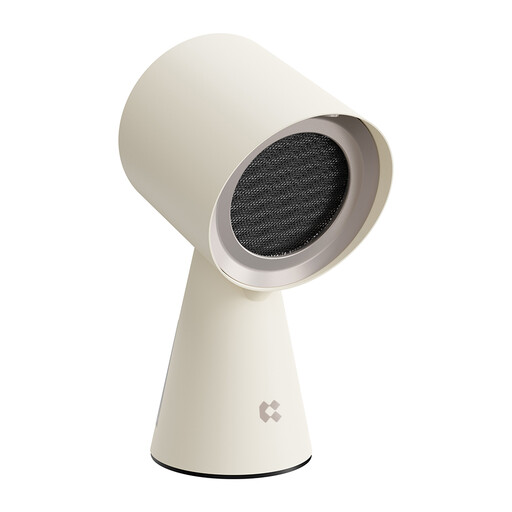
Why it stands out: This appliance is a true innovation for maximum flexibility. As a freestanding, portable cooker hood, it requires no installation whatsoever. Simply place it next to the cooking appliance, and it cleans the air right at the source.
Advantages:
- Absolute Portability: Weighing just 1.5 kg, the device can be used anywhere—in the kitchen, on the balcony, in a camper van, or at the dining table.
- No Installation: The device operates exclusively in recirculation mode and only requires a power outlet.
- Effective Filtration: A three-stage filter system consisting of aluminium and polymer filters captures grease and odours.
- Targeted Extraction: With an airflow of over 2 m?/min, it is designed for use with electric grills, fondue pots, or induction hobs.
- Easy Maintenance: The filters and oil collection tray are easy to remove and clean.
Who is it for? For tenants in flats without an extractor hood, students, campers, or for social cooking events like raclette or fondue where you want to neutralise odours directly at the table. A practical problem-solver for situations where a permanent installation is not possible or desired.
View Product
Looking for More Options?
The models featured already cover a wide range of needs. However, if you prefer a different design or specific features, you can find more alternatives in our range.
Discover Our Full Range of Chimney Cooker Hoods
Frequently Asked Questions (FAQ)
What is the required distance between the hob and the cooker hood?
The recommended minimum distance depends on the type of your hob. As a general guideline, a distance of approx. 65 cm for electric hobs and approx. 75 cm for gas hobs is advised. However, always refer to the specific instructions in the installation manual provided by your cooker hood's manufacturer.
What is the difference between an extraction and a recirculation hood?
An extraction hood vents the purified air outside, which is very effective at removing moisture and odours but requires an external wall vent. A recirculation hood filters the air through a grease and an activated carbon filter before returning it to the room. It is easier to install and ideal for rental properties.
How often should the grease filter be cleaned or the carbon filter replaced?
The metal grease filter should be cleaned every 2 to 4 weeks, depending on how intensively you cook. Many are dishwasher-safe. The activated carbon filter in recirculation hoods is a consumable part and should be replaced approximately every 3 to 6 months to ensure effective odour neutralisation. You can find the exact intervals in your appliance's user manual.


