
Lieferung heute & morgen

Qualitätsgarantie

Willkommens-Angebote freischalten: KOSTENLOSE Lieferung | Bis zu 80 % RABATT | Kostenlose 30-Tage-JoyPlus-Testphase
App herunterladen
Correct tire pressure is crucial for driving safety, fuel efficiency, and tire lifespan. Yet, finding a working air pump at a gas station can be a hassle. A cordless air compressor offers a portable and straightforward solution. However, the market is flooded with devices making grandiose claims. Many buyers only discover after purchase that their new device is unsuitable for real-world use.
This guide will help you identify the common pitfalls and find a model that truly meets your needs. We focus on the objective criteria that define a reliable portable compressor.
Before you make a purchasing decision, you should be aware of the common marketing exaggerations and design flaws that often lead to disappointment.
To avoid a bad purchase, you should focus on the following three core technical features. These are the primary determinants of a cordless tire inflator's real-world usability.
These two values are inextricably linked.
A good device offers a balanced combination of sufficient pressure and a high air flow rate.
The portability of a cordless air compressor hinges on its power source.
Modern devices do more than just inflate tires. These features significantly enhance usability and safety.
Here are three recommendations tailored to different user profiles that avoid the pitfalls mentioned.
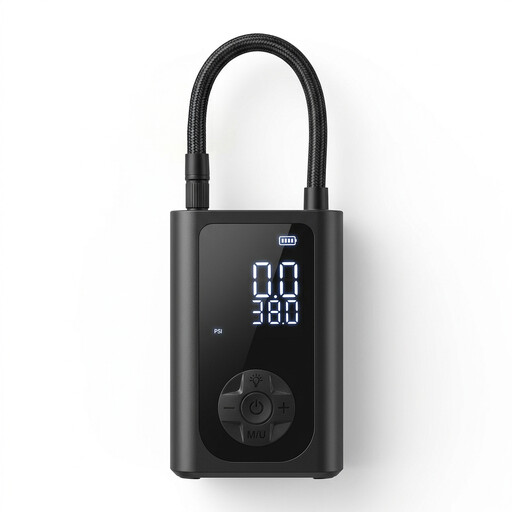
Why it's a good fit: Ideal for drivers who want a compact and reliable device for the glove compartment. It's designed for occasional pressure checks and emergencies, without being overloaded with unnecessary features.
With an air flow rate of 26 L/min, its performance is solid for its size, avoiding the trap of extremely slow devices. The auto shut-off feature reliably prevents over-inflation.
The 4000 mAh battery offers sufficient capacity for emergencies. The 5 preset modes and clear display make it very easy to use, even for non-technical users.

Why it's a good fit: Perfect for commuters, motorcyclists, and outdoor enthusiasts who need a powerful and long-lasting device for regular use. The high battery capacity also makes it a useful travel companion.
With an air flow rate of 35 L/min and a 7500 mAh battery, this model bypasses the pitfalls of weak performance and short runtime. According to GOOLOO, it can inflate a Tesla tire from 30 to 36 PSI in about 63 seconds.
The combination of high performance, a large battery, and a power bank function makes it a true multi-tool. The large LED display is easy to read even in daylight.

Why it's a good fit: For safety-conscious drivers looking for more than just a tire inflator. This device combines a powerful compressor with life-saving tools for emergency situations, such as after an accident.
It not only offers necessary safety features like auto shut-off but also integrates additional emergency tools that are missing from many other models. The 35 L/min performance is more than sufficient for emergencies.
The integrated window breaker and seatbelt cutter make this device a comprehensive safety tool for any vehicle. The LED light's SOS function increases visibility during a breakdown.
We have compiled a complete, real-time updated list of products that fully meet these strict selection criteria and safety regulations.
The runtime heavily depends on the battery capacity (mAh) and the power being drawn. A model with 4000-6000 mAh can typically top off 2-4 car tires by a few PSI or fully inflate a flat bicycle tire. For completely inflating multiple flat car tires, devices with a larger battery (over 7000 mAh) or a connection to a 12V power source are required.
Yes, most high-quality models can. However, this is a demanding task that consumes a lot of time and battery power. A powerful electric tire inflator with a high air flow rate (e.g., 35 L/min) and a large battery is better suited for this. It can take 8-15 minutes per tire.
The accuracy of the digital display is crucial. Deviations of ±0.1 Bar (approx. ±1.5 PSI) are common in good devices. The auto shut-off function is only as precise as the built-in pressure sensor. It is advisable to occasionally compare the pressure displayed by the compressor with a separate, calibrated tire pressure gauge.