
Lieferung heute & morgen

Qualitätsgarantie

Willkommens-Angebote freischalten: KOSTENLOSE Lieferung | Bis zu 80 % RABATT | Kostenlose 30-Tage-JoyPlus-Testphase
App herunterladen
A cordless car polisher gives you the freedom to work without an extension lead. Depending on its design, it can be used for paintwork, wheels, plastic trim or hard-to-reach areas. But high speeds and a generous range of accessories don’t automatically make a tool the right choice. What matters is how you plan to use it, the polishing action, the battery system and how easily you can control it.
A high speed may sound powerful at first. But on a rotary polisher, it means something different from the same figure on a dual-action polisher. Pad diameter, orbit, pressure and material also affect how the machine performs in practice. A mini polisher running at 21,000 rpm is therefore not directly comparable with a machine running at 5,000 rpm with a 125 mm backing plate.
For delicate paintwork, a finely adjustable speed is more important than the highest possible maximum speed. Start on the lowest setting and test the pad and polish on an inconspicuous area.
Figures such as 2.0 Ah or 5.0 Ah refer to battery capacity; they don’t automatically tell you how long you can work. Running time depends on factors including speed, pressure, temperature and material. Some product specifications also measure running time without a load.
Two batteries are useful if you’re planning to valet a whole car. You can charge one while using the other. Also check whether replacement batteries are sold separately and are compatible with the machine.
A large car polishing kit may include numerous sponges, wool pads and abrasives. That’s only useful if the backing plate sizes suit the jobs you have in mind. A 125 mm pad is suitable for larger painted areas, while a mini polisher with a 25, 50 or 75 mm pad is better for door handles, mirrors, wheel spokes or bumper edges.
Accessories should also be clearly labelled by grade and intended use. Don’t use the same pad for cutting compound, wax and delicate plastic surfaces, as residue or scratches may result.
For beginners, a well-controlled dual-action movement is often easier to handle. For detail work in tight spaces, a rotary attachment may be more practical.
The backing plate size affects how easily you can reach flat surfaces and contours. 25 to 50 mm pads are suitable for spot work and tight spaces. 75 mm is a versatile size for smaller sections of bodywork. A 125 mm backing plate covers larger areas more efficiently, but is less manageable around door handles or narrow areas of a wheel.
On a dual-action machine, the orbit affects the pad’s movement. A small orbit, such as 3 or 5 mm, is suitable for controlled detailing. A larger orbit can cover more surface area, but needs enough clearance and a steady hand.
Look for:
Before polishing, clean the surface and remove any loose dirt. Masking tape protects adjacent plastic parts and edges. When working on glass, metal or furniture, use pads and polishing products designed specifically for those materials.
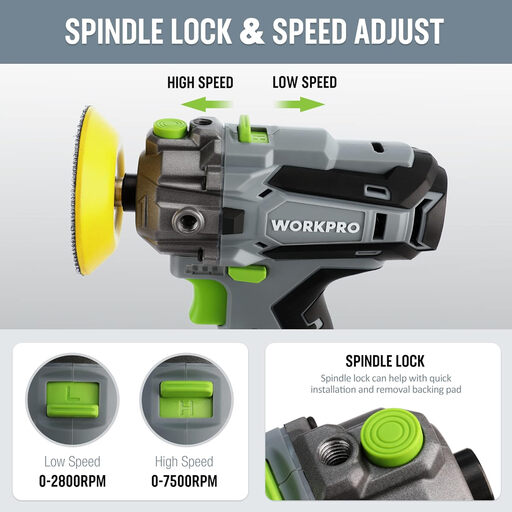
Why this product suits this user: This compact 12 V machine is designed for smaller surfaces and detail work, and comes with two 2.0 Ah batteries.
Two speed settings, from 2600 to 7000 rpm, and a battery indicator make it easier to work with control.
Weighs 0.88 kg including the battery, comes with 75 mm accessories and takes around an hour to charge according to the product information.
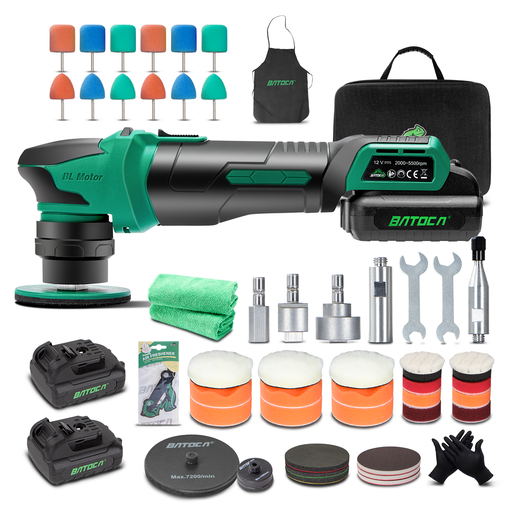
Why this product suits this user: Its dual system, with rotary and dual-action modes and 25 and 75 mm backing plates, is ideal if you want to tackle a range of detailing jobs.
Four speed settings, from 2000 to 5500 rpm, let you adjust the speed instead of relying on a single, uncontrolled setting.
Brushless motor, two 12 V 2.5 Ah batteries, and 3 mm or 12 mm dual-action drive.
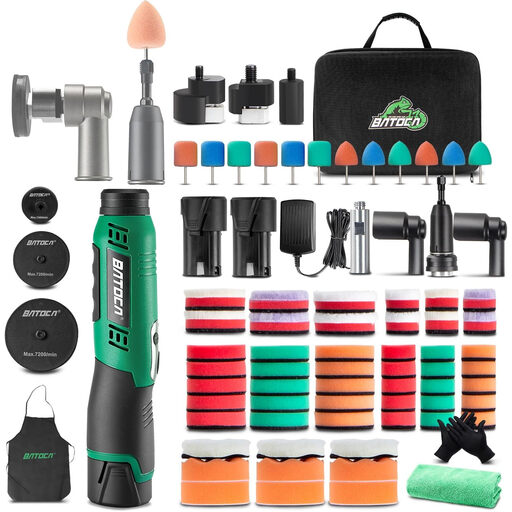
Why this product suits this user: The interchangeable systems and small backing plates are designed for car valeting around mirrors, door handles, wheels and edges.
Rather than being limited to one large backing plate, the kit includes 25, 50 and 75 mm back plates, as well as rotary and DA drives.
Six speed settings in RO mode, a separate mini system running at up to 21,000 rpm, and two 12 V 2.0 Ah batteries.
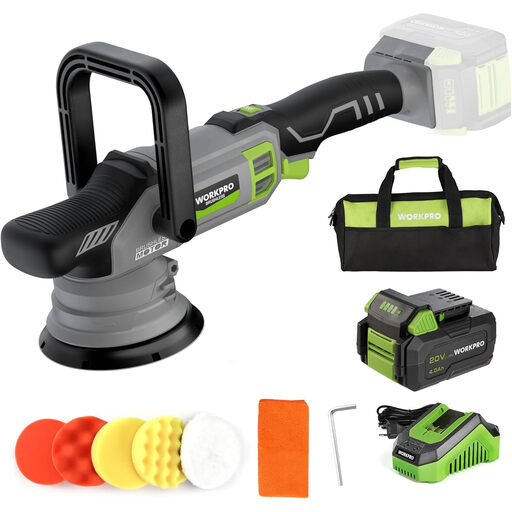
Why this product suits this user: This 20 V machine with a 125 mm backing plate is aimed at users who want to work on paintwork, floors or tiles across larger areas.
Seven settings, from 2000 to 5000 rpm, let you adjust the machine to suit the surface and polishing product.
Brushless motor, dual-action movement, 4.0 Ah battery and storage bag included.
A cordless polisher is no substitute for proper paintwork repairs. Deep scratches, damaged clear coat or rust spots should be assessed before you start. When using abrasives, it’s a good idea to wear safety glasses and suitable gloves, and to work in a well-ventilated area.
We’ve put together a complete, regularly updated list of products that meet these strict selection criteria and fully comply with the safety regulations in force in the EU.
Yes, as long as the machine has a low starting speed, several speed settings and a controllable dual-action movement. Always start on an inconspicuous area and avoid applying too much pressure.
It depends on the battery capacity and how you use the machine. A figure such as 30 or 60 minutes may refer to use without a load, according to the product description. For longer jobs, it’s useful to have two batteries or a compatible replacement battery system.
The charger’s electricity consumption is usually low compared with the cost of polish, pads and replacement batteries. Regular expenses mainly include new sponges, microfibre cloths, polishing products and, where needed, a replacement battery. Before buying, check that suitable consumables and batteries are available.