
Lieferung heute & morgen

Qualitätsgarantie

Willkommens-Angebote freischalten: KOSTENLOSE Lieferung | Bis zu 80 % RABATT | Kostenlose 30-Tage-JoyPlus-Testphase
App herunterladen
A flat tyre on the way to work or a low bike tyre before a weekend tour—these are situations where a cordless compressor promises a quick and straightforward solution. These portable devices have become a popular tool for drivers, cyclists, and DIY enthusiasts. However, the market is flooded with models whose performance claims often fall short in practice. As a Joybuy Product Recommendation Officer, I see the daily pitfalls that lead to purchase regret. This guide will show you what to look for to find a reliable device.
Many buyers are swayed by marketing claims that quickly disappoint in real-world use. Three problems are particularly common and can render a supposed bargain useless:
To avoid these pitfalls, you should focus on three core technical features. These define the real-world usability and reliability of a cordless compressor.
The battery capacity, measured in milliamp-hours (mAh), determines the device's endurance. For occasionally topping up four car tyres, a capacity of at least 2500 mAh is a good benchmark. If you plan to fill completely flat tyres or service multiple bikes and balls, you should consider models with 4000 mAh or more. Also, look for modern charging ports like USB-C. These allow for flexible charging via power banks, laptops, or phone adapters, making you independent of a 12V car socket.
The pressure output is specified in Bar or PSI (Pounds per Square Inch). A cordless compressor with 150 PSI (approx. 10.3 Bar) offers enough headroom for almost any application, from high-pressure road bike tyres to car tyres. Inflation speed is an equally important factor. Manufacturers often state this as the time it takes to increase a standard tyre's pressure by a certain amount (e.g., from 2.0 to 2.5 Bar). Times under 90 seconds for this task indicate a powerful motor.
A cordless air pump with a digital display is standard today and a basic requirement for precise work. The crucial feature is its combination with an automatic shutoff function: you set the target pressure, start the compressor, and the device stops exactly when the value is reached. This prevents over- or under-inflation and increases safety. An integrated LED light is not a gimmick but an important safety feature for use at night or in a poorly lit garage.
Based on these objective criteria, we have identified a few products from our range that are suitable for different user profiles.

Why This Fits Their Persona: Ideal for users seeking a compact and reliable solution for regular tyre pressure checks on cars, bikes, or sports balls. The device is small enough for the glove compartment and covers all basic needs.
The clear digital display and auto-shutoff function prevent inaccurate inflation. The 2500 mAh battery provides enough capacity for typical top-offs, avoiding failure during standard use.
Very compact design and low weight (530 g). Integrated LED emergency light with SOS function.
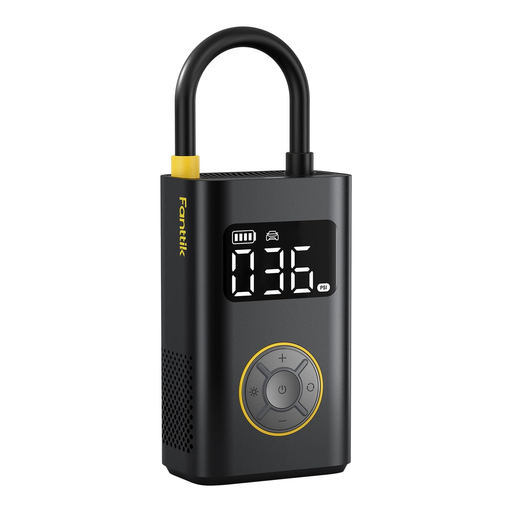
Why This Fits Their Persona: For drivers who value speed, efficiency, and a thoughtful design. Ideal for quick pressure adjustments on larger vehicles like SUVs or for frequent use.
Addresses the overheating problem with an integrated cooling system that allows for up to 23 minutes of continuous operation, according to the manufacturer. The high inflation speed reduces operating time and thus the strain on the motor.
High inflation speed (e.g., topping up a compact car tyre from 30 to 35 PSI in about 1 minute, per the manufacturer). Integrated storage for accessories and the hose.
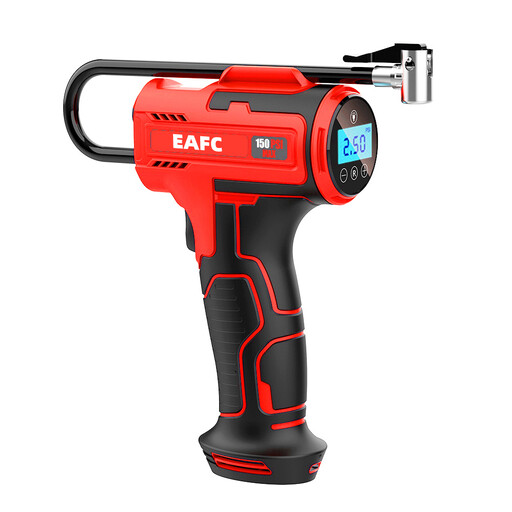
Why This Fits Their Persona: Suitable for users who need to inflate not just car tyres, but also multiple bicycles, balls, or other inflatables. The higher battery capacity provides the necessary endurance for diverse tasks.
Counteracts the weak battery problem with a 4000 mAh capacity (2x 2000 mAh). This ensures enough power is available even for several consecutive inflation tasks.
Large battery capacity for longer and more versatile use. Universally applicable as an electric car tyre pump and for recreational items.
We have compiled a complete, up-to-date list of products that fully meet these strict selection criteria and all relevant safety regulations.
1. How long does a compressor's battery last in practice? The runtime heavily depends on the battery capacity (mAh), the target pressure, and the volume of the tyre. As a rule of thumb, a model with 4000-5000 mAh can top up about four to five car tyres (e.g., from 2.2 to 2.5 Bar) or fill a single, completely flat car tyre. With smaller batteries (approx. 2500 mAh), the performance is correspondingly lower but is usually sufficient for regular top-ups.
2. Can a cordless compressor inflate a completely flat car tyre? Yes, powerful models can do this. However, it is the most demanding task for a portable 12V compressor or a cordless model and consumes a large portion of the battery's capacity. The process can take between 8 and 15 minutes, depending on the tyre size and compressor power. Low-performance models or those with overheating protection might struggle to complete the task.
3. How accurate are the digital manometers on portable compressors? The accuracy of digital manometers in consumer products is generally sufficient for everyday use. Deviations of ±0.1 Bar (or ±1-2 PSI) are common. This is a reliable value for regular maintenance. Nevertheless, it is good practice to occasionally verify the pressure with a separate, calibrated gauge at a service station.