
Lieferung heute & morgen

Qualitätsgarantie

Willkommens-Angebote freischalten: KOSTENLOSE Lieferung | Bis zu 80 % RABATT | Kostenlose 30-Tage-JoyPlus-Testphase
App herunterladen
A cordless ratchet set promises to significantly speed up work on vehicles and machinery. Especially in hard-to-reach areas within an engine bay or on a chassis, an electric ratchet can be the difference between a quick repair and hours of frustration. However, the market is flooded with options whose marketing promises often fall short in practice.
As your Joybuy Product Recommendation Officer, I'm here to help you identify the common pitfalls. We'll focus on the objective criteria that define a quality tool, so you can make an informed decision and avoid wasting money on unsuitable equipment.
Many DIYers invest in a set only to find out after a short time that it can't handle the job. Watch out for these three common problems to avoid a bad purchase.
To separate the quality tools from the mediocre ones, you should check three core technical features. These define the real-world performance of a cordless ratchet wrench.
These two values determine its power.
The power supply is the heart of any cordless tool.
The size of the tool mount determines which sockets you can use.
We have analysed products and matched them to different user profiles to make your choice easier.
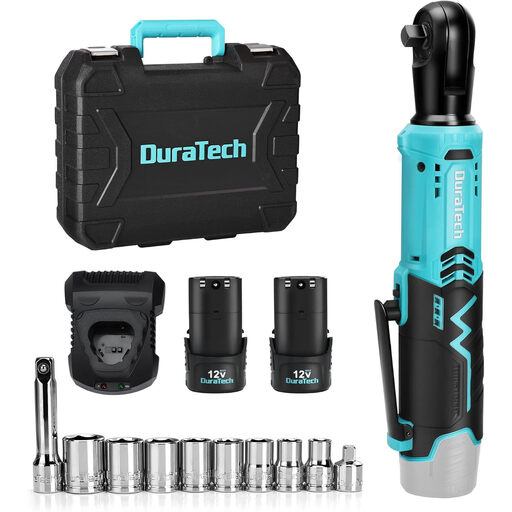
Why This Fits Their Persona: This set is ideal for DIYers who regularly work on their car or motorcycle. It offers a balanced performance of 65 Nm and a complete accessory package to get started right away. It's a classic automotive tool kit for the home workshop.
It bypasses the battery trap by including two 2.0 Ah batteries and a fast charger. It's also a true all-in-one kit with a case, sockets, and adapters, avoiding the incomplete accessory pitfall.
The kit is ready to use out of the box and allows for uninterrupted work thanks to the second battery. The integrated LED light and battery indicator are practical details for daily workshop use.
Why This Fits Their Persona: This user frequently works on transmissions, vehicle interiors, or modern, cramped engines. For them, an extremely slim and short ratchet head is more important than maximum torque. The tool needs to get into places where a hand can barely fit.
These models avoid the trap of focusing solely on power specs. Instead of chasing high Nm figures, the focus is on ergonomics and a compact head geometry. This is a quality feature that often gets lost in marketing brochures.
The key advantage is unparalleled accessibility. These tools make it possible to perform jobs that would be impossible with a standard ratchet or an impact wrench.
Why This Fits Their Persona: Professional mechanics or serious hobbyists need a tool for daily use. Durability, maximum performance, and reliability are what count here. A brushless motor and a robust metal housing are often crucial.
These models avoid the pitfall of a short-lived design. They rely on brushless motors for greater efficiency and less wear, as well as high-quality gear components that can withstand continuous high stress.
The main advantage is investment security. These tools are built for a long service life under demanding conditions and deliver consistently high performance when it's needed most.
We have compiled a complete, up-to-date list of products that fully meet these strict selection criteria and all relevant safety regulations.
1. How much torque does a cordless ratchet really need? For most DIY applications, 40 to 60 Nm is sufficient. The main function of an electric ratchet isn't to break loose extremely tight bolts—a long breaker bar or an impact wrench is better suited for that. Its strength lies in the speed at which it removes already loosened bolts or tightens new ones before they are manually torqued to the correct specification.
2. Can an electric ratchet completely replace a manual ratchet? No, it's a supplement, not a complete replacement. An electric ratchet is unbeatable when it comes to speed. However, for the initial loosening of very tight bolts (breakaway torque) and for the final, precise tightening with a torque wrench, manual tools remain essential.
3. What should I look for in a battery and charger? Look for a kit that includes at least one lithium-ion battery with 2.0 Ah of capacity. A charging time of 60 to 90 minutes is a good standard. A kit with two batteries is ideal for avoiding downtime. A battery level indicator directly on the tool is an extremely practical feature for keeping an eye on the remaining runtime.