
Lieferung heute & morgen

Qualitätsgarantie

Willkommens-Angebote freischalten: KOSTENLOSE Lieferung | Bis zu 80 % RABATT | Kostenlose 30-Tage-JoyPlus-Testphase
App herunterladen
Selecting the right cordless screwdriver involves analysing technical specifications tailored to your specific needs. Whether for precise furniture assembly, general DIY tasks, or delicate electronics work, the key parameters are torque, battery performance, and design. A cordless drill driver offers extended drilling capabilities, while a compact electric screwdriver specialises in light-duty screwdriving tasks. This guide breaks down the technical features to help you make an informed decision.
The performance and suitability of a cordless screwdriver are defined by objective metrics. The following criteria are relevant for your selection.
Torque describes the tool's rotational force. Higher torque allows for driving larger screws into harder materials.
Battery technology is a key factor for power and runtime.
A gearbox allows you to adapt the rotational speed to the task at hand.
A cordless screwdriver set often provides added value. A sturdy case facilitates transport and storage. A selection of bits for various screw heads (slotted, Phillips, Torx) is crucial for immediate use. The quality of the bits, often made from S2 steel, affects their durability and precision.
Based on the technical criteria mentioned, we present three models with different specialisations.
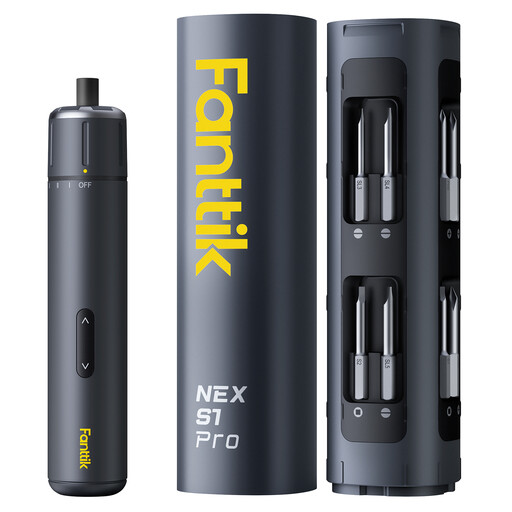
Why we recommend this product: The Fanttik S1 Pro is designed for precision screwdriving with controlled force. Its three electronically selectable torque settings (1.5, 3, and 4.2 N.m) allow for precise adjustment to delicate materials, such as those found in furniture assembly or PC case construction. The maximum torque of 6 N.m (manual 8 N.m) covers common household scenarios. The aluminium alloy case and the magnetic holder for the 16 S2 steel bits underscore its focus on organisation and durability.
Pros:
Who it's for: Users looking for a specialised tool for furniture assembly, electronics repair, or PC building who value precise force adjustment and high-quality craftsmanship.

Why we recommend this product: This set is designed as a comprehensive solution for precision mechanical work. With a very low adjustable torque range of 0.1 to 0.35 N.m, the EasyWox screwdriver is ideal for working on smartphones, laptops, glasses, and other micro-electronics where too much force would damage the components. The inclusion of 52 different bits covers nearly every conceivable screw head in this segment. The compact, magnetic storage system ensures all parts stay organised and within easy reach.
Pros:
Who it's for: Tech hobbyists, repair technicians, and DIY enthusiasts who need a specialised tool for delicate screwdriving tasks on electronic devices.

Why we recommend this product: The Bosch EasyDrill 18V-38 is a classic cordless drill driver that offers versatility for general DIY projects. Its two-speed gearbox and 20 torque settings provide a clear distinction between powerful screwdriving (up to 38 Nm) and high-speed drilling in wood, metal, and plastic. A key feature is its membership in the "POWER FOR ALL ALLIANCE," which makes the 18V battery compatible with a wide range of other tools from various brands. This creates a flexible and expandable system.
Pros:
Who it's for: DIY enthusiasts looking for a robust and versatile all-rounder for various household tasks, from furniture assembly to minor renovations and drilling.
For projects that go beyond simple screwdriving or require a broader range of tools, a more comprehensive kit can be a worthwhile consideration. These kits often combine a cordless screwdriver with other tools like a jigsaw, a sander, or a light, all powered by the same battery system.
You can find an overview of suitable combinations in our Cordless Tool Kit category.
1. What is the difference between a cordless screwdriver and a cordless drill driver? A dedicated cordless screwdriver is primarily designed for driving and removing screws and typically has lower torque and only one gear. A cordless drill driver also features an adjustable chuck for holding drill bits, a two-speed gearbox for higher rotational speeds, and significantly more torque, which also qualifies it for drilling into materials like wood or metal.
2. What torque is sufficient for furniture assembly? For typical assembly of particle board furniture, a torque between 3 and 5 Nm is generally sufficient. More important here is good torque control to prevent over-tightening the screws and damaging the material.
3. How important is battery voltage (Volts)? Voltage (V) is an indicator of the tool's basic power class. A higher voltage allows the motor to generate more power, which translates into higher torque and/or higher speed. For light-duty screwdriving, 3.6V to 12V is sufficient, while 18V is the established standard for demanding drilling and screwdriving tasks in the DIY sector.
Written by: Joybuy Product Recommendation Officer