
Lieferung heute & morgen

Qualitätsgarantie

Willkommens-Angebote freischalten: KOSTENLOSE Lieferung | Bis zu 80 % RABATT | Kostenlose 30-Tage-JoyPlus-Testphase
App herunterladen
The ambiguity of an accident or a scratch on your parked car—situations like these are stressful for any driver. In such cases, a dash cam can provide clarity by documenting traffic events. However, given the vast array of models and technical specifications, making the right choice isn't always easy.
This article serves as your guide. We will introduce objective criteria for selecting a suitable dash cam and present a selection of models with different feature sets. Our goal is to provide you with a basis for making an informed decision, grounded in technical facts and practical benefits.
To find the right car camera, it's helpful to understand a few key technical features. These largely determine the quality and utility of the recordings.
Video resolution is crucial for the level of detail in your recordings. A high resolution allows you to identify license plates or road signs, even from a distance or in poor lighting conditions.
The Field of View (FOV), measured in degrees, determines the captured frame. A wide-angle lens between 140° and 170° is recommended to cover multiple lanes and the area to the side of the vehicle without excessive image distortion.
The number of cameras, also known as channels, defines the surveillance area.
A dash cam with parking mode offers additional protection when the vehicle is parked. It automatically activates recording when a vibration is detected (by the G-sensor) or when motion is detected in the camera's field of view. This feature typically requires a constant power supply via a separate hardwire kit connected to the vehicle's electrical system.
Modern car cameras often offer more than just video recording.
Here is a selection of models that stand out for their specific technical features.
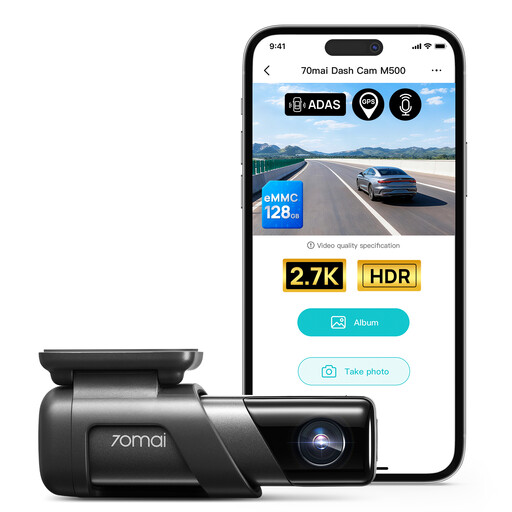
Why it stands out: The M500 is distinguished by its integrated 64 GB eMMC storage. This eliminates the need to purchase a separate SD card and, according to the manufacturer, offers greater stability and longevity compared to conventional memory cards.
Advantages:
Who is it for? For drivers looking for a hassle-free "plug-and-play" solution without the need for a separate memory card, who also value very high resolution and an extremely wide field of view.
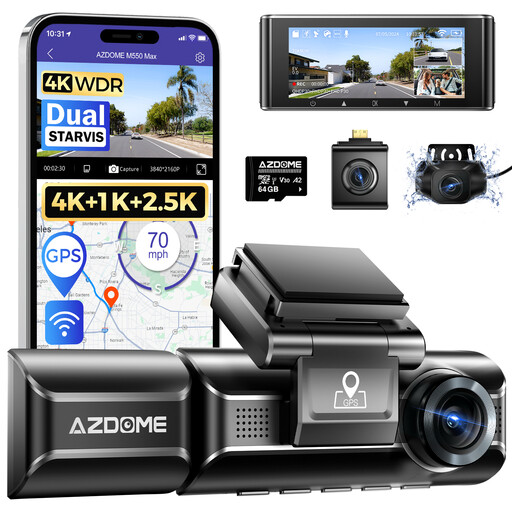
Why it stands out: As a 3-channel system, the AZDOME M550 MAX offers comprehensive surveillance of the front, rear, and interior. The combination of a 4K front camera and two additional cameras makes it an all-in-one solution.
Advantages:
Who is it for? Ideal for professional drivers (taxi, delivery services) or families who want seamless documentation of events in front of, behind, and inside the vehicle. Also great for tech enthusiasts aiming for maximum coverage.
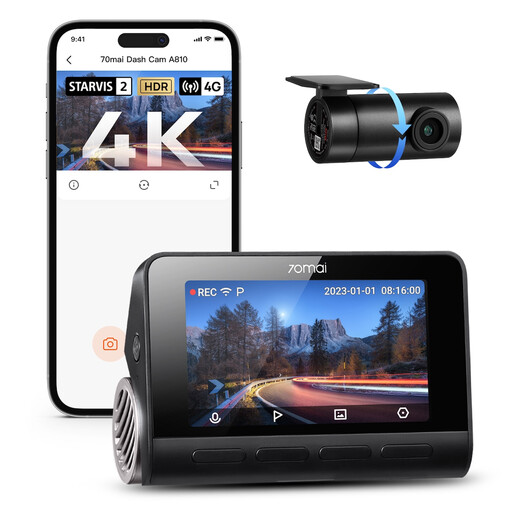
Why it stands out: This model combines true 4K resolution with the advanced Sony STARVIS 2 image sensor. According to the manufacturer, this ensures outstanding image quality, especially at night. The model received a "Good" rating from the magazines Autobild.de and Computerbild.de.
Advantages:
Who is it for? For demanding users who prioritise the highest image quality in all lighting conditions and are looking for a future-proof 4K dash cam with advanced assistance and surveillance features.
If the models presented here do not meet your requirements, or if you need a more flexible surveillance solution for various applications, a battery-powered camera could be an interesting alternative.
? Discover our selection of battery-powered security cameras for flexible monitoring without fixed wiring.
1. Are dash cams legal in Germany? Yes, the use of a dash cam is generally permitted in Germany. However, it is subject to the strict rules of the General Data Protection Regulation (GDPR). Permanent, indiscriminate recording of public space is not allowed. Therefore, most dash cams operate with loop recording, where old footage is continuously overwritten. Saving a recording is only permissible in response to an incident, such as immediately after an accident. If recordings are published, faces and license plates must be blurred.
2. How does parking mode work on a dash cam?Parking mode is activated when the vehicle is parked. A built-in G-sensor (accelerometer) detects vibrations, such as those from a parking bump or vandalism. Alternatively, motion detection can also trigger the recording. As soon as such an event is registered, the camera saves a short, write-protected video clip. This feature requires a continuous power supply for the dash cam, which is usually provided by a hardwire kit connected directly to the vehicle's fuse box.
3. What is loop recording? Loop recording is a standard feature on modern dash cams. The camera records video in short segments (e.g., 1, 3, or 5 minutes). Once the memory card is full, the camera automatically starts overwriting the oldest, unlocked recordings. This ensures continuous recording without the need to manually clear the memory card. Important events detected by the G-sensor (e.g., during heavy braking or an impact) are saved as locked files and are not overwritten.