
Lieferung heute & morgen

Qualitätsgarantie

Willkommens-Angebote freischalten: KOSTENLOSE Lieferung | Bis zu 80 % RABATT | Kostenlose 30-Tage-JoyPlus-Testphase
App herunterladen
Condensation on the windows, a musty smell in the basement, or mould growth on the walls—excessively high humidity in living spaces is not only unpleasant but can also damage the building's structure and harm your health. An electric room dehumidifier promises a solution. However, the market is overwhelming, and many devices don't deliver on their advertising promises. As a Joybuy Product Recommendation Officer, I'll help you identify the crucial features and avoid common purchasing pitfalls.
Two common problems frequently lead to disappointment:
To avoid a bad purchase, you should check three core technical aspects before making a decision. These will determine whether a unit is suitable for your needs or not.
The most important metric is the dehumidification capacity, specified in litres per day (L/day). This must always be considered in the context of the room size and typical room temperature.
The method of water drainage determines user convenience and the degree of automation.
Modern devices often offer more than just basic dehumidification. Look for features that make your daily life easier:
Instead of presenting a confusing list, we have selected units that are tailored to specific user profiles.

Why This Fits Their Persona: Ideal for bedrooms or offices up to 24 m?, where quiet operation is crucial. The smart control via app and compact design fit perfectly into a modern, urban lifestyle.
Sidesteps the noise trap with a designated sleep mode of just 32 dB, which is a very low level for living spaces. The 12 L/day capacity is realistic for the recommended room size.
Ultra-Quiet Operation: The 32 dB sleep mode won't disturb your sleep.
Smart Control: Conveniently operate and schedule via a smartphone app.
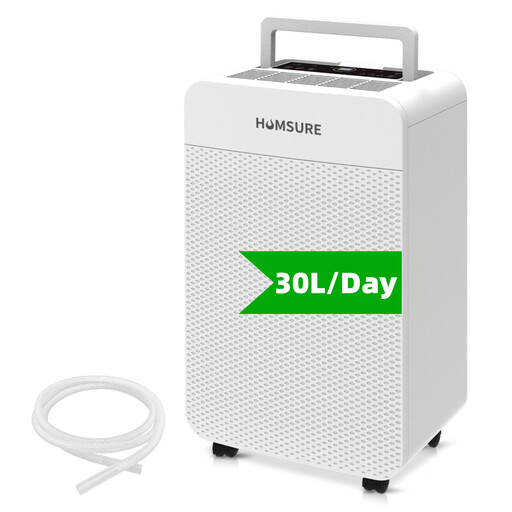
Why This Fits Their Persona: Designed for large, cool, and damp spaces like basements or garages up to 50 m?. Its high performance and focus on continuous operation make it a reliable solution for preserving the building's structure.
Tackles the performance trap with a high nominal capacity of 30 L/day and an auto-defrost function, ensuring consistent operation even in cooler basement temperatures. The included hose allows for maintenance-free continuous use.
High Dehumidification Performance: Effective even in large and problematic areas.
Flexible Water Drainage: Choice between a large 5.3-litre tank or continuous drainage via hose.
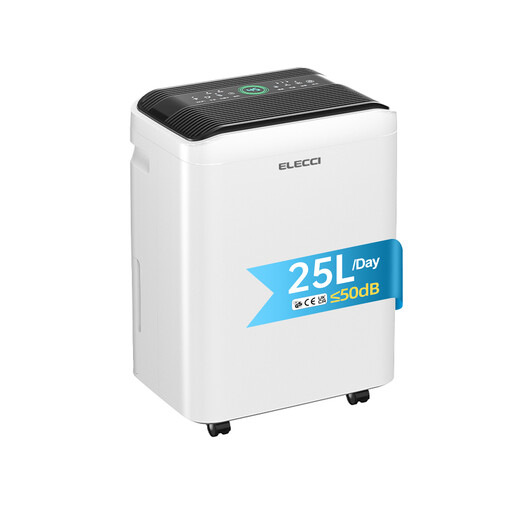
Why This Fits Their Persona: A versatile unit for living areas up to 50 m? that both regulates general humidity and serves as an effective aid for drying laundry. Its quiet operation and easy mobility make it suitable for everyday use.
Offers a good balance of performance (25 L/day) and noise level (from 36 dB). The explicit laundry drying function is a clearly defined added value, not an empty marketing phrase.
Dedicated Laundry Mode: Noticeably speeds up the drying of clothes indoors.
Large Tank and Hose Connection: Offers flexibility for various usage scenarios.
We have compiled a complete, up-to-date list of products that fully meet these strict selection criteria and rigorous safety standards.
1. How much electricity does an electric room dehumidifier use? Power consumption depends on the unit's wattage (W). A typical device for living spaces with a power rating of around 200–300 W will use 0.2–0.3 kilowatt-hours (kWh) in one hour of operation. Models with a hygrostat are more energy-efficient as they only turn on when needed.
2. Where is the best place to position the dehumidifier? Place the unit as freely as possible in the centre of the room, or at least with sufficient clearance (approx. 30–50 cm) from walls and furniture. This ensures optimal air circulation, allowing humid air to be effectively drawn in and dry air to be distributed. Never block the air intake or outlet.
3. How long should a dehumidifier run per day? The ideal runtime depends on the humidity level, room size, and the unit's capacity. For acute issues (e.g., after water damage or for drying laundry), continuous operation over several hours or days may be necessary. For general humidity regulation, a unit with a hygrostat is ideal, as it automatically controls operation and only runs when required.