
Lieferung heute & morgen

Qualitätsgarantie

Willkommens-Angebote freischalten: KOSTENLOSE Lieferung | Bis zu 80 % RABATT | Kostenlose 30-Tage-JoyPlus-Testphase
App herunterladen
Rising temperatures can significantly impact concentration in your home office or at work, and make it difficult to get a restful night's sleep. A desk fan offers an effective and space-saving solution to create a pleasant breeze. However, with a multitude of models featuring different functions, the choice can be overwhelming.
This article serves as a practical guide. We'll introduce you to various criteria that play a role in the purchasing decision and present a selection of models distinguished by their specific features. The goal is to provide you with a solid basis for making an informed choice, so you can find the right fan for your desk or nightstand.
To find the right device for your needs, several technical characteristics and functional aspects should be considered.
A loud operating noise can quickly become distracting, especially in a quiet work environment or at night. A fan's noise level is measured in decibels (dB(A)). A quiet fan for the bedroom or a fan for the office should not exceed 40 dB(A) on its lowest setting. Models that achieve levels around 35 dB(A) are considered particularly quiet, allowing for undisturbed work or sleep.
The type of power supply determines how and where you can use your fan:
A small fan takes up little space on a crowded desk. Pay attention to the dimensions to ensure the device will fit. A useful additional feature is oscillation. This swiveling function ensures that air is distributed over a wider area of the room, rather than in just one direction, providing more even and pleasant cooling.
Here is a selection of models that cater to different needs—from wireless flexibility to ultra-quiet operation.
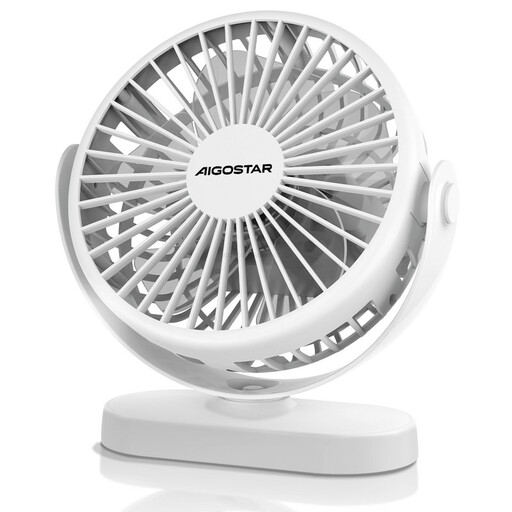
This compact fan from Aigostar combines wireless operation with practical features for versatile use.
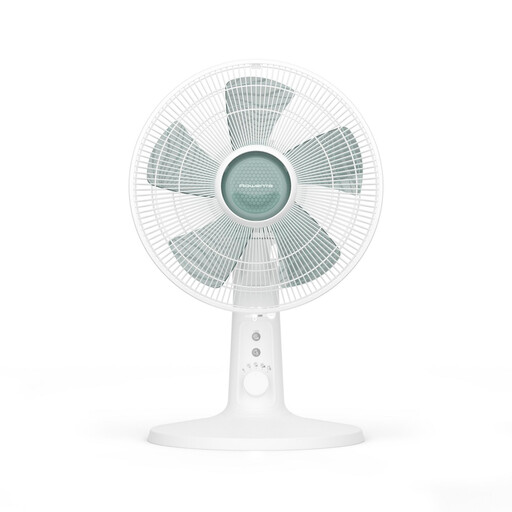
The Rowenta Turbo Silence Extreme+ is designed for powerful yet quiet operation.

This model from Aigostar offers an additional cooling function with a water mist, in addition to classic ventilation.
The models featured here cover specific needs. If you're looking for different designs, colours, or features, there's a wider range of options to explore.
Discover our full range of white fans and find the perfect model for your needs.
A fan is considered quiet if its operating noise is below 40 decibels (dB(A)) on the lowest setting. This is roughly equivalent to the noise level in a quiet library. Models with ratings around 35 dB(A) or lower are particularly well-suited for use in bedrooms or focused work environments.
Oscillation refers to the automatic side-to-side sweeping motion of the fan head. This function distributes the airflow evenly over a larger area of the room instead of concentrating it on a single point. The result is a gentler and more pleasant cooling experience for multiple people or larger spaces.
Yes, that's one of the main advantages of a USB fan. You can power it not only from a computer or with a wall adapter but also with a standard power bank. This makes it an ideal companion for on-the-go use, such as camping, on a train, or in places without direct access to a power outlet.