
Lieferung heute & morgen

Qualitätsgarantie
App herunterladen
Kategorien
Choosing a desk comes down to fundamental criteria: your available space, the material quality, and its primary purpose. A workspace for a home office has different requirements than a gaming desk or a compact table for a student's room. This article analyses various models based on their technical specifications to provide a solid foundation for your decision.
The decision for a new office desk should be based on objective parameters. The following criteria are crucial for a model's functionality and longevity.
The choice of material directly impacts the desk's stability, load capacity, and maintenance.
The desk's size and shape must suit the room and its intended use.
Integrated features significantly increase a desk's practical value.
Based on the criteria above, we present three desk models with different specialisations.
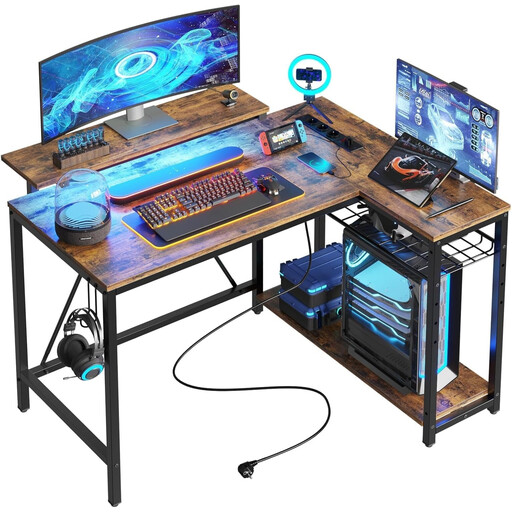
Why we recommend this product: This model is designed as a multifunctional gaming desk that offers high functionality even in small spaces. The L-shape, measuring 106.5 x 82 cm, makes efficient use of corners. A key feature is its integrated tech: an RGB LED strip under the monitor shelf with 7 colours and 22 modes, plus a power strip with 3 outlets and 2 USB ports. The reversible design allows for flexible positioning of the two shelf levels.
Pros:
Who it's for: This model is aimed at gamers and users looking for a compact yet technically well-equipped computer desk for a small office or bedroom.
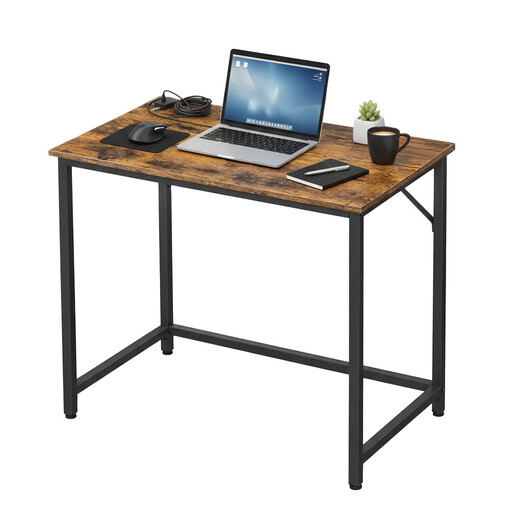
Why we recommend this product: The SONGMICS desk stands out for its minimalist design and compact dimensions of 80 x 50 cm. It focuses on the core function of a workspace without any extra add-ons. The construction, featuring an engineered wood top and a steel frame, is designed for stability, supported by a maximum static load capacity of 50 kg. Adjustable feet ensure a secure stance even on uneven floors.
Pros:
Who it's for: This model is a suitable solution for students, professionals in a home office with limited space, and users who prefer a simple, functional, and stable workspace without additional features.
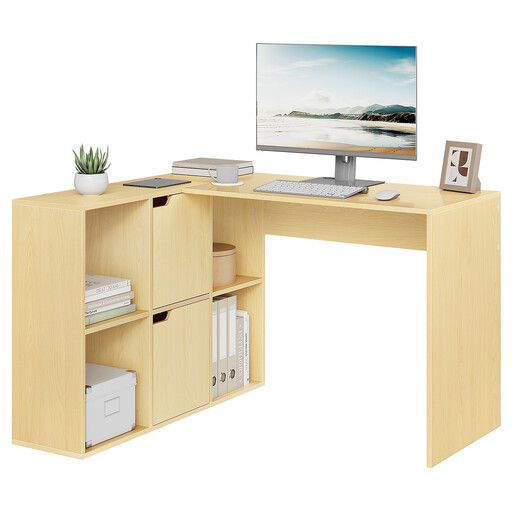
Why we recommend this product: The eSituro L-shaped desk offers a very generous work environment with a 120 x 100 cm surface. Its main advantage lies in its integrated storage: six open compartments provide space for files, books, and accessories, making it a fully-fledged desk with shelves. The ergonomic height of 75 cm and the robust construction are designed for extended work sessions. The light oak finish fits well into modern office environments.
Pros:
Who it's for: This office desk is designed for professionals and creatives who need a permanent, well-organised workspace with plenty of surface area and storage for their home office or study.
If the models presented here do not exactly match your requirements for size, material, or function, our main category offers a broader selection of solutions. There you will find more variants for different use cases and room sizes.
Discover more models in the category: Bedroom Office Desks
1. How high should a desk be? The common standard height for desks is between 72 cm and 76 cm. This height is ergonomically suitable for most average-sized individuals using a standard office chair. It's important that your forearms can rest on the tabletop at an approximately 90-degree angle with relaxed shoulders.
2. What is the difference between a writing desk and a computer desk? The terms are often used interchangeably. Traditionally, a writing desk is a simple surface for writing and working. A computer desk is more specifically designed and often offers additional features for using technology, such as cable management grommets, raised monitor shelves, or integrated mounts for PC towers, as is also common with gaming models.
3. How much weight can a desk support? The maximum load capacity depends on the construction and materials used. Compact models, like the featured SONGMICS desk, often have a static load capacity of about 50 kg, according to the manufacturer. Larger, more robust models can support significantly more. The manufacturer's specification for maximum static load is the most reliable indicator and should be considered when planning your workspace setup.