
Lieferung heute & morgen

Qualitätsgarantie

Willkommens-Angebote freischalten: KOSTENLOSE Lieferung | Bis zu 80 % RABATT | Kostenlose 30-Tage-JoyPlus-Testphase
App herunterladen
Smartphones are practical for everyday snapshots, but a dedicated digital camera for beginners often offers more creative possibilities, better image quality in challenging lighting conditions, and, most importantly, a true optical zoom. If you're looking for an easy-to-use entry-level camera that goes beyond your phone's capabilities, you've come to the right place.
This guide is designed to help you understand the key features and make an informed decision. We'll introduce you to a selection of cameras that are particularly well-suited for photography beginners, students, and teens who value high resolution, creative functions, and an appealing design.
The selection can be overwhelming. Focus on the features that are truly relevant for starting your photography journey.
Many cameras advertise high megapixel (MP) counts, like 48 MP or 64 MP. Often, this resolution is achieved through interpolation. This means the camera's software artificially upscales the image. For displaying on screens, sharing on social media, or making smaller prints, this quality is typically more than sufficient.
Also, pay attention to the video resolution. A 5K camera offers extremely high detail and is a future-proof choice as high-resolution screens become more common. However, Full HD (1080p) is also a solid foundation to start with.
This is one of the biggest advantages over most smartphones. An optical zoom uses the lens mechanics to magnify the subject without any loss of quality. You can bring distant objects up close without the image quality suffering. A digital zoom, on the other hand, simply enlarges a section of the image, which leads to a visible loss in quality. For clear shots from a distance, a camera with optical zoom is therefore the better choice.
The design influences handling and the fun factor. A retro camera often provides a tactile, engaging experience with classic controls. A mini digital camera, in contrast, scores with its extreme portability and fits in any pocket. For students and teens, built-in creative filters, simple menus, and the option to connect accessories like an external microphone are often also appealing.
Here is a selection of models that stand out for different features and are suitable for various beginner needs.

Why it stands out: This model combines an appealing retro design with modern technology. The optical viewfinder offers a classic photography experience, while the high video resolution and autofocus ensure sharp, detailed shots.
Pros:
Who is it for? This camera is a great choice for beginners, students, and teens looking for a stylish and versatile affordable digital camera. It's suitable for everyday photography, social media content, and initial creative video projects.

Why it stands out: Weighing just 18 grams and barely larger than a keychain, this mini digital camera is extremely portable. The included USB-C adapter allows for direct image transfer to a smartphone.
Pros:
Who is it for? Ideal for users who want a discreet and always-available camera for spontaneous snapshots and short videos. It's an interesting companion to a smartphone and a practical gadget for on-the-go use.
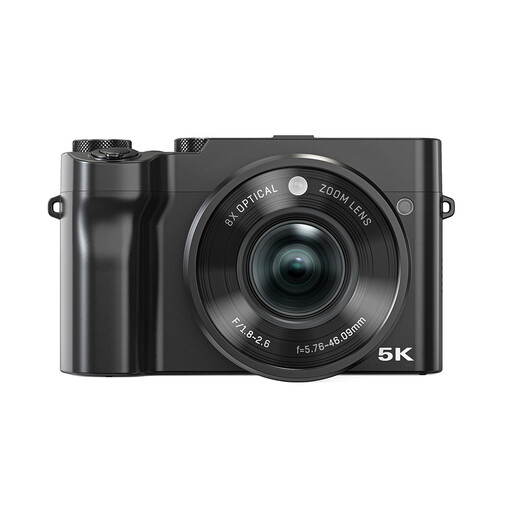
Why it stands out: The main feature of this model is its powerful 8x optical zoom. It allows you to bring distant subjects up close without any loss of quality. A large touchscreen simplifies operation.
Pros:
Who is it for? This compact camera is designed for beginners who appreciate flexibility in their photography. The powerful optical zoom makes it a great companion for travel, nature observation, or sporting events where you can't get close to the action.
The models presented already cover a wide spectrum, but the market offers many more cameras with different specialisations. If you want to compare more models or are specifically looking for cameras for a younger audience, you can find more inspiration in our category.
? Discover more digital cameras for teens
Interpolation is a software process where the camera analyses existing pixels and adds extra ones to artificially increase the image's total resolution. For viewing on digital devices like smartphones, tablets, or laptops, the result is often perfectly adequate. However, the limitations of this technique can become visible in very large prints.
Yes, absolutely. Most modern entry-level cameras, even in the lower price range, offer image and video quality that is more than sufficient for platforms like Instagram, TikTok, or YouTube. Creative features, ease of use, and good connectivity for quick content sharing are often more important here than an extremely high resolution.
For most beginners, an optical zoom offers greater practical benefit. The ability to magnify subjects without losing quality opens up significantly more photographic possibilities than an extremely high megapixel count, which is mainly relevant for large prints. A good optical zoom allows for more creative compositions and flexibility in various shooting situations.