
Lieferung heute & morgen

Qualitätsgarantie

Willkommens-Angebote freischalten: KOSTENLOSE Lieferung | Bis zu 80 % RABATT | Kostenlose 30-Tage-JoyPlus-Testphase
App herunterladen
By a Joybuy Product Recommendation Officer
Modern TVs offer impressive picture quality, but their sound often falls short. The slim design leaves little room for powerful speakers, resulting in a thin and uninspiring audio experience. If you want to experience movies, shows, or games as the creators intended, an external audio system is a worthwhile upgrade.
A soundbar with Dolby Atmos is a particularly effective solution. It not only improves overall sound quality but also creates three-dimensional surround sound that puts you right in the middle of the action. This article serves as your guide. We'll introduce various models and explain the key technical features to help you make an informed decision for your home cinema.
The selection of soundbars is vast. To find the right model for your needs, you should consider a few fundamental aspects.
The number combination in a soundbar's product description indicates its speaker configuration.
To unlock the full potential of a soundbar for your TV, the right connection is crucial. The current standard is HDMI eARC (Enhanced Audio Return Channel). This connection offers two key advantages:
Alternatively, most soundbars offer an optical digital input, which is a solid but more bandwidth-limited connection option. A Bluetooth soundbar function is also handy for streaming music directly from your smartphone or tablet.
A soundbar with a wireless subwoofer offers maximum placement flexibility. Since low frequencies are difficult for the human ear to pinpoint, the subwoofer can be placed almost anywhere in the room where a power outlet is available. This reduces cable clutter and simplifies integration into your living space.
Here is a selection of models that cover a range of needs and budgets. Each device has been chosen based on its technical specifications and features.

Why It Stands Out: The TCL Q65H is a complete 5.1 soundbar that creates an impressive soundscape with 580 watts of total power and a 6.5-inch wireless subwoofer. TCL's proprietary Ray·Danz acoustic technology uses specially shaped reflectors to create a wide and natural soundstage. Support for Dolby Atmos and DTS:X ensures immersive 3D sound, while AI-Sonic technology automatically adapts the audio to your room's acoustics.
Pros:
Who It's For: Home cinema enthusiasts looking for a powerful and immersive surround sound system that doesn't require the complex wiring of separate rear speakers.
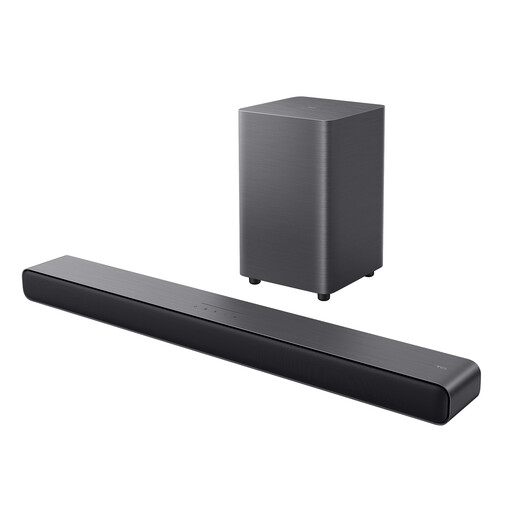
Why It Stands Out: The TCL S55HE offers an excellent entry point into the world of better TV audio. As a 2.1 system with 220 watts of total power, a 4-inch wireless subwoofer, and virtual Dolby Atmos processing, it significantly enhances the sound of movies and music. Despite its compact form factor, it creates a virtual 3D surround effect thanks to DTS Virtual:X. Features like AI-Sonic room adaptation and Bass Enhancement round out the package.
Pros:
Who It's For: Users looking for a straightforward and cost-effective solution to significantly upgrade their TV audio, who value simple setup and operation. Ideal for small to medium-sized rooms.
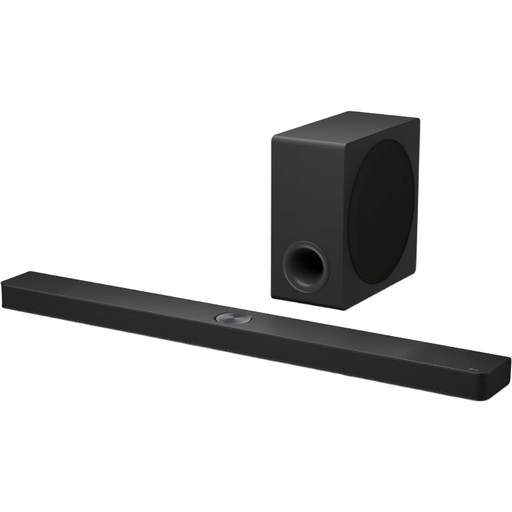
Why It Stands Out: The LG DS90TY is an advanced home cinema soundbar with a 5.1.3-channel configuration. Its standout feature is the world's first centre up-firing speaker, designed to further improve dialogue clarity and soundstage precision. With 570 watts of power, a wireless subwoofer, and full support for Dolby Atmos and DTS:X, it delivers a powerful and detailed 3D audio experience. AI Sound Pro technology analyses content in real-time and automatically adjusts the audio settings.
Pros:
Who It's For: For demanding users and gamers seeking a powerful and technologically advanced soundbar that offers the highest level of immersion and audio precision.
A soundbar is an excellent all-in-one solution. However, depending on your room size and personal preferences, a modular system of individual speakers can be a compelling alternative. Such systems often offer even more flexibility in positioning and acoustic tuning.
If you want to build your own custom audio system, explore our selection of [bookshelf speakers] to design your setup.
Dolby Atmos is an object-based audio format. Instead of just assigning sound to specific channels (left, right, etc.), it can place individual sounds as "objects" in three-dimensional space. A soundbar with Dolby Atmos uses up-firing or side-firing speakers to reflect sound off the ceiling and walls. This creates an immersive soundscape where audio also appears to come from above, significantly enhancing the atmosphere of movies and games.
Technically, a soundbar can function without a subwoofer. However, for a true home cinema experience, a soundbar with a subwoofer is highly recommended. The subwoofer specialises in reproducing low frequencies (bass), which are crucial for explosions, engine rumbles, or the deep soundtrack in movies. Without it, the sound often lacks foundation and impact.
The best method is to connect it via an HDMI cable to an eARC or ARC port. This ensures the highest audio quality for formats like Dolby Atmos and allows you to control the soundbar's volume with your TV remote. If your TV doesn't have such a port, an optical audio cable is the next-best choice.