
Lieferung heute & morgen

Qualitätsgarantie

Willkommens-Angebote freischalten: KOSTENLOSE Lieferung | Bis zu 80 % RABATT | Kostenlose 30-Tage-JoyPlus-Testphase
App herunterladen
For intricate work on electronics, in model making, or when assembling small furniture, precision is crucial. A conventional screwdriver is often too unwieldy for these tasks, and a large cordless drill is too powerful. An electric screwdriver set bridges this gap by offering the control, compact design, and efficiency needed for delicate screw fastenings.
This article serves as your guide. We will introduce you to various models and explain the key features you should consider when making your selection. Our goal is to provide you with a solid basis for making an informed decision, whether for your next DIY project or as a practical gift for men and tech enthusiasts.
Selecting the right tool depends on your specific use case. Three central criteria will help you evaluate the functionality of any set.
Torque, measured in Newton-metres (N.m), indicates the rotational force the screwdriver applies to tighten a screw. For a precision screwdriver set intended for electronics, a low, finely adjustable electric torque (e.g., 0.1–0.35 N.m) is essential to avoid damaging sensitive components and threads. Many models also offer a higher manual torque to loosen stubborn screws by hand. For general home improvement tasks, models with a higher torque range (e.g., 1–3 N.m) are more suitable.
A powerful battery is essential for uninterrupted work. Pay attention to the battery capacity, specified in milliampere-hours (mAh). A higher capacity generally means a longer runtime. Modern devices are often rechargeable via a USB-C port, allowing for flexible charging with power banks, laptops, or standard power adapters. The charging time and standby duration are also relevant indicators of everyday practicality.
A good screwdriver with bits is distinguished by a versatile selection of attachments. For an electronics repair kit, special bits like Pentalobe (for Apple products), small Torx, and Phillips sizes are indispensable. The material quality of the bits, often S2 steel, determines their durability and precision fit. A well-organised storage system, frequently a magnetic case, simplifies the handling and transport of this precision mechanic's tool.
Based on the criteria mentioned, we have compiled a selection of sets suitable for different applications.

Why It Stands Out This set is notable for its digital display for torque indication, which allows for exceptionally precise control during very delicate tasks. The compact, tubular storage makes this mini cordless screwdriver especially portable.
Pros
Who Is It For? Ideal for tech-savvy users and precision mechanics who regularly work on smartphones, laptops, drones, and other micro-electronics and require the utmost precision.
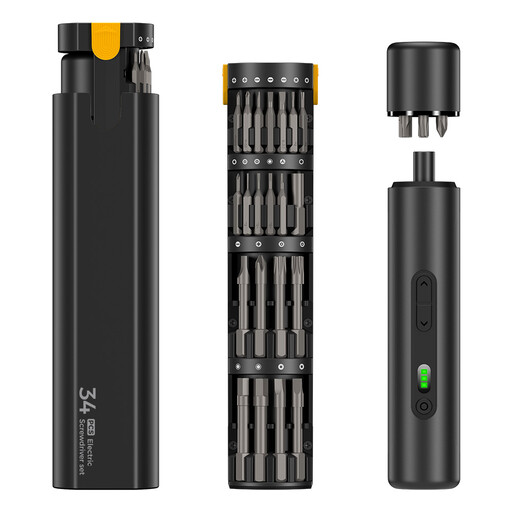
Why It Stands Out This cordless screwdriver set is designed for performance and durability. With a significantly higher torque range and a large battery, it is suitable for more demanding assembly and repair jobs around the house.
Pros
Who Is It For? A great choice for DIYers looking for a versatile tool for furniture assembly, household repairs, and general DIY projects that require more power than electronics repair.

Why It Stands Out This set combines the precision of a fine mechanic's tool with useful accessories for repairs. It is an all-in-one solution for anyone who regularly opens and maintains electronic devices.
Pros
Who Is It For? Perfect for DIY enthusiasts and hobbyists looking for a complete electronics repair kit that goes beyond simple screwdriving functions and offers additional specialised tools for repairs.
The sets presented here cover a broad spectrum of screwdriving tasks. However, if your projects require specialised measurements or diagnostic tasks, you can find other suitable devices and instruments in our electrical testers category.
1. What is the difference between a cordless drill/driver and an electric precision screwdriver? A classic cordless drill/driver is designed for high torque and large screws (e.g., in furniture assembly or drywall installation). An electric precision screwdriver, on the other hand, operates with very low torque and high speed. It is specifically designed for small, delicate screws in electronic devices like laptops, cameras, or game consoles.
2. What torque is suitable for repairing laptops or smartphones? For most screws in modern consumer electronics, an electric torque in the range of 0.1 N.m to 0.3 N.m is ideal. Excessive torque can damage plastic casings, circuit boards, or the fine threads of the screws themselves. An adjustable torque control is therefore a crucial feature.
3. How long does the battery of a mini cordless screwdriver last? The battery life depends heavily on the capacity (mAh) and the intensity of use. Models with a 500 mAh battery often provide up to 60 minutes of continuous operation. In standby mode, a single charge can last up to 30 days or more on many devices. For occasional repairs, this is typically more than sufficient.