
Lieferung heute & morgen

Qualitätsgarantie

Willkommens-Angebote freischalten: KOSTENLOSE Lieferung | Bis zu 80 % RABATT | Kostenlose 30-Tage-JoyPlus-Testphase
App herunterladen
By Joybuy Product Recommendation Officer, August 30, 2026
The search for the right ergonomic office chair can quickly become complex. The market is filled with options promising comfort and healthy posture. However, not every model delivers on its advertising promises. Many users invest in a chair only to find that back pain and discomfort persist or even worsen after just a few months.
This guide will help you identify common purchasing pitfalls and recognise the crucial features a truly supportive chair must have for long workdays in a home office chair or at the office.
Before we dive into the technical details, it's important to understand two of the most costly mistakes buyers often make.
A well-informed purchase is based on understanding the core components that ensure durability and true ergonomic benefits.
To make an informed decision, you should carefully examine three technical aspects. These determine whether a chair is merely a place to sit or genuine support for your body.
The mechanism is the heart of any swivel chair. There are fundamental differences:
A truly ergonomic chair adapts to you, not the other way around. Look for these non-negotiable adjustment options:
An adjustable gaming chair often offers an extreme backrest recline, but the crucial ergonomic adjustments for focused work are typically less pronounced.
The longevity of a chair depends directly on the materials used.
Based on the criteria above, we have identified several models suitable for different needs and budgets.
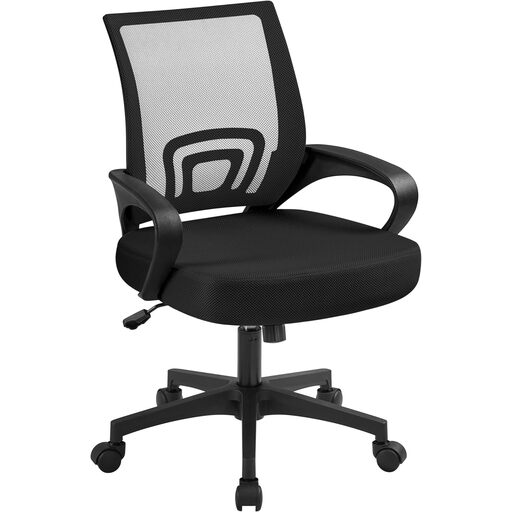
Why this model fits: Ideal for students or a first home office setup. It offers basic ergonomic features like integrated lumbar support and height adjustment at an accessible price, without compromising on fundamental stability.
This model bypasses the material trap with a breathable mesh backrest that prevents heat build-up. It provides basic yet functional adjustments, thus avoiding the "one-size-fits-all" assumption.
According to the manufacturer, the gas lift is SGS and BIFMA certified, which is a key feature for safety and durability in this price range. The weight capacity is up to 136 kg.
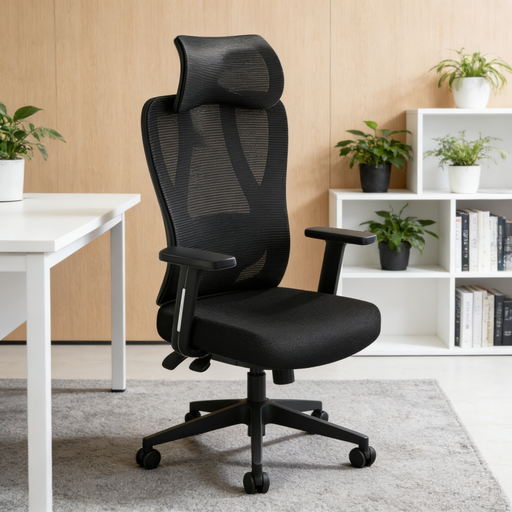
Why this model fits: For professionals who sit for eight or more hours daily. Its advanced adjustment options, especially the 4D lumbar support, allow for precise spinal alignment and effectively prevent fatigue.
This model refutes the "one-size-fits-all" assumption with its 4D pivoting lumbar support and adjustable backrest height. The dual-layer, breathable mesh fabric is a clear commitment to high-quality materials.
The combination of a backrest that reclines up to 140° and fully customisable lumbar support offers a high degree of flexibility for both focused work and relaxing breaks.
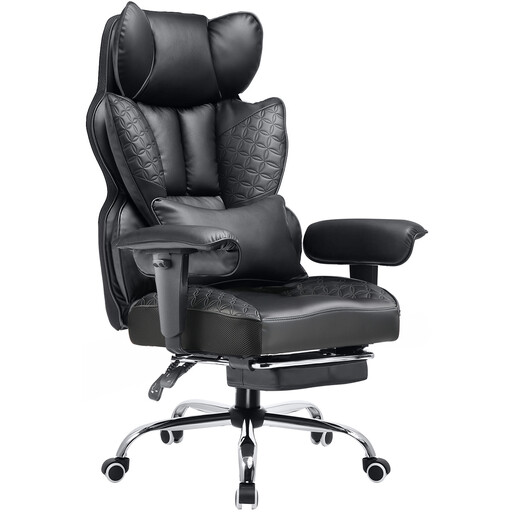
Why this model fits: Designed for users who need an exceptionally sturdy frame and a high weight capacity. Its executive chair aesthetic, combined with PU leather and a footrest, provides superior comfort for long workdays or relaxing breaks.
This model addresses the pitfall of poor material quality with a reinforced frame and a heavy-duty gas lift. It is explicitly designed as an office chair for up to 150 kg, ensuring long-term stability.
The combination of high load capacity, a high backrest, and a retractable footrest offers a comprehensive comfort package optimised for both work and relaxation.
We have compiled a complete, up-to-date list of products that fully meet these strict selection criteria and comply with current safety regulations.
The lifespan of an office chair heavily depends on the quality of its mechanism, gas lift (Class 3 or 4 is a good indicator), and upholstery. With daily use, a high-quality model can last between 7 and 10 years, whereas cheaper models often show significant wear on the mechanism or padding after just 1 to 3 years. Regular maintenance and adhering to the weight limit will extend its lifespan.
An adjustable gaming chair can be an alternative, but there are important differences. Gaming chairs are often optimised for a reclined posture and feature pronounced side bolsters (racing-seat design) that can restrict movement. In contrast, a good ergonomic office chair is designed for an upright, active sitting posture and often provides more precise adjustments for lumbar support and seat depth, which is more beneficial for long periods of focused work.
BIFMA (Business and Institutional Furniture Manufacturer's Association) and SGS (Société Générale de Surveillance) are organisations that set standards for the safety, durability, and structural performance of office furniture. A chair with such a certification has been tested for aspects like stability, strength, and the lifespan of its components (e.g., casters, gas lift, mechanism). It is an objective quality mark that builds confidence in the product's longevity.