
Lieferung heute & morgen

Qualitätsgarantie

Willkommens-Angebote freischalten: KOSTENLOSE Lieferung | Bis zu 80 % RABATT | Kostenlose 30-Tage-JoyPlus-Testphase
App herunterladen
A good folding camping table is the centerpiece of many outdoor activities—from your morning coffee by the lake to a shared dinner under the stars. However, the market is flooded with models whose promises often don't hold up in practice. Many buyers are frustrated by unstable constructions or impractical designs. This guide will show you which critical features to look for to make an informed decision and avoid common purchasing mistakes.
Before we dive into the important features, let's highlight the three most common problems that lead to disappointment. Understanding these will help you search more effectively for a durable and functional model.
To avoid the pitfalls mentioned above, you should focus on three core technical areas. These largely determine the functionality and longevity of your table.
The heart of any folding camping table is its folding system. There are two common variants: roll-top tables, where the tabletop is rolled up like slats, and briefcase-style tables, which fold in the middle. Regardless of the system, the quality of the joints and locks is critical. Look for precisely crafted hinges and a solid locking mechanism for the legs. An aluminum camping table often offers the best compromise between low weight and high strength, as aluminum is naturally corrosion-resistant and robust.
The material affects weight, stability, and weather resistance.
A height-adjustable camping table offers enormous flexibility. It can be adapted to uneven terrain and used as a dining table at a standard height, a low side table, or a cooking surface. Be sure to check the exact dimensions when folded (the pack size) before buying. A good folding picnic table should be storable in a flat, compact form, ideally in an included carrying bag.
Based on the criteria above, we have identified a few models that are particularly well-suited for different user profiles.

Why this model is a great fit: Ideal for anyone who values minimal weight and pack size. With its compact dimensions of 69 x 69 cm, it's perfect for one to two people, fits in any car trunk, and is quick to set up and take down.
The robust leg-locking mechanism counteracts the instability typical of lightweight tables. The high-strength aluminum alloy construction ensures durability without adding significant weight.
Telescopic legs allow for flexible height adjustment, which is especially practical on uneven ground. The flat folded profile makes transport effortless.
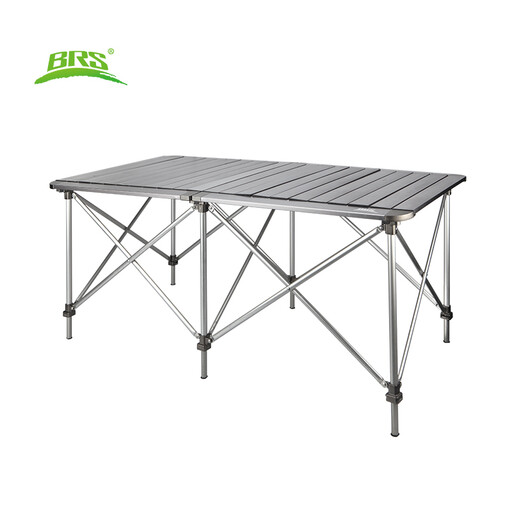
Why this model is a great fit: With a length of over 126 cm and two separately usable table surfaces, this model offers ample space for family meals, game nights, or as a combined cooking and dining station.
The double-sided construction with independent support legs ensures high stability, which is often lacking in single large tabletops. Despite its size, the table remains portable thanks to the aluminum alloy.
Two separate, height-adjustable surfaces offer maximum flexibility for different activities simultaneously. The pack size is optimized for a table of this size.
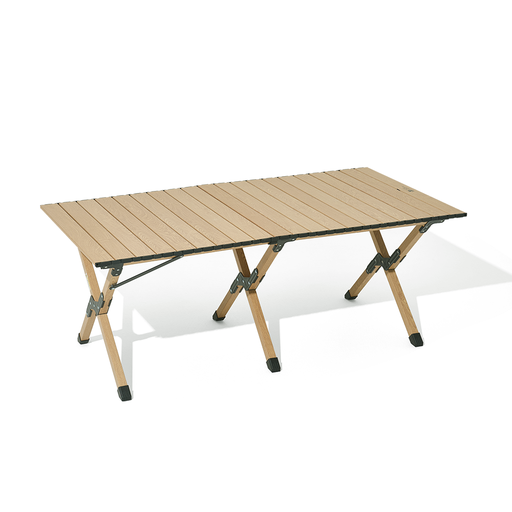
Why this model is a great fit: For users who want to combine functionality with an appealing aesthetic. The natural wood-look tabletop on a lightweight aluminum frame makes it a standout at any picnic or garden gathering.
The X-cross frame forms a stable triangular support structure and prevents wobbling. The aluminum material ensures weather resistance and low weight, avoiding the typical disadvantages of wooden tables.
The roll-top design allows for a very compact pack size lengthwise. The tabletop and frame are packed separately, which makes stowing easier.
We have compiled a complete, up-to-date list of products that meet these strict selection criteria and safety standards.
The load capacity varies greatly depending on the model and construction. Lightweight, compact tables are often rated for 15 to 20 kg (33 to 44 lbs), while more robust models can support 30 kg (66 lbs) or more. It is important to check the maximum load capacity in the manufacturer's specifications and to distribute the weight as evenly as possible across the tabletop.
Cleaning is straightforward. In most cases, a damp cloth is sufficient. For heavier soiling, a mild soap solution can be used. It is important to dry the table thoroughly after cleaning to avoid water spots and to maintain the function of the joints. Store the table in a dry place when not in use.
That depends on your priorities. Roll-top tables, where the tabletop consists of slats, often offer a very compact, elongated pack size but require an extra assembly step. Briefcase-style tables, which fold in the middle, are generally quicker to set up but have a larger, flatter shape when folded. Consider which shape is easier to store in your vehicle or storage space.