
Lieferung heute & morgen

Qualitätsgarantie

Willkommens-Angebote freischalten: KOSTENLOSE Lieferung | Bis zu 80 % RABATT | Kostenlose 30-Tage-JoyPlus-Testphase
App herunterladen
A good folding camping table is more than just a surface—it's the hub of your outdoor life. It's where you cook under the awning, play cards with the family, or set up as a folding picnic table by the lake. But the market is vast, and not every model lives up to its advertising. Before you make a decision, it's crucial to understand the common weaknesses that can quickly render a seemingly good purchase useless.
Many buyers focus on price or an attractive design, but overlook critical design flaws. The result is wobbly tables that end up in the basement after a short time, or models that prove impractical to transport. This guide will show you what to look for to find a functional and durable folding outdoor table.
Disappointment after buying a camping table can often be traced back to three recurring problems. By understanding these, you can specifically look for models that avoid these weaknesses.
The Stability Trap: Wobbly Joints and Weak Frames A common annoyance is a table that wobbles at the slightest touch. The cause is usually low-quality plastic joints or a poorly designed frame structure. On budget-friendly models, the locking mechanisms wear out quickly, making the entire structure unstable. A glass of water can suddenly become a hazard to any electronics on the table.
The Packed-Size Illusion: "Folding" Doesn't Always Mean "Compact" The term "folding" is often used generously. Some tables merely fold in half, leaving a bulky package that takes up valuable space in your car trunk or RV. A truly practical folding camp table is distinguished by a thoughtful design with a small packed size, where the tabletop and frame can often be stored separately to save space.
The Material Deception: Lack of Weather Resistance A table designed for outdoor use must withstand the elements. Many manufacturers advertise weather resistance, but the reality is often different. Untreated steel parts can rust, low-quality plastic coatings become brittle from UV radiation, and wooden tops swell when exposed to moisture. An aluminum camping table often offers the most balanced solution, as aluminum is naturally lightweight and corrosion-resistant.
To avoid the pitfalls mentioned above, you should focus your attention on three core parameters. These define the practicality and longevity of a camping table.
The material is crucial for weight, stability, and durability.
A lightweight camping table with a small packed size is essential for mobile use.
A good camping table adapts to its surroundings.
Based on the criteria above, we have identified a few models that are well-suited for specific use cases.
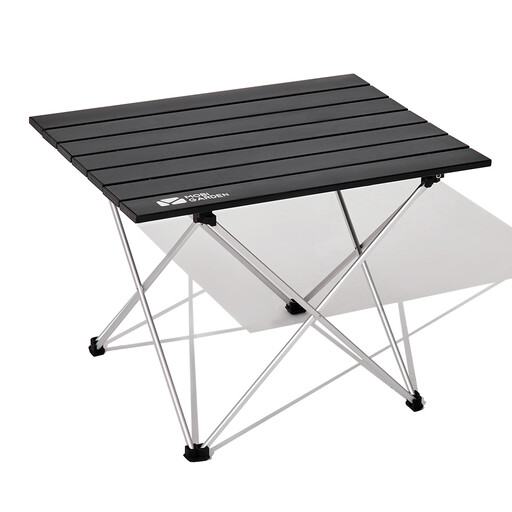
Why This Fits Their Persona: Ideal for users where every gram counts. Weighing only about 1.25 kg (2.75 lbs) and featuring a very compact packed size, this table fits into a backpack or pannier without becoming a burden.
It bypasses the "Packed-Size Illusion" because the tabletop and frame are stored separately, which minimizes the packed volume.
Extremely low weight (approx. 1.25 kg / 2.75 lbs) and a stable X-cross frame structure made of aluminum alloy.

Why This Fits Their Persona: Perfect for campers who need a versatile table. The adjustable height makes it an all-rounder—whether as a low cooking table next to the van or a dining table for two on uneven forest ground.
It solves the stability problem on uneven ground with its telescoping legs, which can be adjusted individually.
Height-adjustable telescoping legs for maximum flexibility and a robust leg-locking mechanism for stability.
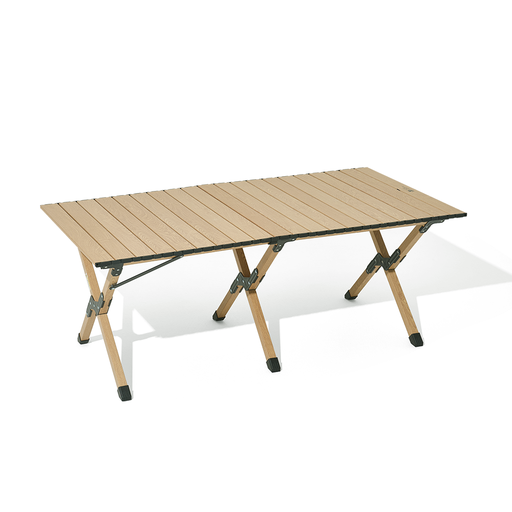
Why This Fits Their Persona: When space for several people is needed, a large and stable surface is essential. With a length of 116 cm (45.7 in), this model offers enough room for shared meals or game nights outdoors.
It counters the stability trap common in large tables with a solid X-cross frame construction that forms a stable triangular support.
Large tabletop surface (116 cm / 45.7 in) and a roll-top design that allows for a manageable packed size despite its dimensions.
We have compiled a complete, up-to-date list of products that meet these strict selection criteria.
The load capacity varies depending on the model and construction. Ultralight tables for hikers are often designed for a static load capacity of about 15 to 20 kg (33-44 lbs), which is sufficient for a stove and dishes. Larger, more robust models for families can support 30 kg (66 lbs) or more. This information can be found in the manufacturer's product specifications and should not be exceeded.
An aluminum camping table is easy to maintain. A damp cloth is usually sufficient for cleaning. Avoid aggressive cleaning agents or abrasive sponges, as they can damage the surface coating. It is important to let the table dry completely before packing it away to prevent corrosion on screws or joints. Store it in a dry place.
That depends on your priorities. A roll-top camping table, where the tabletop consists of individual slats, usually offers the smallest packed size and can be stored in a cylindrical bag—ideal for backpacking trips. A classic folding camp table with a solid top that folds in the middle is often quicker to set up and take down, but has larger dimensions when packed.