
Lieferung heute & morgen

Qualitätsgarantie

Willkommens-Angebote freischalten: KOSTENLOSE Lieferung | Bis zu 80 % RABATT | Kostenlose 30-Tage-JoyPlus-Testphase
App herunterladen
A reliable folding utility knife is an indispensable tool for DIY enthusiasts, tradespeople, and crafters. Whether you're cutting carpet, opening packages, or doing precision craftwork, the demands are high. However, the market is flooded with models whose weaknesses only become apparent with use. An unstable locking mechanism or a cumbersome blade change process can be more than just frustrating—it can also be a safety hazard.
This guide will help you identify the crucial features. We'll show you the three typical pitfalls to avoid and which technical details truly matter, so you can make an informed decision.
Many buyers focus on appearance or price, overlooking functional flaws that can render a knife useless. Pay special attention to these three points:
To avoid the pitfalls mentioned above, you should carefully examine three technical aspects before buying. These determine the safety, efficiency, and longevity of your tool.
The type of blade lock is the most important safety feature. Two systems have proven effective in practice:
The standard blade for this type of knife is the trapezoid blade. It is robust, double-sided, and ideal for powerful cuts in materials like carpet, cardboard, or plastic sheeting. Look for blades made of SK5 carbon steel, as they are known for their edge retention and stability.
A modern quick-change mechanism is essential. You should be able to remove the old blade and securely insert a new one at the push of a button. This saves time and minimises the risk of injury. Many models already come with includes spare blades, which is a practical advantage.
The handle material affects both the feel and the durability:
A utility knife with a belt clip significantly increases portability. The knife is always within reach on your belt or pocket, so you don't have to search for it in a toolbox.
Based on the quality criteria mentioned, we have identified several models suitable for different user profiles.
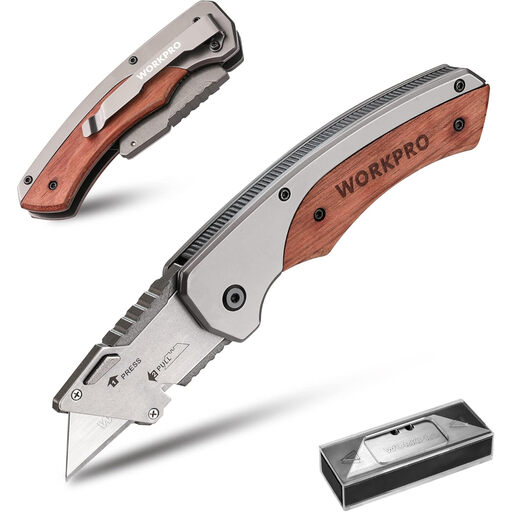
Why This Fits Their Persona: Ideal for DIY enthusiasts who want a reliable and visually appealing tool for various jobs around the house and garden. It combines classic design with modern functionality.
The robust liner-lock mechanism prevents the blade from accidentally closing. The mahogany wood handle is more durable and provides a better grip than cheap plastic alternatives.
Proven liner-lock safety and a tool-free quick-change mechanism for SK5 blades. Includes a belt clip for easy transport.
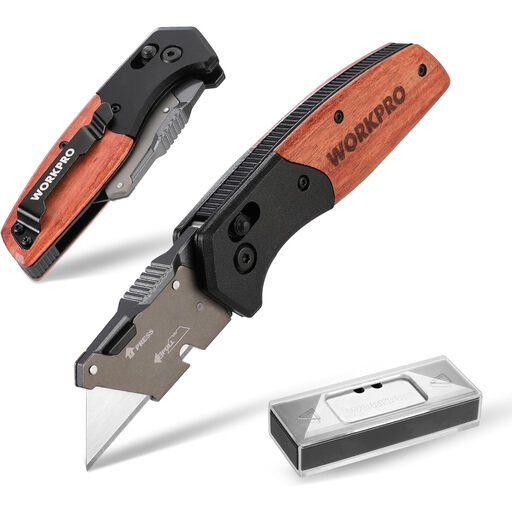
Why This Fits Their Persona: Perfect for tradespeople (e.g., floor layers, drywall installers) who need a tool for continuous use that offers fast, one-handed operation and maximum safety.
The external slide-lock mechanism provides an exceptionally secure lock and is optimised for one-handed use, boosting work efficiency compared to fiddly systems.
Advanced slide lock for secure, one-handed operation. Lightweight and durable handle made of aluminium alloy and wood. Includes 10 SK5 replacement blades.
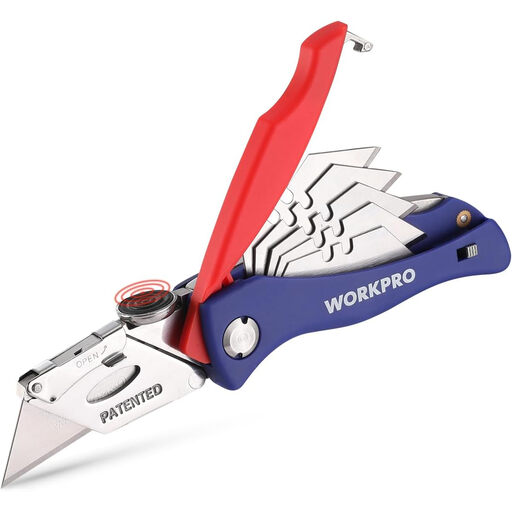
Why This Fits Their Persona: A functional and safe option for anyone needing a solid basic tool for occasional cutting tasks without a big budget. Ideal as a first **folding carpet knife**.
Despite its affordable price, this model features a reliable lock-back safety mechanism and a sturdy stainless steel handle that offers more stability than simple plastic grips.
Integrated blade storage in the handle for 5 spare blades. Patented quick-change mechanism and a secure lock-back design.
We have compiled a complete, up-to-date list of products that fully meet these strict selection criteria and safety standards.
The frequency of blade changes depends on the material and intensity of use. A blade should be changed as soon as you notice that cutting requires more force or the cut becomes frayed. Cutting with a dull blade is inefficient and increases the risk of slipping. Since trapezoid blades have two cutting edges, you can flip the blade once before a complete replacement is necessary.
Laws regarding carrying knives vary significantly by country and region. In many jurisdictions, folding utility knives are classified as tools. Carrying them for professional or trade-related purposes (e.g., to and from a job site) is often permissible as a "legitimate reason." However, carrying one without a valid reason in public spaces, especially at gatherings, should be avoided. Always check your specific local and national regulations to be certain.
The main difference lies in stability and application. A trapezoid blade is a single, thick, and very stable blade designed for powerful cuts in tough materials like carpet, leather, or thick cardboard. A snap-off blade consists of several segments; the frontmost segment is broken off when it becomes dull to reveal a new, sharp tip. It is thinner and better suited for precise cuts in lighter materials like paper, film, or thin cardboard. For heavy-duty work, the trapezoid blade is the safer and more durable choice.