
Lieferung heute & morgen

Qualitätsgarantie

Willkommens-Angebote freischalten: KOSTENLOSE Lieferung | Bis zu 80 % RABATT | Kostenlose 30-Tage-JoyPlus-Testphase
App herunterladen
Purchasing a new fridge-freezer is a significant decision that will impact your daily life for years to come. With rising energy costs, varying household sizes, and a wide array of technical features, the choice can be complex. This guide is designed to help you understand the criteria relevant to your needs. We provide objective information and present a selection of models to make the decision easier when buying a refrigerator.
Before you decide on a model, three key aspects should be considered: the build type, energy efficiency, and technical features.
The first fundamental decision concerns how the appliance will be integrated into your kitchen.
The required net capacity depends on the size of your household. As a rule of thumb, allow about 100 litres of cooling capacity for one person and an additional 50 litres for each subsequent person.
Since March 2021, the new EU energy label with classes from A (highest efficiency) to G has been in effect. An appliance with Energy Efficiency Class C is already considered very economical under this new standard. Pay attention to the annual energy consumption in kilowatt-hours (kWh) to estimate long-term running costs.
For open-plan kitchens, the noise level is also an important factor. A quiet fridge-freezer with an operating noise level below 38 decibels (dB) is barely perceptible and contributes to a peaceful home environment.
Modern appliances offer technologies that improve food storage and make daily life easier.
Based on the criteria mentioned, we have compiled a selection of different models that cater to various requirements.
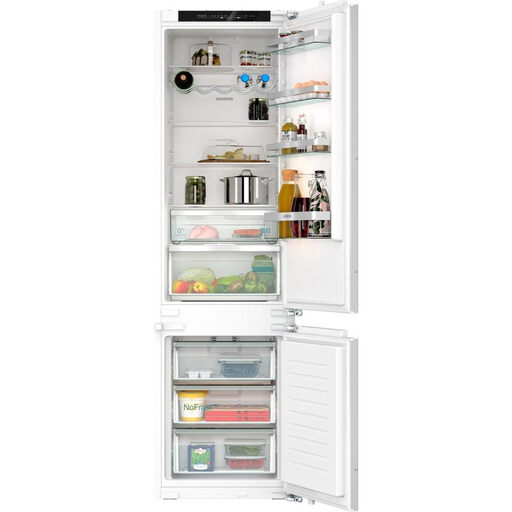
Why it stands out: This Siemens refrigerator is a fully integrated, "Made in Germany" built-in model. It combines advanced freshness technology with very quiet operation and is designed for kitchen planners who value a seamless look.
Pros:
Who is it for? For households planning a new built-in kitchen or replacing an old appliance, who are looking for a durable, quiet, and fully integrable solution.
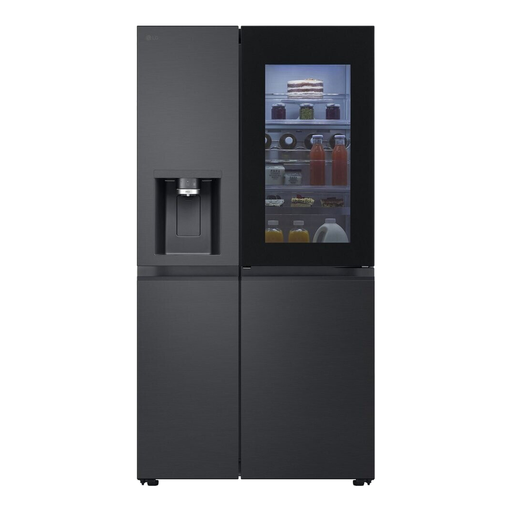
Why it stands out: This LG refrigerator is a freestanding side-by-side model that impresses with innovative features and a very large net capacity of 628 litres. The InstaView door and the Craft Ice maker are particularly noteworthy.
Pros:
Who is it for? For large families and tech-savvy users who appreciate maximum storage space, an integrated water and ice dispenser, and smart convenience features.
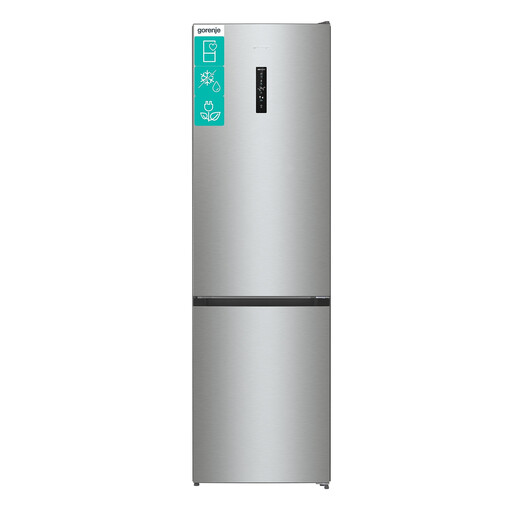
Why it stands out: The Gorenje refrigerator is a standard freestanding model that combines high energy efficiency with a spacious interior and quiet operation. With an Energy Efficiency Class C rating, it is an economical choice for the environmentally conscious household.
Pros:
Who is it for? For price- and energy-conscious families looking for a reliable, spacious, and quiet freestanding appliance without complex smart functions.
If our recommendations do not include the right model for your specific needs, there are other options to explore. Especially if you are looking for a spacious model with double doors, a look at our selection of side-by-side refrigerators could be helpful.
? Discover more models in the non-plumbed side-by-side refrigerator with freezer category here
"No Frost" is a technology that prevents the formation of ice and frost in the freezer compartment. A fan circulates cold, dry air evenly and expels moist air to the outside. This eliminates the tedious and energy-intensive task of manual defrosting. Additionally, food items do not stick together, and the appliance's energy efficiency remains consistently high.
A refrigerator 0-degree zone (often called a "freshness zone" or "BioFresh") is a separate compartment where the temperature is kept consistently at around 0°C. This low temperature significantly slows the growth of microorganisms. As a result, perishable foods like meat, fish, cold cuts, and dairy products stay fresh for much longer, retaining their nutrients and flavour.
Since the introduction of the new EU energy label in March 2021, the scale ranges from A (very efficient) to G (less efficient). The requirements have been tightened, so many appliances that were previously rated A+++ are now classified as C, D, or E. A fridge-freezer with Energy Efficiency Class C or D is now considered very economical and is a good choice for an environmentally and cost-conscious household. Classes A and B are still rare at present and are reserved for future, even more efficient technologies.