
Lieferung heute & morgen

Qualitätsgarantie

Willkommens-Angebote freischalten: KOSTENLOSE Lieferung | Bis zu 80 % RABATT | Kostenlose 30-Tage-JoyPlus-Testphase
App herunterladen
Published: 2026-07-05 | By: Joybuy Product Recommendation Officer
The number of electronic devices we use daily is constantly growing, but the space in our bags and on our desks remains limited. Many users face the challenge of carrying a separate, often bulky power adapter for their laptop, smartphone, and tablet. This not only leads to cable clutter but also results in inefficient charging times. This article serves as a guide to help you understand how modern charging technologies work and make an informed choice based on objective criteria.
Before making a decision, it's helpful to understand a few technical basics. These criteria will help you find a charger that is perfectly tailored to your needs.
A charger's power output is measured in watts (W) and determines how quickly a connected device can be charged. A modern smartphone often requires 20-45W for fast charging, a tablet around 30-60W, and a laptop, depending on the model, 65W or more.
A crucial standard here is Power Delivery (PD). This technology allows a USB-C power adapter to communicate with the connected device and provide the optimal charging power. To take full advantage of fast charging, ensure that both the charger and your device support PD. For example, a USB-C laptop charger with PD support can also charge your smartphone or tablet safely and efficiently.
A multi-port charger offers the advantage of powering several devices at once. Consider how many devices you regularly need to charge simultaneously. Modern chargers often combine USB-C and USB-A ports.
A charger with multiple USB-C ports is often a future-proof choice.
The abbreviation GaN stands for gallium nitride, a semiconductor material that is replacing traditional silicon in modern power adapters. The main advantage of GaN lies in its higher efficiency. GaN chargers can handle more power in a smaller space while generating less waste heat. The result is a significantly more compact and lightweight fast charger, ideal for travel or a clutter-free workspace.
Based on the criteria above, we have compiled a selection of chargers that cover a range of different use cases.
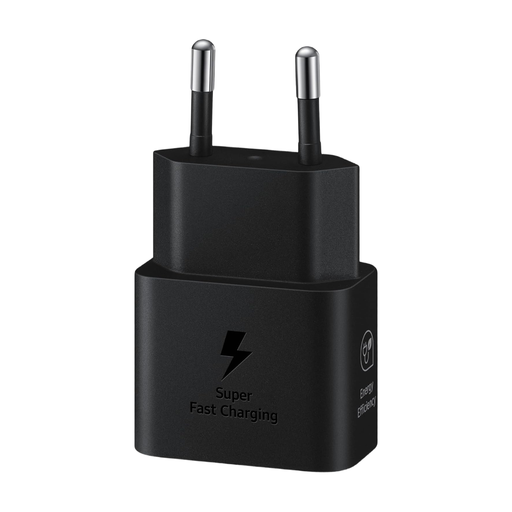
View Product: Samsung EP-T2510 Smartphone Black AC
The Samsung EP-T2510 is an ultra-compact USB-C charger designed specifically for fast-charging single devices. Through the use of GaN technology, it is slimmer than many conventional models. According to the manufacturer, its standby power consumption has been reduced from 20 mW to 5 mW, contributing to its energy efficiency.
This charger is an excellent choice for users seeking a minimalist and efficient charging solution for a single device, such as their smartphone or tablet. It is particularly well-suited for daily use and as a travel charger when only one device needs to be charged quickly.
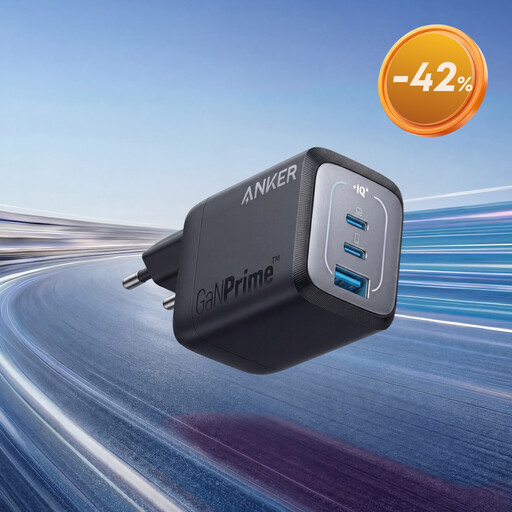
View Product: Anker 735 PRIME Wall Charger 67W
The Anker charger 735 Prime is a versatile 67W charger that combines power and portability. With two USB-C ports and one USB-A port, it can power up to three devices simultaneously. When only one USB-C port is in use, it delivers the full 67W of power, which is sufficient for many laptops like the MacBook Air or Pro 13". According to Anker, it is 51% smaller than an original 67W MacBook charger.
This model is aimed at professionals and travellers looking for an all-in-one solution for their laptop, smartphone, and another device. It offers a great balance of power, port selection, and compact design.
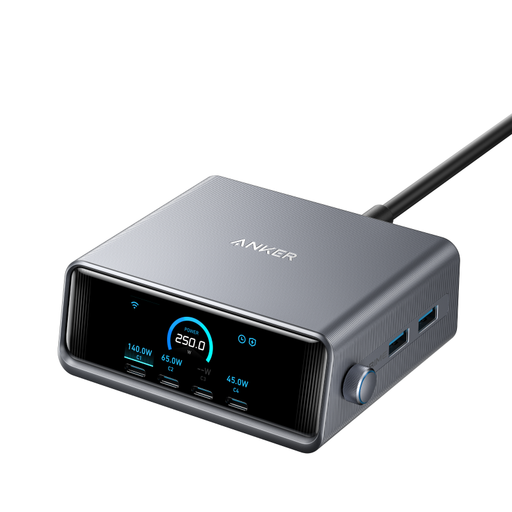
View Product: Anker Prime Charger (250W, 6 Ports, GaNPrime)
This desktop charger is designed for users with maximum power demands. With a total output of 250W and six ports (four USB-C, two USB-A), it can power an entire workstation. The first USB-C port delivers up to 140W, enough for demanding laptops like a 16" MacBook Pro. An integrated LCD screen displays real-time charging information.
This charger is the ultimate solution for power users, families, or small offices where a multitude of devices—from smartphones and tablets to multiple high-end laptops—need to be charged quickly and simultaneously.
The selection presented here covers common use cases. However, if you need a charger with different specifications, a different port configuration, or in another power class, you can find more models in our broader product category.
A GaN charger uses gallium nitride instead of traditional silicon as its semiconductor material. This material allows for higher electrical conductivity and efficiency. In practice, this means that for the same power output, GaN chargers are smaller, lighter, and run cooler than their silicon-based counterparts.
Yes, compatibility is generally assured. Modern chargers with standards like Power Delivery (PD) communicate with the connected device to negotiate the safe and correct voltage and current. Therefore, a powerful USB-C laptop charger can also charge a smartphone without damaging it, as it automatically adjusts the power output. However, the charging speed depends on the maximum charging power supported by the end device.