
Lieferung heute & morgen

Qualitätsgarantie

Willkommens-Angebote freischalten: KOSTENLOSE Lieferung | Bis zu 80 % RABATT | Kostenlose 30-Tage-JoyPlus-Testphase
App herunterladen
We've all been there: the bulk shopping is done, the garden harvest was a success, or the kitchen freezer is simply bursting at the seams. Additional freezer space is often the only solution, but where do you put the appliance? Unheated spaces like a garage, basement, or pantry are ideal, but they place special demands on the unit. A standard chest freezer can lose performance or even fail completely in low ambient temperatures.
This guide is here to help. We'll explain the key technical features to look for when buying a garage-ready chest freezer and present a selection of models designed to operate in cooler environments.
Choosing the right appliance depends on specific technical characteristics that ensure reliable operation under fluctuating temperature conditions.
The most important criterion for a chest freezer for a cold environment is its ability to function flawlessly at low ambient temperatures. Many standard appliances are designed for use in living spaces (approx. 16–32 °C). If the ambient temperature drops below this, the compressor may start irregularly or not at all.
Look for two key indicators:
Consider how much additional storage space you actually need. A freezer that is too large consumes unnecessary energy, while a small chest freezer will quickly reach its limits. For an average household, models between 140 and 200 litres are often a great addition.
The energy efficiency class has a direct impact on running costs. The scale ranges from A (very efficient) to G (less efficient). A chest freezer with energy efficiency class C is already a very economical option and helps to keep the electricity bill low in the long run.
Even if the appliance is in the garage or basement, a loud compressor can be a nuisance. A quiet chest freezer with an operating noise level below 40 dB is barely noticeable.
Other practical features include:
Here is a selection of models that are particularly well-suited for use in secondary spaces like garages or basements due to their specific features.
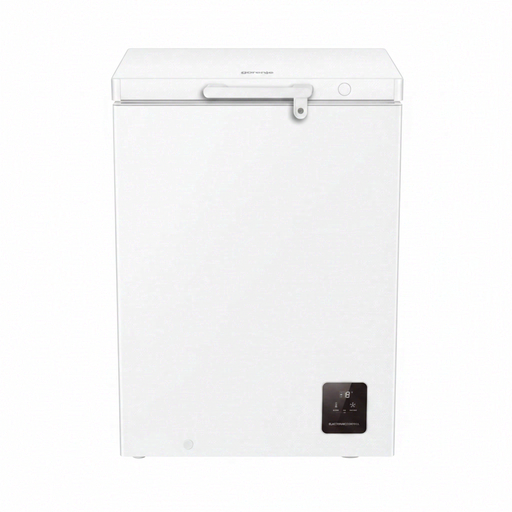
What makes it stand out: The Gorenje FH15E6W5 is a solid and reliable chest freezer that focuses on the essentials. With a net capacity of 141 litres, it offers sufficient space for a family's additional needs. Its SN-T climate class allows it to operate in a wide temperature range from 10 °C to 43 °C. A particular highlight is its low operating noise of just 37 dB, making it a very quiet option.
Advantages:
Who is it for? This model is ideal for households looking for a straightforward, quiet, and reliable addition to their basement or a temperate garage, who do not require operation in sub-zero temperatures.

What makes it stand out: The Bauknecht chest freezer GTE 150MD is specifically designed for use in demanding environments. The WinterProof technology ensures reliable operation in ambient temperatures down to -15 °C, according to the manufacturer Bauknecht. Another key feature is the flexible Multi-Zone function, which allows the appliance to be converted from a freezer to a refrigerator at the touch of a button. It features modern operation via a touch display.
Advantages:
Who is it for? Perfect for users who need maximum flexibility and want to place their chest freezer in an unheated garage or a cold basement. The conversion function is especially practical for seasonal needs.

What makes it stand out: This model from Bauknecht combines a generous net capacity of 198 litres with high energy efficiency and advanced features. Like its smaller sibling, it features WinterProof technology for operation down to -15 °C and the flexible Multi-Zone function. With an energy efficiency class of C, it is also very economical to run. The Door Balance function keeps the lid stable in any position, making loading and unloading easier.
Advantages:
Who is it for? Ideal for larger families, gardeners, or hunters who need a lot of storage space, operate the appliance in a cold garage, and also value low running costs.
Haven't found the right model for your needs yet, or are you looking for different sizes and features? In our Cooling Containers category, you'll find a wider selection of freezer appliances for various applications.
No, not every appliance is suitable. Standard chest freezers are often only designed for ambient temperatures above 10 °C or 16 °C. In an unheated garage, the temperature can drop below this in winter, which can lead to malfunctions. Therefore, look for models with an extended climate class (e.g., SN) or special manufacturer technologies like "WinterProof" that explicitly permit operation at lower temperatures.
The climate class indicates the temperature range in which a refrigeration or freezer appliance will function correctly, according to the manufacturer. The most common classes are:
Power consumption depends on the energy efficiency class, net capacity, set temperature, and ambient temperature. Paradoxically, a chest freezer in a cold garage may use less energy in the winter because the temperature difference between the inside and outside is smaller. However, it is crucial that the appliance is designed for these conditions. A look at the EU energy label provides information on the average annual consumption in kilowatt-hours (kWh). Models with class C or better are particularly economical.