
Lieferung heute & morgen

Qualitätsgarantie

Willkommens-Angebote freischalten: KOSTENLOSE Lieferung | Bis zu 80 % RABATT | Kostenlose 30-Tage-JoyPlus-Testphase
App herunterladen
Creating a functional workspace in your home is essential for productive and focused work. The desk is the centerpiece of any home office setup. Choosing the right model depends on your individual needs for ergonomics, available space, and organisation. This guide outlines various criteria to consider when selecting a home office desk and presents a curated selection of models for different requirements.
To make an informed decision, you should consider several functional aspects. The following points serve as a guide in your search for the perfect office desk.
An ergonomic workspace promotes healthy posture. A height-adjustable desk allows you to switch between sitting and standing, which can break up the monotony of long workdays. Models with electric adjustment and a memory function for preferred height settings offer added convenience. The ability to precisely adjust the desk height to your body and office chair is a key factor for ergonomic work.
Not every home has room for a spacious office. For smaller apartments or multi-purpose rooms, there are clever solutions. A small desk with a compact footprint may be all you need. A corner desk with storage often makes efficient use of unused room corners and provides space for documents and office supplies with integrated shelves or drawers. For maximum flexibility, a folding desk can be easily stowed away when not in use, freeing up valuable living space.
The materials of a desk determine its durability and stability. A combination of a robust steel frame and an engineered wood top is a popular and reliable design for a computer desk. Pay attention to the specified maximum static load capacity to ensure the desk can safely support the weight of all your equipment—from monitors and a laptop to books.
Based on the criteria mentioned, we have compiled a selection of desks that meet different demands for functionality and design.
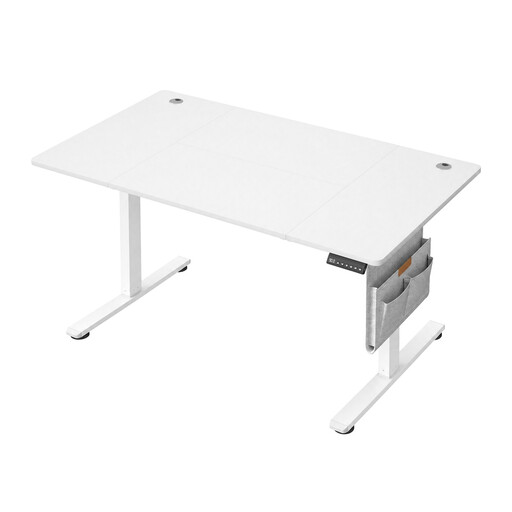
What Makes It Stand Out This model combines ergonomic flexibility with thoughtful details for an organised workspace. The quiet motor allows for smooth height adjustment between 72.1 cm and 120.1 cm, while the memory function lets you save four preset heights. The sturdy construction of a steel frame and particleboard provides a stable foundation.
Pros
Who It's For Ideal for home office professionals who prioritise ergonomics and want to regularly alternate between sitting and standing. This model works well as a central computer desk in a dedicated workspace.

What Makes It Stand Out This corner desk with storage is designed to make optimal use of room corners. The L-shape provides a generous work surface, while the integrated drawers and shelves offer ample space for office supplies and files. The design is reversible, so the cabinet can be mounted on the left or right depending on your room layout.
Pros
Who It's For A suitable solution for users who need a permanent workstation with plenty of surface area and integrated storage. It is especially well-suited for home office setups in living rooms or bedrooms where a clear separation between work and personal space is desired.
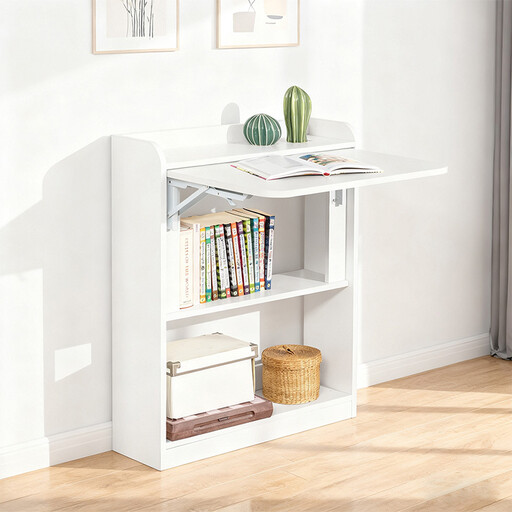
What Makes It Stand Out This folding desk is an extremely space-saving solution. When not in use, the tabletop can be easily folded up, turning the unit into a slim wall shelf. With a depth of only 20 cm when folded, it blends seamlessly into any room. The three integrated compartments still offer practical storage space.
Pros
Who It's For Perfect for students, people in shared living spaces, or anyone who only occasionally needs a workspace and doesn't want to set up a permanent office desk. It is the ideal choice when flexibility and space efficiency are the top priorities.
The selection presented here covers common requirements. However, if you are looking for other models or a specific style, such as a simple white desk, you may find the right product in our wider collection.
Explore more white tables and desks here
1. How high should a home office desk be? The ideal height of a desk depends on your height and your chair. For a fixed-height desk, the standard range is often between 72 and 76 cm. For optimal ergonomics, the desktop should be positioned so that your forearms form a right angle with your upper arms while your shoulders are relaxed. A height-adjustable desk offers the most flexibility here, as it can be precisely adapted to your needs.
2. What should I consider for a small home office desk? With a small desk, the key is to make multi-functional use of the limited space. Look for models with vertical storage solutions like shelves or integrated compartments. A folding desk is also an excellent option, as it creates space when needed. Measure the available area carefully and ensure there is still enough room to move around the desk.
3. How do I organise cables at my computer desk? Cable clutter can be distracting. Many modern desks offer integrated solutions like cable grommets in the desktop or discreet cable trays underneath. Alternatively, you can use self-adhesive cable clips, cable sleeves, or cable management boxes to bundle and neatly route the cords from your monitor, laptop, and other devices.