
Lieferung heute & morgen

Qualitätsgarantie

Willkommens-Angebote freischalten: KOSTENLOSE Lieferung | Bis zu 80 % RABATT | Kostenlose 30-Tage-JoyPlus-Testphase
App herunterladen
Setting up a functional workspace begins with choosing the right desk. Whether for a home office, studying, or as a hub for gaming, the requirements for a desk are as unique as its users. With a vast array of models, materials, and features available, the decision can be complex. This guide provides a clear overview of the most important criteria and presents a selection of models for various needs to help make your choice easier.
Before you decide on a model, there are some fundamental considerations to keep in mind. The following points will help you define your needs and make an informed decision.
An ergonomic workspace is crucial for concentration and well-being. A height-adjustable desk allows you to switch between sitting and standing, which can improve posture and break up the monotony of long workdays. When choosing such a model, the adjustment range and ease of use are important factors. An electric desk with a memory function allows you to save preferred heights and recall them at the touch of a button. This is especially practical if the desk is used by multiple people or if you want to quickly switch between your ideal sitting and standing heights.
Efficient use of space is critical, especially in smaller apartments or multi-functional rooms. A corner desk makes optimal use of unused corners and often provides a larger work surface without dominating the room. Models like a desk with drawers or a desk with shelves help you stay organised and keep important documents and office supplies within easy reach. A tidy computer desk promotes a structured workflow and minimises distractions.
The size of the desktop should be based on your needs. Do you need space for multiple monitors, as is often the case with a gaming desk? Or do you share your workspace with another person? A desk for 2 people provides enough room for two separate workstations without getting in each other's way. Pay attention not only to the width but also to the depth of the desktop to ensure sufficient distance from the monitor and space for your keyboard and mouse.
Based on the criteria mentioned, we have compiled a selection of desks that meet different requirements for function, size, and design.
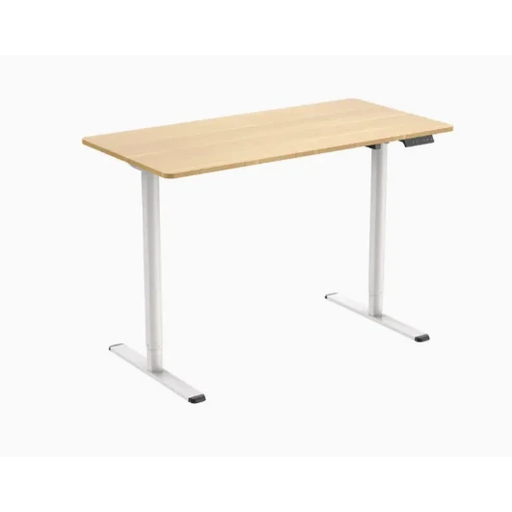
What makes this model stand out: This model from Loctek is a functional solution for an ergonomic single workstation. The electric height adjustment with four memory presets makes switching between sitting and standing effortless. With its compact dimensions of 120 x 60 cm, this home office desk also fits well in smaller rooms.
Advantages:
Who is this model for? Ideal for professionals and students who want to set up an ergonomic and flexible workspace in a limited space and who value ease of use.
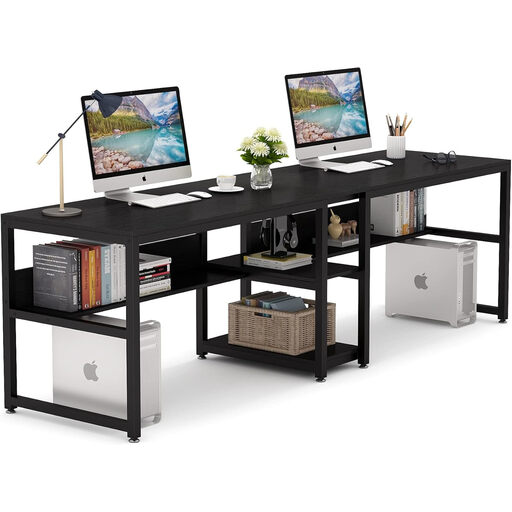
What makes this model stand out: The Tribesigns dual workstation is designed for shared use. With a length of 200 cm, it offers two full-sized workspaces side by side. Integrated shelves in the centre and lower section create additional storage and a clear separation between the work areas.
Advantages:
Who is this model for? A suitable solution for couples or partners who need a shared desk for 2 people in their home office. It also works well as a spacious gaming desk with plenty of room for equipment.
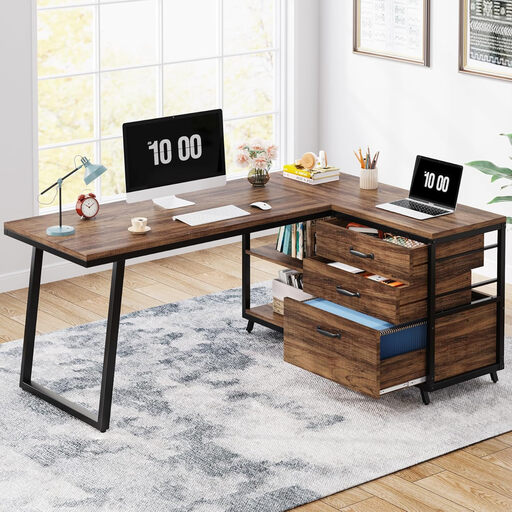
What makes this model stand out: This L-shaped office desk from Tribesigns is an organisational powerhouse. Its reversible design allows it to be placed flexibly in left or right corners. With three drawers and two open shelves, it offers extensive storage for a tidy workspace.
Advantages:
Who is this model for? Suitable for users who want to create a maximally functional workspace in smaller rooms and place a high value on integrated storage solutions.
The selection presented here covers common use cases. However, you may have more specific requirements, such as needing to accommodate a printer directly at your workstation.
Looking for a computer desk with special compartments? Discover more models in our computer desks with printer shelves for home category.
For a fixed-height desk, the standard in Europe is typically between 72 and 76 cm. However, your individual height is the deciding factor. As a rule of thumb, when you are sitting upright, your forearms should rest on the desktop at an approximate 90-degree angle. A height-adjustable desk offers the advantage of being precisely adjusted to your own height and that of your office chair.
A gaming desk is often tailored to the specific needs of gamers. This usually includes a larger and deeper desktop for multiple monitors, a high load capacity for heavy hardware, and special features like integrated cable management, cup holders, or headphone hooks. In contrast, a classic office desk or home office desk often focuses on a more minimalist design, ergonomics, and practical storage solutions like drawers.
Don't just plan for the desk's dimensions alone, but also for the space for the chair and room to move behind it. As a minimum, you should plan for about 80–100 cm of clearance behind the desk. Carefully measure the available space in your room before deciding on a model. For very limited spaces, a compact computer desk or a corner desk can be a great solution.