
Lieferung heute & morgen

Qualitätsgarantie

Willkommens-Angebote freischalten: KOSTENLOSE Lieferung | Bis zu 80 % RABATT | Kostenlose 30-Tage-JoyPlus-Testphase
App herunterladen
A loose hinge, a new shelf to assemble, or a picture to hang—small repair and assembly jobs regularly pop up around the house. In these moments, the right tool is often missing. A well-organised, complete tool kit is the perfect remedy, saving you the tedious process of buying tools individually. It offers a practical all-in-one solution for the most common tasks.
This article serves as a guide. We will introduce you to a selection of tool sets and provide objective criteria to help you choose the right tool assortment for your home.
Before you decide on a model, a few basic considerations are helpful. A suitable DIY tool set should be tailored to your typical use cases.
Not everyone needs a professional-grade tool kit. For most everyday household tasks, a solid basic tool kit is sufficient. Check if the following essential tools are included:
A more comprehensive DIY tool set may also include hex keys, socket attachments (sockets), or even a cordless tool.
The longevity of a tool largely depends on the material used. Tools made from carbon steel or chrome vanadium steel offer a good balance of hardness and toughness. Also, pay attention to the construction of the handles. Ergonomically shaped grips with non-slip surfaces (often made of TPR plastic) fit better in the hand, allow for more precise power transfer, and increase comfort, especially during extended use.
The case itself is more than just packaging. A robust and well-organised complete tool box protects the tools from dirt and damage and ensures everything stays in its place. Moulded compartments or holders prevent the parts from getting mixed up. Compact cases are easy to store, while modular or multi-layered systems often offer better organisation for larger sets.
Here is a selection of complete tool kits that are well-suited for various applications due to their composition and design.
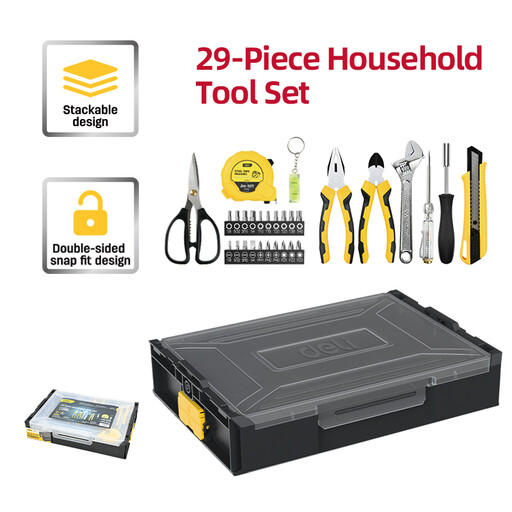
Why it stands out: The Deli set focuses on the essential tools for everyday use. Its special feature is the modular and stackable case design with a transparent lid, which allows for quick content identification and simplifies organisation.
Pros:
Who is it for? This household tool set is a great choice for renters and homeowners who are looking for a compact and well-organised basic kit for occasional repairs and who value easy storage.
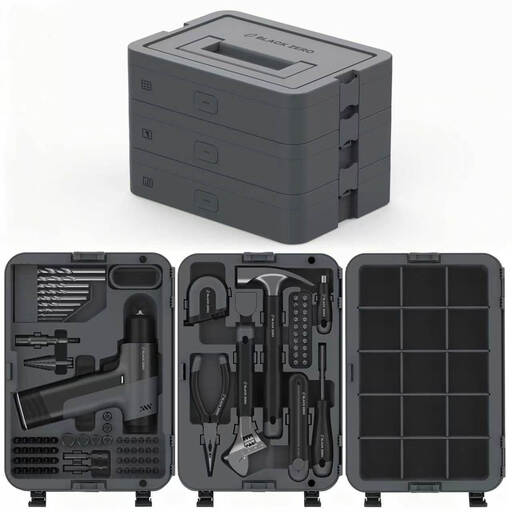
Why it stands out: The BLACKZERO set distinguishes itself with the inclusion of a 16V cordless drill and its patented case structure. The three-layer case has a separate level just for the drill and its accessories, providing exceptional organisation and protection.
Pros:
Who is it for? Ideal for ambitious DIYers and home improvement enthusiasts who are looking for not just a hand tool set, but a complete repair kit that includes a powerful cordless tool. The thoughtful organisation will appeal to users who value efficiency and order.
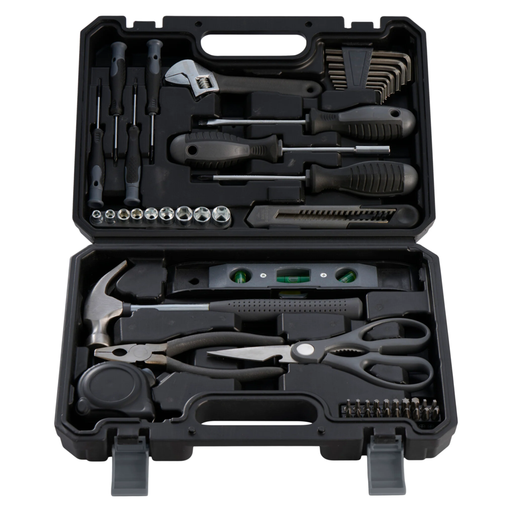
Why it stands out: With 57 pieces, this set from PROBUILDER offers a very comprehensive collection that goes far beyond the basics. In addition to standard tools, it includes precision screwdrivers, a wide range of bits, and a socket set, making it a versatile all-rounder.
Pros:
Who is it for? This set is an excellent choice for beginners looking for a comprehensive starter kit, as well as for experienced hobbyists who need a versatile and complete set for the workshop, garage, or home.
The products featured here already cover many use cases. However, if you need a different configuration or specialised tools, you can find more options in our broader category.
Discover our entire range of Tool Sets here.
1. What belongs in a good basic tool kit for the home? A solid basic kit should include tools for the most common tasks. This typically includes a hammer, a set of screwdrivers (or a bit holder with bits), combination pliers, a tape measure, a utility knife, and a spirit level. Sets with hex keys and a small socket set significantly expand the range of applications.
2. Is a complete tool kit suitable for beginners? Yes, absolutely. A complete tool kit is an ideal solution for beginners. It offers a carefully curated selection of tools, so you don't have to research and buy each item individually. You get a coordinated and ready-to-use set for your first projects and everyday repairs.
3. How do household tool kits differ from professional sets? The main difference often lies in the scope, specialisation, and material durability. Professional sets frequently contain more specialised tools for specific trades (e.g., electrical, plumbing) and are designed for daily, intensive use, which is reflected in the material quality and price. A DIY tool set is optimised for the variety of tasks that arise in a household and offers a good compromise between scope, quality, and cost.