
Lieferung heute & morgen

Qualitätsgarantie

Willkommens-Angebote freischalten: KOSTENLOSE Lieferung | Bis zu 80 % RABATT | Kostenlose 30-Tage-JoyPlus-Testphase
App herunterladen
The search for the right coated frying pan for an induction hob can quickly become overwhelming. The market is flooded with promises of durability, perfect non-stick performance, and health safety. Yet, it's not uncommon to find that after just a few months, the expensive pan fails to live up to its promises. As your Joybuy Product Recommendation Officer, I'll help you identify the crucial features and avoid common purchasing traps.
Before you make a decision, you should be aware of three common problems that lead to frustration and unnecessary expense:
To make an informed purchasing decision, you should focus on a few, but critical, technical parameters. These determine the performance, longevity, and safety of your new pan.
The base is the most critical component of a pan for induction. Look for the following characteristics:
The combination of the pan's body and its coating defines the cooking properties and lifespan.
Finally, practical aspects determine everyday usability:
Instead of making a one-size-fits-all recommendation, we have identified models that meet specific needs and avoid the pitfalls mentioned earlier.
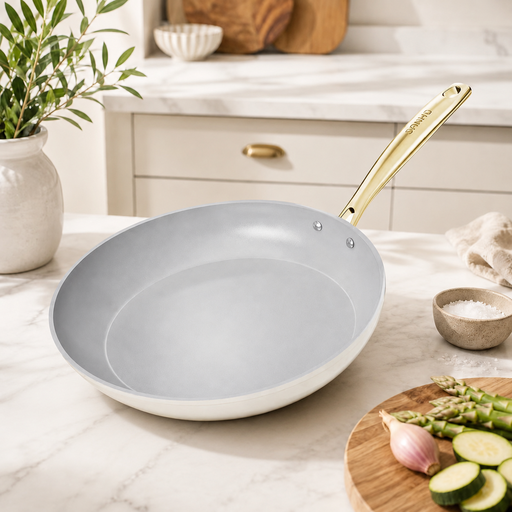
Why This Fits Their Persona: Ideal for those who prioritise health-safe materials and durable non-stick performance for daily use. Perfect for low-fat cooking of vegetables, fish, or eggs.
The ceramic coating is explicitly declared as free of PFAS, PFOA, PTFE, lead, and cadmium, directly addressing concerns about hidden harmful substances. The aluminium core with a stainless steel base ensures fast and even heat distribution on induction hobs.
The patented diamond-titanium coating offers high scratch resistance. Additionally, the pan is oven-safe up to 260°C (500°F), which significantly expands its range of uses.
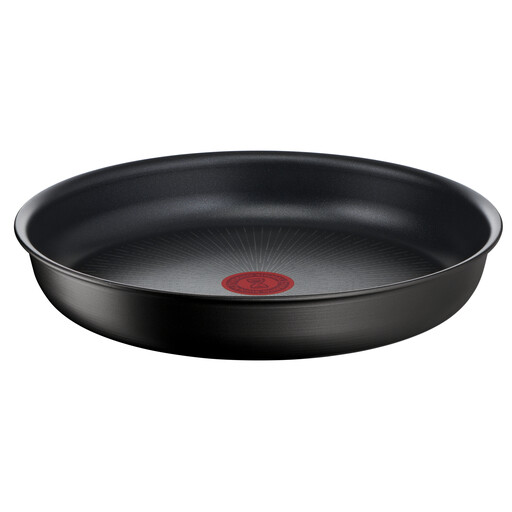
Why This Fits Their Persona: Perfect for kitchens where every inch counts. The combination of a detachable handle, stackability, and high versatility makes this system ideal for intensive daily use, from the hob to the oven to the fridge.
According to Tefal, the Titanium Anti-Scratch non-stick coating is up to 6 times more durable than a standard coating, thus countering the problem of short-lived coatings. The Thermo-Fusion base is optimised for fast, even heat distribution on induction hobs.
The main feature is the space-saving, stackable design thanks to the detachable handle (sold separately). The pan is also oven-safe up to 250°C (482°F) (without handle) and suitable for all hob types.
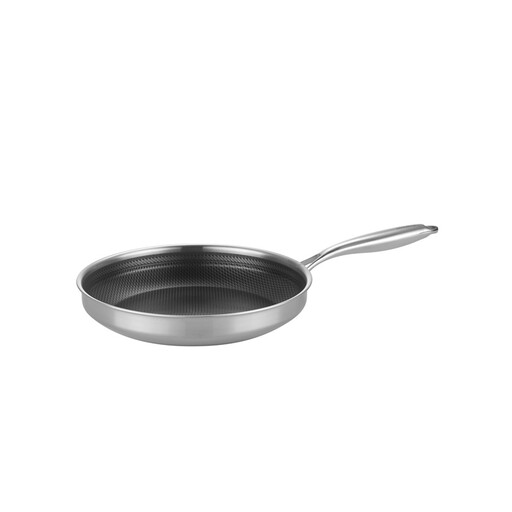
Why This Fits Their Persona: For cooks who want the robustness of stainless steel and the benefits of a non-stick coating. The hybrid technology is designed for precise searing at high temperatures and promises exceptional longevity.
This pan combines a stainless steel structure with an engraved ceramic coating. This is designed to merge the durability of a stainless steel pan with non-stick functionality, thus bypassing the typical wear and tear of pure coatings. It is also PFAS/PTFE/PFOA-free.
The three-layer construction with an aluminium core ensures excellent and rapid heat conduction on all hob types. The pan is oven-safe up to 260°C (500°F) and offers professional handling with its stainless steel handle.
We've compiled a complete, up-to-date list of products that fully meet these strict selection criteria and UK safety regulations.
1. How long does a coated induction pan last? The lifespan heavily depends on the quality of the coating and its care. Inexpensive models can lose their non-stick properties after just one to two years. High-quality pans with reinforced ceramic or titanium coatings can last five years or more with proper care (hand washing, not using metal utensils, and avoiding overheating).
2. Why does my "induction-compatible" pan perform poorly? This is usually due to the pan's base. Either the ferromagnetic layer is too thin, leading to slow heating, or the base diameter is too small for the cooking zone being used. Uneven heat distribution is also a sign of a lower-quality base construction.
3. Is a ceramic or a PTFE coating better for induction? Both types of coatings can be very well-suited for induction hobs. The suitability is determined not by the coating itself, but by the construction of the pan's base. A ceramic pan is often a good choice for health-conscious buyers as it is guaranteed to be PFAS-free. A modern, multi-layer PTFE non-stick pan can offer greater longevity and better non-stick properties when used correctly. The decision is ultimately a balance between material preference and specific product features.