
Lieferung heute & morgen

Qualitätsgarantie

Willkommens-Angebote freischalten: KOSTENLOSE Lieferung | Bis zu 80 % RABATT | Kostenlose 30-Tage-JoyPlus-Testphase
App herunterladen
A restful night's sleep is the foundation of any successful outdoor adventure. But the search for the right inflatable sleeping pad can quickly become overwhelming. Many products promise superior comfort and minimal weight, but fail to deliver on those promises in practice. This guide will help you identify the crucial features, avoid common purchasing traps, and make an informed decision.
Before we dive into the technical details, it's important to understand the most common issues that can lead to dissatisfaction and a bad purchase.
To make the right choice, you should focus on three objective criteria that determine the true utility of an inflatable sleeping pad.
The inflation method significantly impacts convenience and handling.
The material determines not only the pad's robustness but also your sleeping comfort.
For hikers and backpackers, a small pack size and low weight are crucial. A good ultralight sleeping pad weighs under 800 grams and can be compressed to the size of a water bottle. For car campers, where weight is less of a concern, a larger and thicker camping air mattress can be a more comfortable alternative. Weigh what's more important for your typical trips: maximum comfort at camp or minimal weight on your back.
Here are a few recommendations tailored to specific use cases that avoid the pitfalls mentioned above.
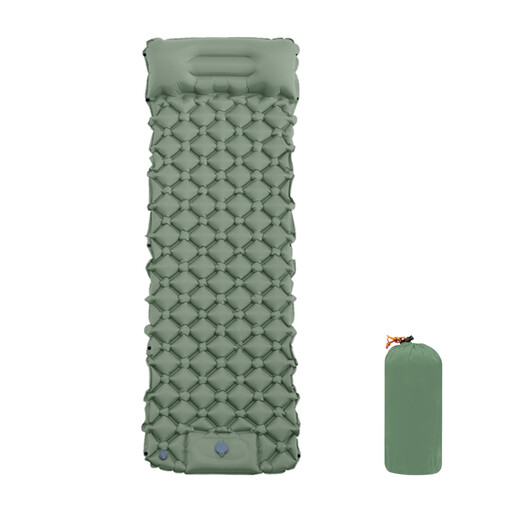
Why it's a great fit: Weighing just 690g with a pack size of 26×10 cm, this pad is ideal for long treks where every gram counts. It fits easily into a backpack without taking up much space.
The egg-crate air cells and 15 cm thickness provide stable support and prevent bottoming out. The dual-layer valve effectively prevents overnight air loss.
Integrated foot pump for fast inflation (approx. 30-60s). The built-in pillow saves you from packing an extra item.
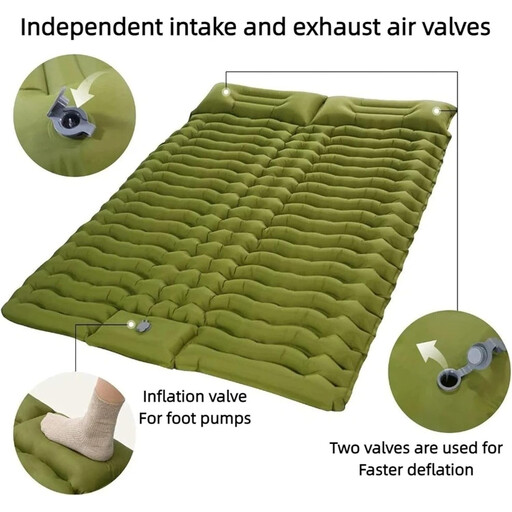
Why it's a great fit: It offers a single, large sleeping surface for two people, eliminating the annoying gap between two individual pads. Ideal for couples or small families sleeping in the same tent.
Despite its size, the pad inflates in under 3 minutes thanks to the integrated foot pump. The 50D Polyester Pongee material is durable and quiet.
Generous double-bed size (200x160 cm) with an integrated pump and pillows. The pack size remains very compact for a double pad at 29x16x16 cm.

Why it's a great fit: For campers who travel by car and prioritise maximum comfort. Its 28 cm height and velvety surface create a bed-like feel that's hard to achieve with traditional sleeping pads.
The internal coil-beam construction ensures a stable sleeping surface, avoiding the wobbly feeling of simple air mattresses. The integrated foot pump makes it independent of power sources.
Exceptional 28 cm height for maximum ground clearance and comfort. The large 2-way valve allows for very fast deflation and packing.
We've compiled a complete, up-to-date list of products that fully meet these strict selection criteria and all applicable safety regulations.
The R-value is a measure of a material's thermal resistance. Simply put: the higher the R-value, the better the pad insulates you from the cold ground. For summer camping (temperatures above 5°C), an R-value of 1-2 is sufficient. For spring or autumn use, values of 2-4 are recommended. For winter camping, R-values above 4 are necessary. Many ultralight inflatable pads have a low R-value and are primarily designed for warmer conditions.
Most high-quality pads come with a small repair kit containing patches and adhesive. To make a repair, inflate the pad and submerge it in water section by section to find the leak (look for rising air bubbles). Mark the spot, deflate the pad, and dry the area thoroughly. Then, apply the adhesive, place the patch over it, and press down firmly. Let the adhesive dry completely before re-inflating the pad.
Yes, but only if it's designed for it. A simple air pad with no internal insulation offers very little protection from the cold ground. For winter use, you need a pad with a high R-value (above 4), which often features down or synthetic fill for insulation. Alternatively, you can combine an inflatable pad with a closed-cell foam pad (like one made of EVA foam) to increase the overall insulation.