
Lieferung heute & morgen

Qualitätsgarantie

Willkommens-Angebote freischalten: KOSTENLOSE Lieferung | Bis zu 80 % RABATT | Kostenlose 30-Tage-JoyPlus-Testphase
App herunterladen
A dead battery or a flat tyre can quickly turn a routine drive into a stressful situation, especially during the cold months when batteries are most vulnerable. A jump starter with a compressor promises an all-in-one solution for such emergencies. However, the market is filled with devices whose advertising claims often suggest more than the technology can deliver. Before you make a decision, it's crucial to understand the most common pitfalls that can lead to a poor purchase.
To make an informed decision, you should focus on the technical specifications that define actual performance and safety.
The Peak Current is the maximum amperage the device can deliver for a very brief moment. More important for the actual starting process, however, is the Cranking Current, which must be sustained for several seconds to turn the engine over.
The capacity of the internal battery, given in milliampere-hours (mAh), determines not only how many times you can provide a jump start but also how long the jump starter power bank can charge your mobile devices like smartphones or tablets.
The maximum pressure rating in PSI or Bar is often a marketing figure. More critical for the practical usability of a jump starter with an air pump is the air flow, measured in litres per minute (L/min).
We have analysed products based on objective parameters that cover the diverse needs of vehicle owners in the UK and Europe.
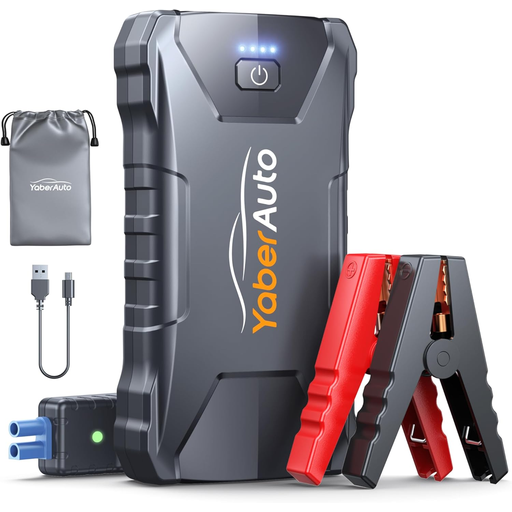
Why This Fits Their Persona: Ideal for drivers of standard gasoline or smaller diesel vehicles who need a straightforward and extremely compact solution. The device fits easily into the glove compartment and provides enough power for everyday emergencies without being overloaded with unnecessary features.
This model avoids the trap of exaggerated peak current ratings. It focuses on a realistic 2000A starting current suitable for gasoline engines up to 7.0L and diesel up to 5.5L, and integrates all 10 essential safety features often missing from budget options.
Extremely compact and lightweight: Weighing only 0.34 kg, it is one of the most portable devices available.
Comprehensive protection: Integrated safety mechanisms against reverse polarity and short circuits with an audible alarm.
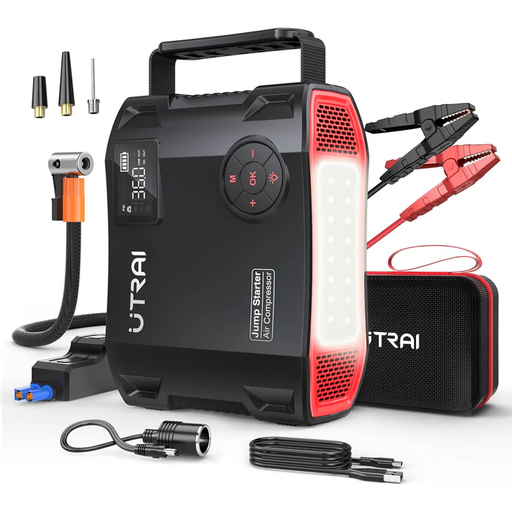
Why This Fits Their Persona: Designed for owners of large SUVs, motorhomes, or boats with high-displacement diesel (up to 10.0L) and gasoline engines. The combination of extremely high peak current, large battery capacity, and a powerful compressor makes it the ideal companion for off-grid adventures.
This device avoids the weak compressor trap. With an air flow of 45 L/min and an automatic shut-off, the compressor is not just a gimmick but a fully functional tool that can inflate a car tyre from 0 to 36 PSI in about 4 minutes.
Enormous Power: 6000A peak current and 27000mAh capacity reliably start even large engines.
Powerful Compressor: 150 PSI with 45 L/min air flow and a preset function.
DC Output: Can power 12V devices like coolers or vacuum cleaners.
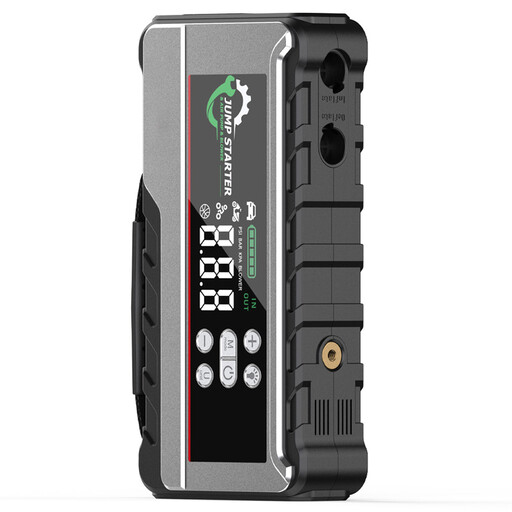
Why This Fits Their Persona: For users seeking a multifunctional powerhouse with the latest charging technology. The ability to fast-charge laptops via PD 65W makes this device a true mobile workstation and an emergency helper in one.
This model solves the problem of slow charging times and limited functionality. While many power banks can only charge smartphones, the Porbi X11 also powers energy-hungry devices like laptops thanks to PD 65W, and it fully recharges itself in about 1.2 hours.
PD 65W Fast Charging: Charges laptops, tablets, and itself extremely quickly.
Multifunctional: Combines a jump starter, compressor, power bank, and even a blower function for inflating and deflating items like air mattresses.
High Performance: 3000A peak current and 24800mAh capacity.
We have compiled a complete, up-to-date list of products that fully meet these strict selection criteria and European safety regulations.
1. How often do I need to charge a jump starter with a compressor? Most manufacturers recommend charging the device every 3 to 6 months, even if it's not used. This is necessary to maintain the health of the lithium-ion battery and ensure it's ready for an emergency. The self-discharge rate of modern devices is low, but not zero. Always follow the instructions in the user manual for your specific model.
2. Can I use a jump starter to revive a completely dead battery? Many modern jump starters feature a "Boost" or "Force Start" function. This is specifically designed to enable a start attempt even on batteries with very low or no residual voltage. This function bypasses some of the automatic safety checks and should be used with caution. However, a jump starter is not a battery charger; it is only meant to start the engine. The car battery must then be recharged by a long drive or an external charger.
3. Is a higher peak current always better? Not necessarily. The peak current must match your vehicle's requirements. An oversized jump starter for a small car offers no practical advantage but is more expensive to purchase. A balanced ratio of peak current, stable cranking current, and the quality of components like the jumper cables and clamps is far more important. Pay attention to the manufacturer's specifications regarding compatibility with your engine (displacement and fuel type).