
Lieferung heute & morgen

Qualitätsgarantie

Willkommens-Angebote freischalten: KOSTENLOSE Lieferung | Bis zu 80 % RABATT | Kostenlose 30-Tage-JoyPlus-Testphase
App herunterladen
A dead battery or a flat tire always happens at the worst possible time. A jump starter with a compressor promises to solve both problems with a single device. But the market is flooded with models making bold claims, and many drivers invest in a unit that fails when they need it most.
As your Joybuy Product Recommendation Officer, I'm here to help you separate the wheat from the chaff. We'll uncover the most common pitfalls and show you which technical specs truly matter, so you can make an informed decision.
Marketing buzzwords often obscure technical shortcomings. Pay close attention to these three points to avoid a costly mistake:
To objectively evaluate the performance of a jump starter with a compressor, you should check three core parameters. These reveal its true suitability for your vehicle and your needs.
The peak current, measured in amps (A), is the maximum current the device can deliver for a short burst to start the engine. A higher number isn't always necessary, but it must be appropriate for your vehicle's engine.
Always check the manufacturer's specifications for compatibility with gasoline and diesel engines (indicated in liters of displacement).
Capacity, listed in milliampere-hours (mAh), determines how many jump starts are possible or how many times you can charge your smartphone. A higher capacity offers more reserves. However, battery stability is more important. Pay attention to information on self-discharge and the recommended charging intervals. Some modern devices use sodium-ion batteries, which, according to manufacturers, have a significantly lower self-discharge rate and a longer cycle life than conventional lithium batteries.
A good 12V car compressor is defined by two key metrics:
A cordless car air pump with a digital display and an auto-shutoff function is especially convenient. You set the target pressure, and the device stops automatically once it's reached. This prevents damage from over-inflation.
Based on these objective criteria, we have identified several models suitable for different needs.
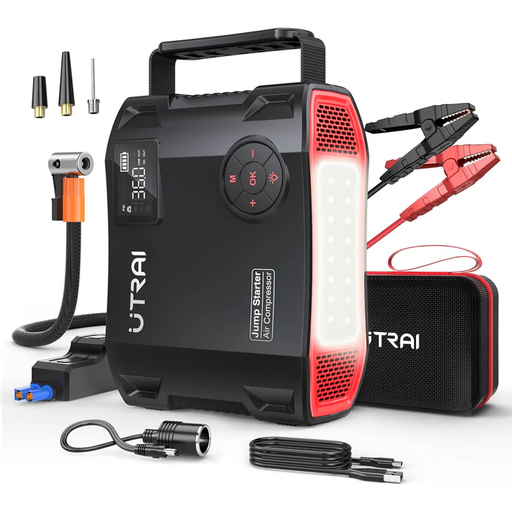
Why This Fits Their Persona: This model is a powerful all-rounder. It offers enough power for most cars and SUVs and features a fast compressor, making it ideal for family cars and commuter vehicles where reliability is a top priority.
With a stated peak current of 6000A and compatibility for diesel engines up to 10.0L, it bypasses the pitfall of being underpowered. The compressor, with its 45 L/min airflow and auto-shutoff, addresses the problem of slow and imprecise pumps.
High battery capacity (27000mAh) for multiple uses. Fast compressor (0 to 36 PSI in approx. 4 minutes, per manufacturer). 160W DC output to power other 12V devices.
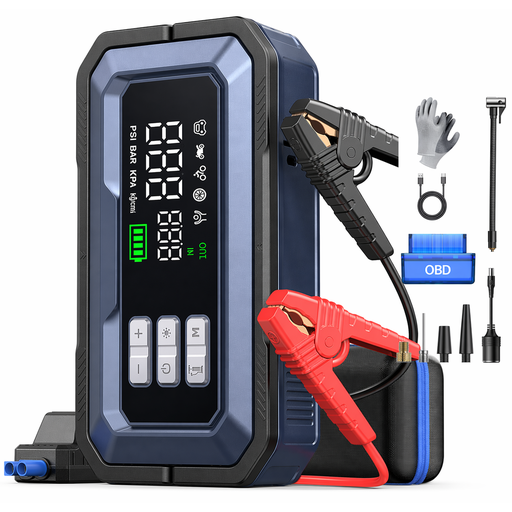
Why This Fits Their Persona: Anyone driving vans, RVs, or vehicles with large-displacement diesel engines needs maximum starting power. This unit is specifically designed for such demanding scenarios and offers additional diagnostic features.
With a stated peak current of 7000A and explicit suitability for diesel engines up to 14L, it is armed against the problem of insufficient power for large engines. The rugged construction and compressor overheat protection ensure reliability.
Extremely high peak current for demanding engines. Integrated OBD2 fault code reader for vehicle diagnostics. Bright 2000-lumen work light with a pivoting panel.
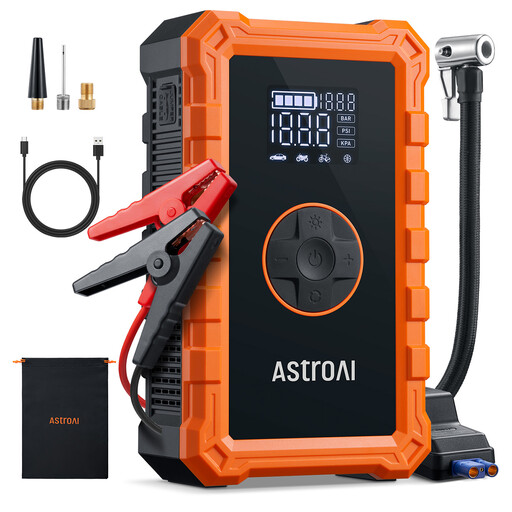
Why This Fits Their Persona: For drivers of small or compact cars who need a reliable solution that isn't overkill. Its compact design and simple operation make it a practical addition to the trunk without taking up much space.
The device offers a realistic 1500A peak current for its specified vehicle class (up to 6.0L gas/3.0L diesel). The compressor includes an auto-shutoff function, which minimises the risk of over-inflation.
Very compact and portable design. Large, easy-to-read 2.4-inch display shows all key information. Five preset modes for the compressor.
We have compiled a complete, up-to-date list of products that fully meet these strict selection criteria.
This largely depends on the battery's self-discharge rate. As a rule of thumb, it's recommended to check the device every 3 to 4 months and recharge it as needed to maintain battery health and ensure it's ready when you need it. Always refer to the manufacturer's specific instructions in the user manual.
Check the jump starter manufacturer's specifications. They typically list the maximum engine displacement for gasoline and diesel engines (e.g., "for up to 8.0L gas and 6.0L diesel engines"). Compare this value with your vehicle's data, which you can find in your vehicle's registration or owner's manual. When in doubt, choosing a model with a little extra performance headroom is a safe bet, especially for diesel engines or for frequent use in winter.
Yes, most of these multi-function devices come with various nozzle adapters. This allows you to inflate not only car tires but also motorcycle and bicycle tires, sports balls, or air mattresses. The preset modes for different applications make it easy to set the correct pressure.