
Lieferung heute & morgen

Qualitätsgarantie

Willkommens-Angebote freischalten: KOSTENLOSE Lieferung | Bis zu 80 % RABATT | Kostenlose 30-Tage-JoyPlus-Testphase
App herunterladen
A dead car battery or a flat tyre always happens at the worst possible time. In those moments, a reliable all-in-one solution is worth its weight in gold. A jump starter with an air compressor promises to be just that: a multifunctional emergency kit for your car that can jump-start your engine, inflate tyres, and often serve as a power bank. But the market is flooded with devices making bold claims. Many drivers invest in a unit only to have it fail when they need it most.
To prevent this from happening to you, we'll highlight the three most common pitfalls when buying and what you really need to look for to make an informed decision.
To avoid falling into these traps, you should check three core technical parameters. These determine whether a jump starter is suitable for your vehicle and your needs.
The Peak Current (Peak Amps) is the initial burst of power the device delivers to turn over an engine. A higher value is generally better, but it must be appropriate for your engine size. More importantly, the device must supply enough power for the entire starting process.
Always check the manufacturer's specifications for compatibility with your petrol or diesel engine's displacement (in litres). A good 12V jump starter should display this information clearly.
An integrated tyre inflator compressor is only useful if it's practical for real-world use. The maximum pressure, often listed as 150 PSI, ensures the device can reach a car tyre's target pressure. However, the crucial metric for efficiency is the airflow rate (L/min).
An automatic shut-off feature, which stops inflation once the preset target pressure is reached, is an important convenience and safety feature.
The jump starter power bank is the heart of the device. Its capacity, often advertised as a power bank with compressor and jump starter, determines how many start attempts are possible or how many times you can charge your smartphone.
Additional features like an integrated LED flashlight with an SOS mode and USB ports for charging mobile devices complete a good car emergency kit.
Here are three recommendations tailored to different user profiles that specifically avoid the pitfalls mentioned.
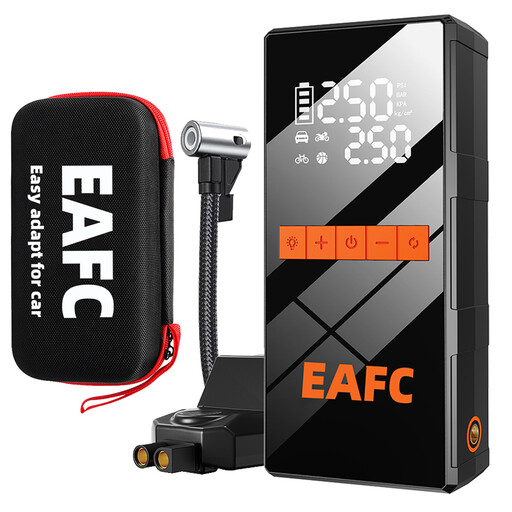
Why it's a good fit: Ideal for drivers of small to mid-size cars who need a reliable and compact 4-in-1 solution for the trunk, without paying for extreme performance specs they don't need.
The performance specs (1200A peak, for up to 4.0L petrol) are realistically tailored for standard cars and don't create false expectations. It's a well-balanced multifunctional device.
Combines a jump starter, compressor, power bank, and LED light in a compact design. The compressor's automatic shut-off prevents over-inflating tyres.

Why it's a good fit: Designed for owners of large-displacement vehicles like SUVs, vans, or RVs who require high and dependable starting power, even for diesel engines.
With 4500A peak current and suitability for up to 9.0L petrol / 8.0L diesel engines, this device delivers the real power that exaggerated marketing claims often only hint at. Its cooling system prevents overheating during demanding tasks.
Very high starting power for large engines. The digital compressor with 5 preset modes and the clear LCD display make operation simple and precise.
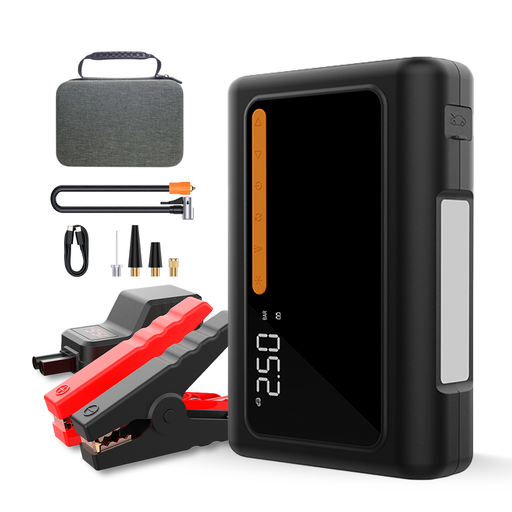
Why it's a good fit: Perfect for drivers who value durability, maximum safety, and reliability in extreme temperatures. The sodium-ion technology is designed for long-term, low-maintenance use.
It addresses the weaknesses of conventional lithium batteries. According to the manufacturer, the battery is fireproof, has an extremely low self-discharge rate (~1% per month), and operates reliably in a temperature range of -40°C to 80°C.
Outstanding longevity (≥ 6,000 cycles) and extreme temperature resistance. The ability to be reactivated even after a deep discharge offers additional peace of mind.
We have compiled a complete, up-to-date list of products that fully meet these strict selection criteria and German safety regulations.
Even when not in use, most manufacturers recommend fully charging the device every 3 to 6 months. This helps maintain battery health and ensures the portable jump starter is ready in an emergency. Models with very low self-discharge, such as those with sodium-ion batteries, require less frequent charging.
Not necessarily. The peak current must match your vehicle's engine. An oversized device for a small car offers no additional benefit, while an underpowered one will fail on a large SUV or van. The key is the manufacturer's stated compatibility with your engine's displacement size.
Yes, that's what these devices are designed for. However, the time it takes depends heavily on the compressor's airflow rate (L/min). A powerful jump starter booster with a high airflow rate can fill a tyre in just a few minutes. Note that these devices are intended for emergency use, not for continuous operation like a workshop compressor.