
Lieferung heute & morgen

Qualitätsgarantie

Willkommens-Angebote freischalten: KOSTENLOSE Lieferung | Bis zu 80 % RABATT | Kostenlose 30-Tage-JoyPlus-Testphase
App herunterladen
A dead car battery or a flat tyre always happens at the worst possible time – usually early in the morning on the way to work or at night on a deserted country road. Relying on roadside assistance isn't just time-consuming; it can also be expensive. A jump starter with a compressor promises a solution, acting as a multifunctional roadside emergency kit. But the market is flooded with devices making grandiose promises. Before you make a decision, it's crucial to understand the common pitfalls that can lead to a bad purchase.
The 2 Most Common Traps When Buying a Jump Starter:
To ensure your device works reliably in an emergency, you should check three core technical features. These determine the performance and safety of your investment.
The power you need depends directly on your vehicle. A small petrol car requires significantly less power than a large SUV with a diesel engine.
A good portable 12V compressor should be able to do more than just inflate footballs.
The jump starter power bank is the heart of the device. Its quality and the integrated protection mechanisms are crucial for safe use. Look for the following safety features:
Instead of making a one-size-fits-all recommendation, we have identified models tailored to specific user profiles.

Why This Fits Their Persona: Ideal for families with larger vehicles like SUVs or vans. The high 4500A output provides peace of mind for reliably starting even large diesel engines (up to 8.0L, according to the manufacturer). The 10 protection features minimise the risk of user error.
The digital compressor with 5 preset modes and automatic shut-off bypasses the trap of an unusable tyre inflator. The performance is designed for common family vehicles and isn't just a marketing gimmick.
High compatibility with petrol (up to 9.0L) and diesel (up to 8.0L) engines. Comprehensive safety package with 10 protection mechanisms.
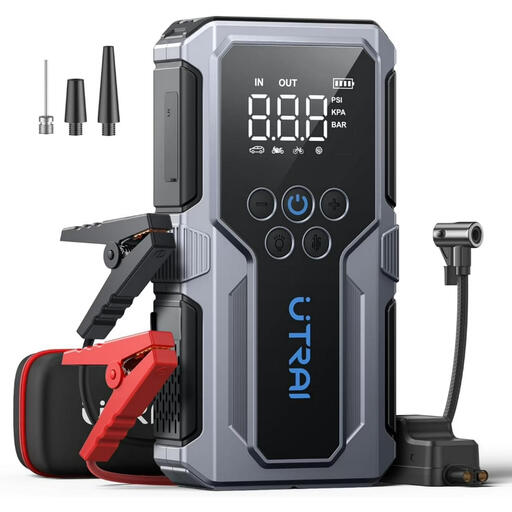
Why This Fits Their Persona: A pragmatic solution for drivers of standard passenger cars or older models who need a reliable basic emergency kit without paying for maximum capacities they won't use. The 3000A is sufficient for most petrol and mid-size diesel engines.
The device features a clear LCD screen to display battery status and tyre pressure, avoiding the guesswork associated with budget units that lack a display. The compressor with automatic shut-off is another key feature here.
Excellent performance-to-price ratio. The integrated power bank function with Quick Charge ports offers practical added value on the go.
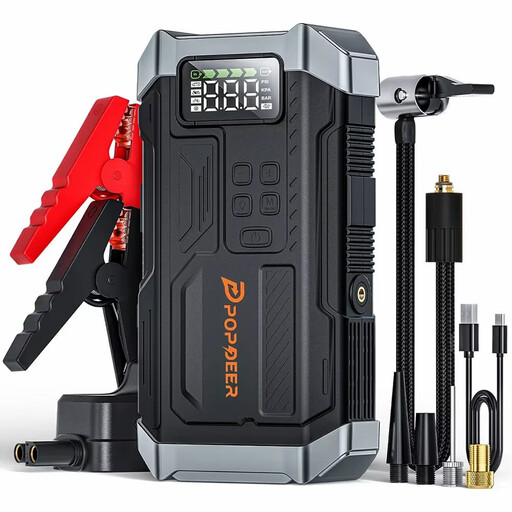
Why This Fits Their Persona: For owners of vans, motorhomes, or high-performance vehicles (up to 10L petrol / 8L diesel, according to the manufacturer). The advanced cooling system is designed for frequent use or demanding tasks like inflating multiple large tyres.
Directly addresses the overheating pitfall with its honeycomb cooling system, which improves heat dissipation. The high amperage is backed by the ability to start even batteries with very low voltage.
Very high power reserves for demanding vehicles. Enhanced thermal management for a longer lifespan and increased safety during intensive use.
We have compiled a complete, up-to-date list of products that fully meet these strict selection criteria.
To maintain battery health, most manufacturers recommend fully charging the device every 3 to 6 months, even if it hasn't been used. Storing the unit in a vehicle at extreme temperatures (e.g., in direct sunlight during summer or in severe frost during winter) can accelerate self-discharge and shorten the battery's lifespan.
Yes, this is possible. However, the performance is not comparable to that of a stationary workshop compressor. Depending on the tyre size and the device's power, inflation can take several minutes. It is important to follow the manufacturer's operating instructions, especially regarding the maximum continuous runtime (e.g., 10 minutes of operation followed by a cool-down period), to prevent the device from overheating.
Not necessarily. The crucial factor is that the device's power matches your vehicle's engine. An oversized unit for a small car offers no practical advantage but is more expensive to purchase. For most standard passenger cars with petrol engines, a device with around 2000A is sufficient. For larger SUVs, vans, or diesel vehicles, models with 3000A or more are a wiser choice to ensure you have enough power reserves, even in adverse conditions.