
Lieferung heute & morgen

Qualitätsgarantie

Willkommens-Angebote freischalten: KOSTENLOSE Lieferung | Bis zu 80 % RABATT | Kostenlose 30-Tage-JoyPlus-Testphase
App herunterladen
The selection of board games for children is vast, and choosing the right one can be a challenge. Many parents and family members look for options that are not only entertaining but also age-appropriate and offer high replay value. This article serves as a guide, presenting a selection of games based on objective criteria like age recommendations, game mechanics, and themes. The goal is to provide you with an informed basis for your next family game night or for choosing a gift for a child.
To find the perfect game, it's helpful to consider a few fundamental aspects. These criteria can narrow down your search and ensure the game meets your expectations.
The manufacturer's age recommendation is a crucial starting point. Games for younger children (around 4-5 years old) often feature simple rules, short play times, and tactile components. For older children, such as with educational games for primary schoolers, the rules can become more complex and require strategic thinking. It is advisable to choose a game that matches the child's current developmental stage to avoid it being either too simple or too overwhelming.
Think about the primary setting in which the game will be played. Are you looking for a two-player game or a family game for up to six participants? The player count is essential for determining if the game is suitable for your family size or the child's circle of friends. The average game duration is also a relevant factor, especially for games for family nights, where the attention span of younger children must be taken into account.
An engaging theme—be it adventure, detective work, or trading—can significantly boost motivation and fun. Many board games for kids also playfully integrate educational benefits. These can include counting spaces, doing maths with play money, recognising colours and shapes, or developing logical thinking skills.
Here is a presentation of three different games that cater to various age groups and interests.
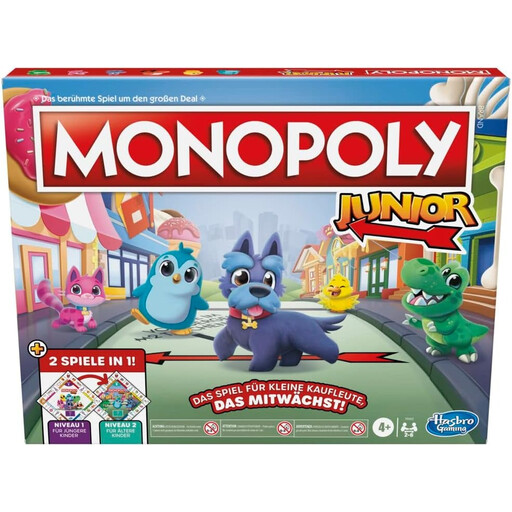
Why it stands out: Monopoly Junior offers a unique feature with its double-sided game board: it grows with your child. One side is designed for children aged 4-5 and focuses on matching and counting, while the second side, for kids aged 6 and up, introduces reading and simple maths.
Pros:
Who is it for? This game is a great choice for families looking for an entry point into the world of classic family board games. It is particularly well-suited for households with children of different ages, as both difficulty levels allow for a shared gaming experience.

Why it stands out: Catan Junior adapts the game mechanics of the famous strategy game "The Settlers of Catan" for a younger audience. The pirate theme and simplified rules make the entry into strategic board games accessible and exciting.
Pros:
Who is it for? Catan Junior is aimed at kids' games from age 6 and is perfect for young players ready for their first strategy game. It's an excellent option for families seeking a game with more interaction and planning elements that still remains easy to understand.

Why it stands out: This version of Cluedo modernises the classic detective game with a revised story, new characters, and additional clue cards that can speed up the gameplay. The objective remains to solve a crime through logical deduction.
Pros:
Who is it for? Cluedo is designed for children aged 8 and up and families who enjoy puzzles and detective stories. It is an exciting game for evenings together and a fitting gift for kids in primary and early middle school who love to solve mysteries.
This selection represents just a small fraction of the available board games for kids. Every family and every child has individual preferences. If you are looking for more ideas, games for other age groups, or specific themes, you will find a broader selection in our Board Games for Kids category.
For children aged 6 and up, games that introduce initial strategic elements without being too complex are suitable. Catan Junior is an example where collecting and trading resources are practised in a fun way. The second level of Monopoly Junior, which requires reading and maths, also fits well into this age group.
To find a suitable gift for a child, use the criteria mentioned above: age, interests (theme), and the typical number of players. A game that incorporates the child's favourite themes (e.g., pirates, detectives, animals) is often a big hit. Also, consider whether the child is more likely to play with friends or with family.
Many classics have been specially adapted for children. Monopoly Junior simplifies the rules of the original, making it accessible to younger players. The new edition of Cluedo retains the core of the game but modernises the story and materials. Such junior or family versions are often a great way to bring generations together at the game table.