
Lieferung heute & morgen

Qualitätsgarantie

Willkommens-Angebote freischalten: KOSTENLOSE Lieferung | Bis zu 80 % RABATT | Kostenlose 30-Tage-JoyPlus-Testphase
App herunterladen
A well-chosen children's bookshelf is more than just a piece of furniture. It creates order, promotes your child's independence, and can spark a joy for reading. But the market is full of models that seem practical at first glance, yet prove to be unsuitable or even unsafe in daily use. Before you make a decision, it's important to know the most common pitfalls to make a durable and sensible choice for the bookshelf in your child's room.
Many shelves are advertised with appealing images, but their true weaknesses only become apparent after a few months of use. Pay special attention to these three points:
To avoid a bad buy, you should base your decision on objective features. These three parameters are essential for a safe and functional shelf for kids.
Safety is the top priority. A stable children's bookshelf must either have a wide, sturdy base or be securely fastened to the wall. Look for the following features:
A good shelf is tailored to the child's size and abilities. A Montessori shelf is characterized by presenting books with the cover facing forward. This allows children to visually recognize the books and select them independently. The low height ensures that even toddlers can reach their treasures without help. This accessibility not only promotes independence but also an early sense of order.
Modern children's room furniture needs to be flexible. A good shelf often doubles as a toy shelf. Models with a combination of open shelves for books, larger boxes for toys, and perhaps even hooks for bags or clothes offer a comprehensive organizational solution. A simple children's shelf in white blends harmoniously into almost any room design and can be used for many years. A wall shelf in the child's room is an excellent option to save valuable floor space while creating storage.
Instead of naming a single "best" model, we present various shelves here that are suitable for different needs and room situations.
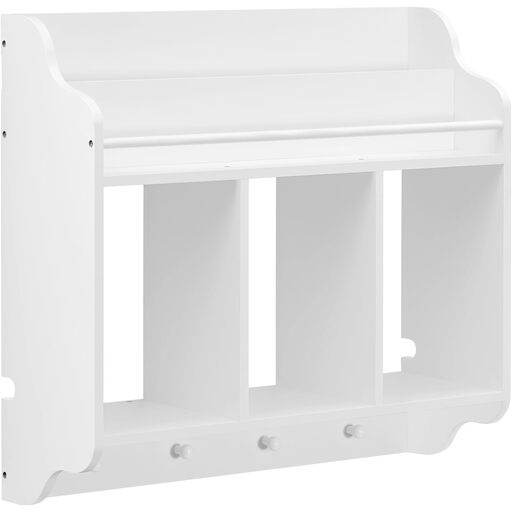
Why this model is a good fit: Ideal for smaller children's rooms where you want to keep the floor clear. It combines book ledges, open compartments for figures or toys, and four hooks for bags or jackets—a thoughtful all-in-one solution.
The secure wall mounting eliminates the tipping hazard. The rounded corners and the additional bar on the top shelf, which prevents items from falling, directly address safety concerns.
High functionality in a small footprint thanks to the combination of shelf space and hooks. The material (E1 class MDF) meets common standards for children's furniture.
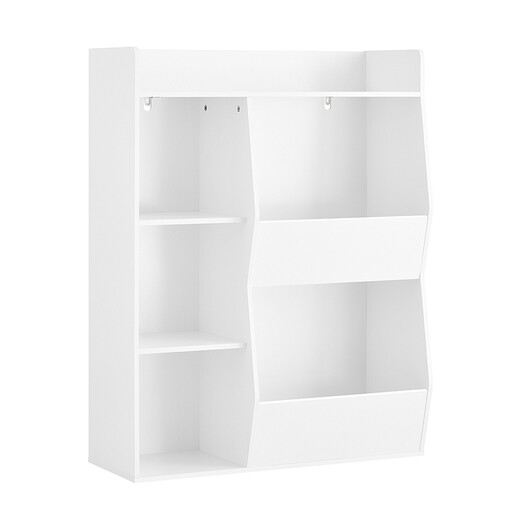
Why this model is a good fit: With its 104 cm height and five open compartments, this shelf is consistently designed around the needs of children. It allows them to independently reach and put away toys and books.
The design with open, easily visible compartments avoids the pitfall of impractical depth. According to the manufacturer, the corners are rounded and an anti-tip device is included, covering the key safety aspects.
Actively promotes the child's independence and sense of order. The clear structure and child-friendly height make it an educationally valuable piece of furniture.
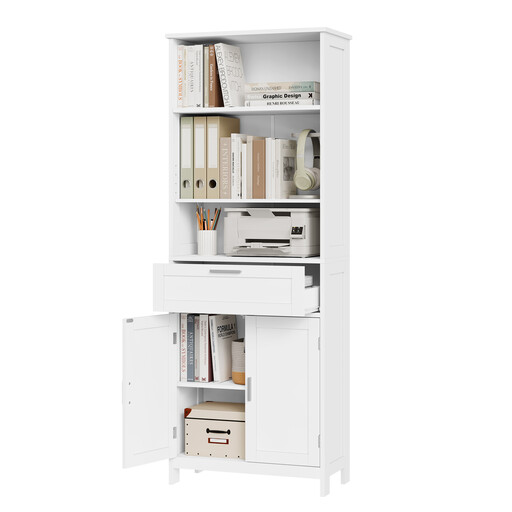
Why this model is a good fit: Although labelled as a bathroom cabinet, this tall shelf is excellent for children's rooms with lots of toys, books, and craft supplies. The combination of open shelves, a drawer, and a closed cabinet section helps maintain order.
The included anti-tip device is essential at this height and is provided by the manufacturer. The adjustable shelves solve the problem of impractical compartments, as they can be adapted to the size of books or toy boxes.
Maximum storage flexibility through the combination of different storage types (open, closed, drawer) and adjustable shelves.
We have compiled a complete, up-to-date list of products that meet these strict selection criteria and safety requirements.
A low, easily accessible shelf is useful for children as young as 12 to 18 months. As soon as a child can stand and grasp things steadily, they can learn to select books themselves and (with a little help) put them away again. This promotes motor skills and independence from an early age.
Always use the anti-tip device provided by the manufacturer. This usually consists of a bracket or a strap that is screwed to the shelf and the wall. Choose wall plugs and screws that are suitable for your wall type (e.g., concrete, drywall). The fastening should be done in the upper third of the shelf to effectively minimise the leverage effect and thus the risk of tipping.
The main advantage of a Montessori shelf lies in its presentation and accessibility. Books are displayed with their covers facing forward, which is more visually appealing to children than a narrow book spine. The low-profile design allows the child to access their books without assistance. This builds self-confidence and fosters a positive, self-directed relationship with reading and order.