
Lieferung heute & morgen

Qualitätsgarantie

Willkommens-Angebote freischalten: KOSTENLOSE Lieferung | Bis zu 80 % RABATT | Kostenlose 30-Tage-JoyPlus-Testphase
App herunterladen
A well-organised child's room fosters their independence and creativity. The right kids' bookshelf is a key element for keeping books and toys tidy. However, the selection is vast, and not every model that looks appealing is practical and safe for daily use. Many parents quickly realise their purchase was a compromise. This guide will show you what to look for to avoid common buying mistakes and find a durable, long-lasting solution.
Buying a shelf for a child's room seems straightforward, but certain flaws often only become apparent with daily use. Watch out for these three typical weak points to avoid a bad investment.
To find a functional and safe storage shelf for kids, you should carefully examine three technical features. These define a model's quality and everyday practicality.
Safety is the highest priority. An essential feature is an anti-tip kit that allows the shelf to be securely anchored to the wall. Make sure this is included with your purchase. Equally important are rounded corners and edges to minimise injuries during play. The material used, often MDF (Medium-Density Fibreboard), should meet at least the E1 emission standard. This ensures that formaldehyde emissions do not exceed health-safe limits. A solid back panel also contributes to overall stability.
A good bookshelf in a child's room is designed so that children can independently reach and put away their treasures.
A child's room is a place for playing, drawing, and the occasional spill. The shelf's surfaces should therefore be robust and easy to clean.
Instead of making a one-size-fits-all recommendation, we have identified models that meet specific family needs and adhere to the quality criteria mentioned.
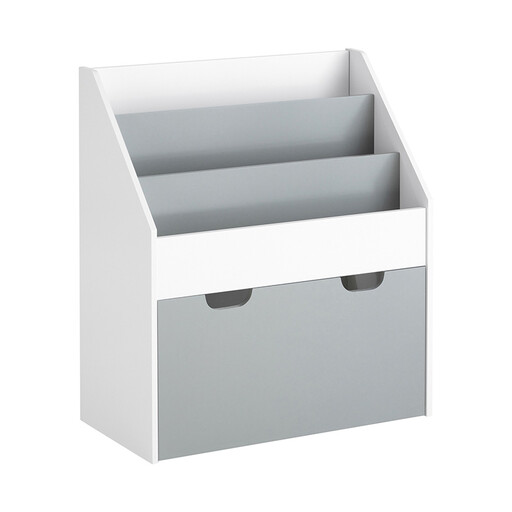
Why this model is a great fit: Perfect for parents looking for an all-in-one solution. This shelf with a toy box combines open compartments for books with a large, removable chest for building blocks, dolls, and other toys. It helps children learn to distinguish between different types of toys and tidy up systematically.
The low height of 70 cm and the open compartments are easily accessible for toddlers. The combination of book sections and a separate toy box prevents everything from disappearing unsorted into deep compartments.
The toy box is equipped with (removable) castors, which makes tidying up easier. The shelf features rounded edges, and according to the manufacturer, an anti-tip kit is included.
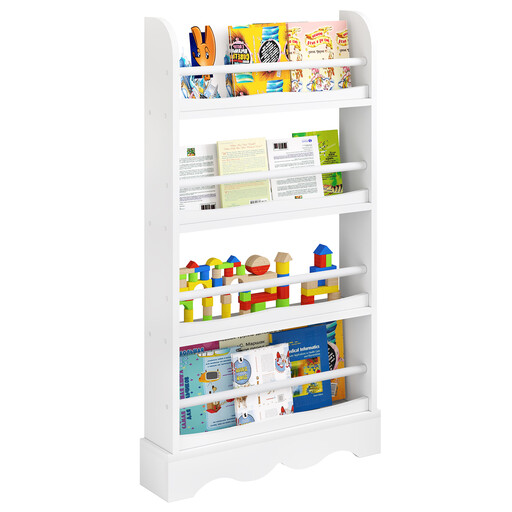
Why this model is a great fit: Perfect for smaller kids' rooms or nooks. With a depth of only 12 cm, this shelf makes optimal use of wall space without taking up valuable floor area. It's a classic solution for a dedicated bookshelf in a child's room.
The shallow depth and front retaining bars ensure that books remain visible and within reach, rather than sliding to the back. The design is engineered for wall stability, and an anti-tip kit is included, according to the manufacturer.
Made from P2-grade MDF with rounded corners. The height of 108.5 cm is easily reachable for preschoolers. The smooth, water-resistant surface is easy to maintain.
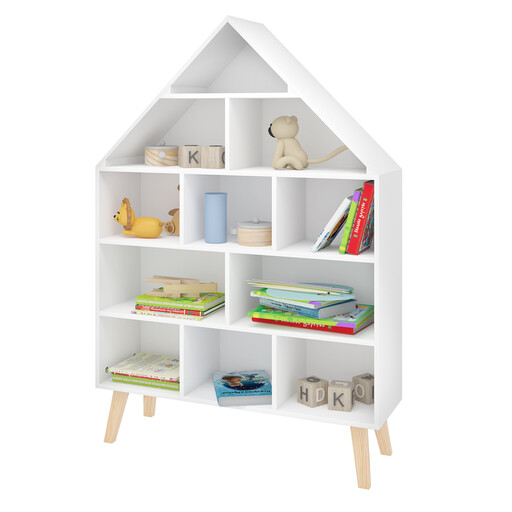
Why this model is a great fit: For families who want the toy shelf to also be a design statement. The playful house shape fits charmingly into the room's decor and motivates children to tidy up, thanks to its appealing design.
Despite its design, functionality and accessibility are prioritised. The 11 compartments of various sizes are open and easy for children to reach, avoiding the problem of impractically deep storage spaces.
The construction, featuring E1-grade MDF boards and solid pine wood legs, ensures stability. According to the manufacturer, the water-based paint is non-toxic and easy to clean.
We have compiled a complete, up-to-date list of products that fully meet these strict selection criteria and local safety regulations.
1. How do you securely attach a kids' shelf to the wall? Any kids' shelf that could pose a tipping hazard must be anchored to a solid wall (not unreinforced drywall) using the provided anti-tip kit. Strictly follow the manufacturer's assembly instructions. Use wall plugs and screws appropriate for your wall type. Check the connection for tightness regularly.
2. From what age is an open toy shelf useful? An open, low-profile shelf is beneficial for children from around 18-24 months. At this age, they begin to purposefully reach for objects and develop their motor skills. Such a shelf, often called a Montessori shelf, promotes independence, as the child can access their toys and books without parental help.
3. What is the most practical material for a kids' shelf? For most families, a high-quality coated MDF board (E1 class) is the most practical choice. It offers a great balance of stability, ease of maintenance, and cost. The surface is resistant to scratches and easy to clean, which is a crucial advantage in a home with children.