
Lieferung heute & morgen

Qualitätsgarantie

Willkommens-Angebote freischalten: KOSTENLOSE Lieferung | Bis zu 80 % RABATT | Kostenlose 30-Tage-JoyPlus-Testphase
App herunterladen
An organized child's room, where books and toys have their own designated place, is often easier said than done. The search for the right piece of furniture can be a challenge: it should be safe, practical, and ideally, foster your child's independence. A well-chosen kids' bookshelf is more than just a storage unit—it's a cornerstone for developing an early love of reading and a sense of order.
This article serves as your guide. We will introduce you to various concepts and explain which criteria are important when selecting a shelf for your child's room bookshelf. Our goal is to provide you with an informed basis for your decision, so you can find the perfect model to meet your family's needs.
Before you decide on a model, several fundamental aspects should be considered. These criteria help to objectively evaluate the functionality and safety of a shelf.
Safety in a child's room is the top priority. Look for a sturdy construction with rounded corners and edges to minimize the risk of injury. A crucial safety feature is an anti-tip device, which securely anchors the shelf to the wall. This prevents the furniture from tipping over if a child attempts to climb on it.
For materials, panels like MDF (E1) are a common choice. The E1 classification indicates that the material is low-emission and meets European standards for indoor use.
A low-profile kids' bookshelf allows even the youngest children to select and put away their books independently. Models designed according to Montessori principles often feature a distinctive characteristic: the books are displayed with the cover facing forward.
This design of a Montessori shelf makes it easier for children who can't yet read to recognize their favorite stories by the cover. This direct accessibility promotes autonomy and an interest in books.
Consider what else needs to be stored besides books. Many families need a combined solution for nursery storage. A multifunctional toy shelf or a kids' shelf with a toy box can be a very practical solution here. Such models offer compartments for books and, at the same time, bins or boxes for building blocks, dolls, and other toys. This helps create a clear sense of order and makes tidying up a simple ritual.
Based on the criteria mentioned above, we have compiled a selection of functional and thoughtfully designed kids' bookshelves.
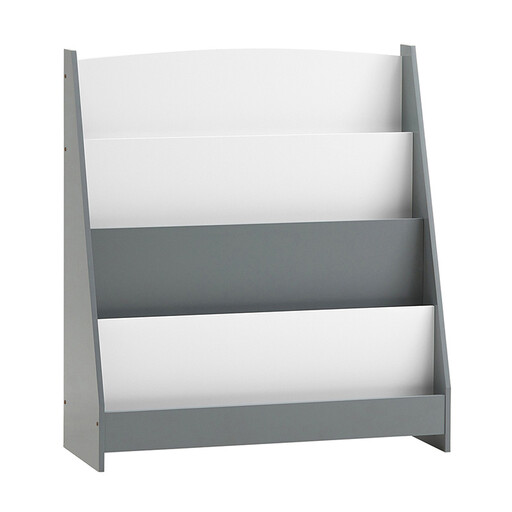
Why it stands out: This shelf is consistently designed to promote independence. The four front-facing compartments allow children to easily recognize book covers and reach their favorite books without assistance. With a height of 88 cm, it is easily accessible for toddlers and preschoolers.
Advantages:
Who is it for? For parents looking for a classic Montessori shelf to specifically encourage their child's love of reading and independence. It is ideal for displaying picture books.
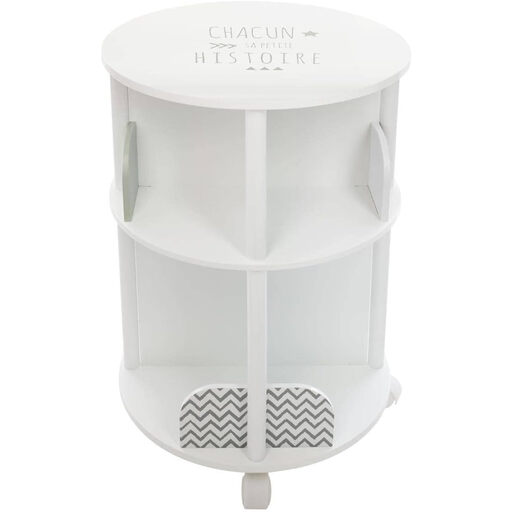
Why it stands out: The standout feature of this shelf is its mobility. Thanks to the mounted casters, it can be moved flexibly around the room—practical for rearranging the play corner or creating space while vacuuming. The round design is space-saving yet offers easily accessible storage.
Advantages:
Who is it for? For families who appreciate a flexible and mobile storage solution. It's a great choice for dynamic room layouts or smaller children's rooms where furniture needs to be multifunctional.
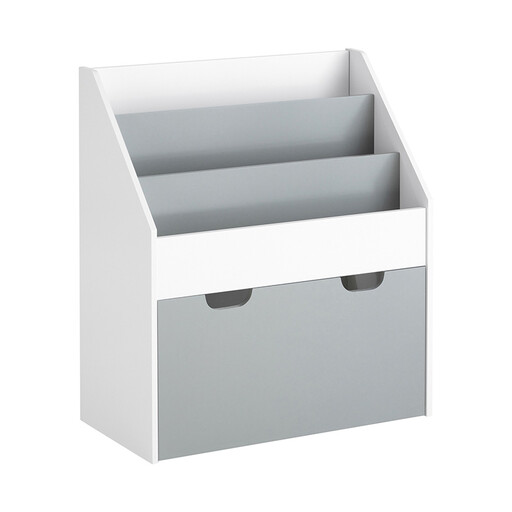
Why it stands out: This model is an all-in-one solution for nursery storage. It combines three book compartments with a large, removable toy box on casters. At 70 cm high, it is an especially low-profile bookshelf, making it ideal for the youngest children.
Advantages:
Who is it for? For parents looking for a compact and multifunctional solution for books and toys. It is particularly well-suited for the rooms of toddlers and preschoolers to help keep things tidy.
Haven't found the perfect model for your needs yet? Every child's room is different, and needs can vary. If you are looking for other styles, sizes, or colors, you can find additional inspiration in our collection.
Discover more models in our Gray Shelves category.
1. From what age is a kids' bookshelf useful? A low, accessible bookshelf is useful for children from around 18 to 24 months. As soon as a child can stand and walk confidently, they can learn to take books from a shelf and put them back independently. This promotes motor skills and self-reliance.
2. What defines a Montessori shelf? A Montessori shelf is primarily characterized by displaying books with their covers facing forward. This allows children who cannot yet read to recognize and select books based on the pictures. Additionally, these shelves are typically low and easily accessible for children to foster their independence.
3. How do I securely mount a bookshelf to the wall? Most shelves designed for children come with an anti-tip kit. This kit usually consists of a bracket or a strap that is attached to the shelf and the wall. It is crucial to follow the manufacturer's assembly instructions carefully and use wall plugs and screws appropriate for your wall type to ensure a stable and secure anchor.