
Lieferung heute & morgen

Qualitätsgarantie

Willkommens-Angebote freischalten: KOSTENLOSE Lieferung | Bis zu 80 % RABATT | Kostenlose 30-Tage-JoyPlus-Testphase
App herunterladen
The world of detectives, secret agents, and unsolved mysteries fascinates many children. Inspired by heroes like "The Three Investigators," they want to conduct their own investigations. A well-chosen kids' detective kit can turn this enthusiasm into a creative and educational hobby. However, the market is flooded with products, and not all of them live up to their promises. Before you invest in a children's detective case, it's crucial to know the common pitfalls that can quickly turn excitement into frustration.
To find suitable and durable secret agent gear, it helps to pay attention to a few key features. These objective criteria will help you evaluate a product's quality beyond its marketing promises.
The complexity of a detective set should match the child's age and abilities. For children around 8 years old, a focused kit, such as one for lifting fingerprints, is often a great starting point. Older children (10–12 years) might enjoy more complex challenges, like a The Three Investigators detective set with chemical experiments or electronic components. Pay close attention to the manufacturer's age recommendation. Equally important is the CE marking, which confirms the product meets EU safety standards. For kits containing small parts or chemicals, the corresponding warnings (e.g., "Not suitable for children under 3 years") are mandatory and should be taken seriously.
The value of a detective toy lies in its function. Before buying, consider the primary purpose of the gear:
A toy's durability often depends on the materials used. A children's detective case made of sturdy plastic or even metal will withstand more than a flimsy cardboard box. For electronic devices, check the battery requirements. Find out which battery type (e.g., AA, AAA) is needed and whether batteries are included. This helps avoid disappointment upon unboxing and allows you to estimate follow-up costs.
Based on these criteria, we have selected a few products suitable for different types of budding investigators.

Why This Fits Their Persona: Ideal for kids taking their first steps into detective work. The set focuses on one core task—securing fingerprints—making it easy to understand and ready to use right out of the box.
This kit isn't overloaded. It contains exactly what's needed for fingerprint analysis: powder, a brush, and lifting tapes. The sturdy metal tin protects the contents and prevents parts from getting lost.
Focuses on a classic detective technique. The high-quality metal tin provides secure storage and is built to last.
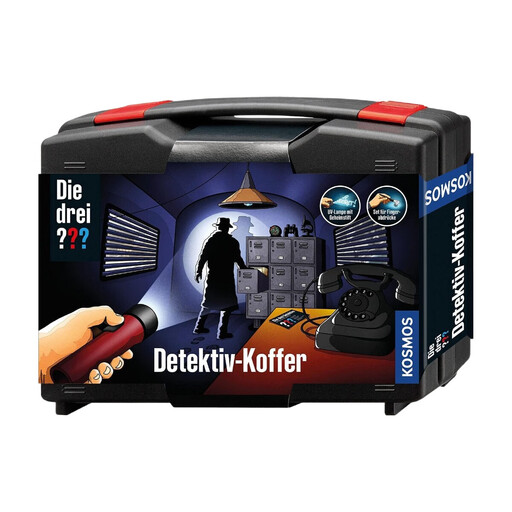
Why This Fits Their Persona: This set is a dream come true for any fan of the book and audio drama series. It's a comprehensive detective case that allows kids to emulate the methods of their heroes, Jupiter, Peter, and Bob.
Instead of just one function, this case offers a wide range of tools, from a UV light and a plaster cast kit to code wheels. The detailed manual, complete with pro tips and specific cases, ensures long-lasting fun and avoids frustration from unclear instructions.
Comprehensive kit with over 30 pieces in a sturdy case. It promotes logical thinking and creativity through guided criminal cases.

Why This Fits Their Persona: Perfect for inquisitive kids who want to go beyond simple role-playing and learn the scientific methods of forensic science. It combines play with real experiments.
This set combats boredom by offering depth. Instead of just providing props, it delivers a real lab station with pH test strips, chemicals, and a UV lamp for forensic analysis. The manual introduces the experiments through exciting short stories.
Combines role-playing with scientific experimentation. Fosters an understanding of chemistry and forensics in a fun, engaging way.
We have compiled a complete, up-to-date list of products that fully meet these strict selection criteria and rigorous safety standards.
1. From what age is detective toy gear appropriate? Most manufacturers recommend their detective kits for children aged 8 and up. At this age, fine motor skills and cognitive understanding are typically developed enough to handle the tools and understand the instructions. Simpler sets are available for younger children, while more complex lab kits are better suited for kids aged 10 or 12.
2. What's included in a typical kids' detective case? A basic children's detective case often includes a magnifying glass, fingerprinting materials (powder and a brush), evidence bags, and a notebook. More comprehensive kits may contain additional gear like a UV lamp with an invisible ink pen, plaster for casting track impressions, code wheels, or even electronic spy toys like a door alarm or a listening device.
3. Do electronic detective gadgets require special batteries? Most electronic detective toys use standard batteries like AA or AAA. Some smaller devices, like a spy watch, may require button cell batteries (e.g., CR2032). It's wise to check the product description before purchasing to ensure you have the right batteries on hand, as they are often not included.