
Lieferung heute & morgen

Qualitätsgarantie

Willkommens-Angebote freischalten: KOSTENLOSE Lieferung | Bis zu 80 % RABATT | Kostenlose 30-Tage-JoyPlus-Testphase
App herunterladen
Owners of large cat breeds like Maine Coons or those with multiple cats know the problem: a conventional cat tree is often too small, unstable, or doesn't offer enough variety. It wobbles when a heavy cat jumps on it, the perches are too cramped, and the scratching posts wear out quickly. The result is an unused piece of furniture and sofas that continue to get scratched.
This article serves as a buyer's guide to simplify the selection of a suitable model. It highlights the crucial criteria for a large cat tree and presents various models tailored to the needs of large or multiple cats. The focus is on objective features like stability, material quality, and functionality.
Choosing the right model depends on several factors. The following three points are especially important for creating a durable and safe environment for your cat.
A stable cat tree is the fundamental requirement, especially for large and heavy cats. Look for a wide and heavy base plate, as it forms the foundation for the entire structure. Models with a reinforced base offer additional security. The overall weight of the cat tree is also a good indicator of its stability. Many large models also come with an anti-tip kit, which allows the cat tree to be secured to the wall. This is a sensible measure, particularly for floor-to-ceiling versions or in households with very active pets.
A cat tree for large cats must offer ample space. The lounging areas should be large enough for a full-grown cat to stretch out comfortably. Platforms with a side length of over 40 cm are a good benchmark here. A cat tree with a condo and perch should be designed so that even large animals can get in and out with ease. For households with multiple cats, models with various levels and several retreats are ideal to prevent competition for the best spots. An XXL cat tree typically offers such variety.
The primary function of a cat tree is claw maintenance. Ensure there is a sufficient number of scratching posts fully wrapped in durable sisal. The diameter of the posts should also be considered; thicker posts are generally more durable and offer more resistance. Additional scratching furniture for indoor cats, such as integrated scratching boards or ramps, encourages natural scratching behaviour and helps protect your furniture.
Based on the criteria mentioned above, we have compiled a selection of models that are well-suited for demanding cats and their owners due to their construction and features.
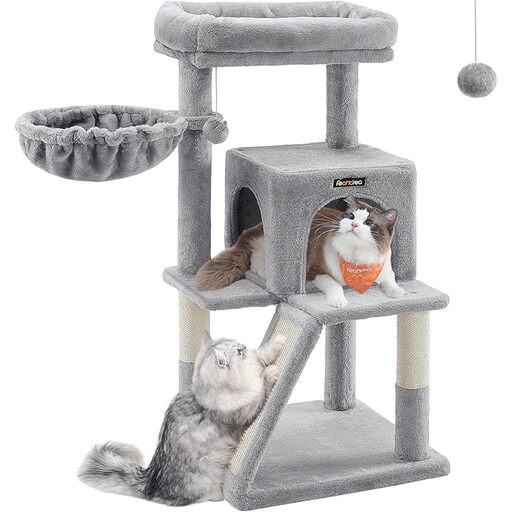
What sets it apart: This model is specifically designed to meet the needs of large or heavy cats. The extra-wide and well-padded top perch offers superior comfort, while the integrated scratching ramp makes climbing easier.
Pros:
Best for: Ideal for owners of a single large cat or for senior cats who can benefit from the easily accessible ramp.
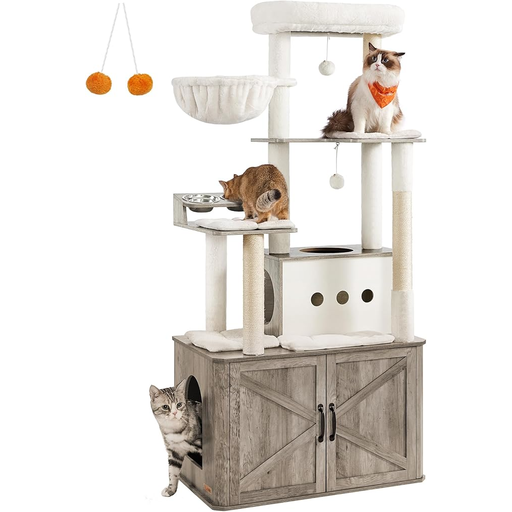
What sets it apart: This model is an all-in-one solution that combines a cat tree, a hidden cabinet for a litter box, and a feeding station. It's a space-saving and aesthetically pleasing option for modern living spaces.
Pros:
Best for: Cat owners with limited space who are looking for a multifunctional solution that combines several pieces of cat furniture into one.

What sets it apart: At a height of 206 cm, this XXL cat tree is a true climbing paradise. It was specially developed for households with multiple or very active cats and offers an abundance of scratching, playing, and resting zones.
Pros:
Best for: Perfect for households with multiple cats or for owners of very large and active breeds who need maximum enrichment opportunities.
If the models presented here don't exactly match your requirements, or if you'd like to compare other styles and sizes, you can find a wider selection in our category. Discover more models that fit your living space and your cat's needs.
Find more models in the Cat Trees & Condos category here
The best method for stabilization is to use the included anti-tip kit to secure it to a wall. Always place the cat tree on a level, solid surface, ideally in a corner of the room to give it support from two sides. Regularly check that all screws are tightened securely.
For a Maine Coon or a similarly large breed, three features are crucial: a large, heavy base plate for maximum stability, perches with an edge length of at least 45 cm, and thick scratching posts (ideally over 9 cm in diameter) that can withstand the cat's weight and strength.
Yes, a single but well-equipped cat tree for multiple cats can be sufficient. The key is that it offers several attractive resting spots at different heights, so both animals can find an undisturbed retreat at the same time. Multiple scratching posts are also beneficial to prevent competition.