
Lieferung heute & morgen

Qualitätsgarantie

Willkommens-Angebote freischalten: KOSTENLOSE Lieferung | Bis zu 80 % RABATT | Kostenlose 30-Tage-JoyPlus-Testphase
App herunterladen
Tripping hazards in the hallway, disorganised piles of shoes in the bedroom, or a lack of suitable storage space—many households know the challenge of keeping a growing shoe collection tidy and accessible. A modular shoe rack system offers a flexible and customisable solution. These systems allow you to make the most of your available space, whether in a narrow niche, under a staircase, or as a floor-to-ceiling structure.
As your Joybuy Product Recommendation Officer, I have analysed various models and concepts to provide you with objective guidance. This article introduces different types of interlocking systems and explains what to look for when making your choice to find a suitable and durable solution for your needs.
Before you decide on a model, a few basic considerations are helpful. The following points are based on objective product features and will help you evaluate the functionality of different systems.
Most modular shoe racks consist of plastic panels (often polypropylene, PP) and connectors (usually made of ABS plastic). Look for models where the panels are enclosed by a metal frame. This frame significantly increases the stability and the maximum load capacity per compartment. A pure all-plastic shoe cabinet model without metal reinforcement is lighter but is better suited for lighter footwear like sandals or trainers. The quality of the material is crucial for longevity and prevents the compartments from deforming under load.
The main advantage of an interlocking system is its flexibility. A modular shoe rack can be assembled in various shapes—tall and narrow for a corner, wide and low for a space under a coat rack, or even in a stepped configuration. Check if the system allows for a flexible arrangement of compartments and if dividers can be removed. This is particularly important if you want to store boots, ankle boots, or other bulky items in addition to low-cut shoes. Such a space-saving shoe cabinet adapts to your spatial conditions, not the other way around.
The decision between an open interlocking shoe rack and shoe storage with doors depends on your priorities.
Here is a selection of products that stand out for their specific features and applications.
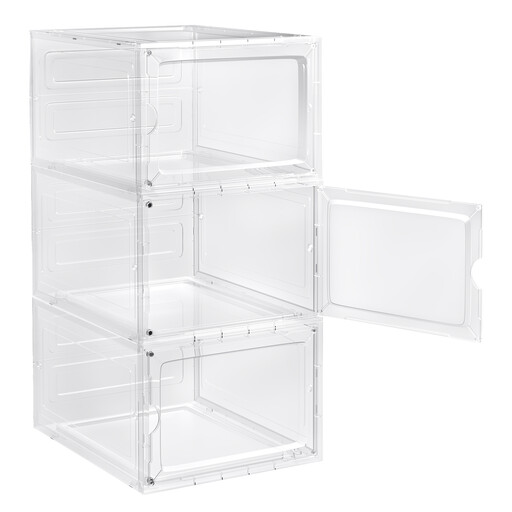
Why It Stands Out: This set of three individual boxes is the ideal solution for anyone who wants to build their collection gradually and remain flexible. The shoe boxes are stackable and can be connected both vertically and horizontally thanks to a locking mechanism. The fully transparent design with a magnetic front door turns them into a display for special shoes while allowing quick access without having to unstack the boxes.
Advantages:
Who Is It For? Ideal for trainer collectors who want to display their favourite pairs dust-free. It's also practical for individuals with a smaller shoe collection looking for an aesthetic and expandable storage solution for their dressing room or wardrobe.
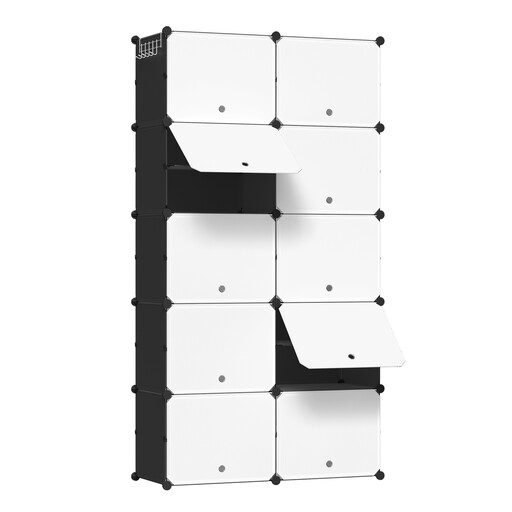
Why It Stands Out: With a capacity for up to 40 pairs of shoes, this system is a comprehensive solution for the entire household. The 10 compartments can be customised thanks to removable dividers, creating space for boots or bags. Additional hooks on the sides offer practical storage for umbrellas, keys, or totes. The construction of PP panels, ABS connectors, and a metal frame ensures the necessary stability.
Advantages:
Who Is It For? Perfect for families or individuals with a large shoe collection who need a central, high-capacity storage solution. As a shoe cabinet for the hallway, basement, or dressing room, it provides maximum organisation within a compact footprint.
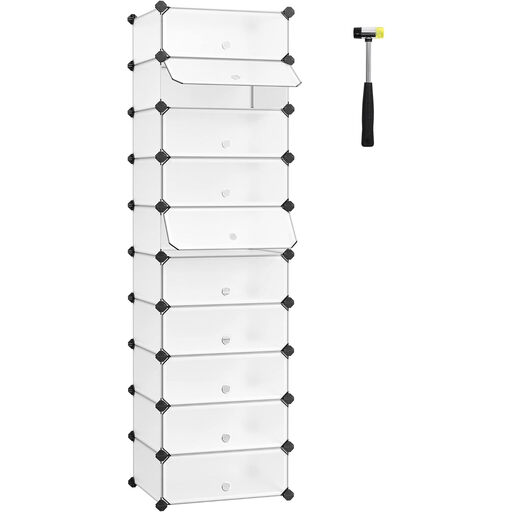
Why It Stands Out: This tall and narrow rack is a prime example of a space-saving shoe cabinet. With its dimensions of 43 x 173 x 31 cm, it makes optimal use of the room's height. The 10 compartments are equipped with semi-transparent doors that discreetly conceal the contents while still allowing for quick identification. Assembly is tool-free and simplified by numbered parts and illustrated instructions.
Advantages:
Who Is It For? An excellent choice for residents of apartments or rooms with limited floor space. This shoe organiser is perfect for the bedroom or entryway to efficiently utilise vertical storage.
The products featured cover common use cases. However, if you are looking for specific components or other storage solutions with similar materials, exploring related categories might be helpful. A wider selection of elements, such as sturdy plastic doors for furniture or DIY projects, can also be found in our range.
1. How stable is a modular shoe rack system made of plastic? Stability largely depends on the construction. Models that combine PP panels with a surrounding metal frame and ABS plastic connectors offer high structural integrity. It is important that all parts are assembled correctly and securely. Also, pay attention to the maximum load capacity per compartment specified by the manufacturer and avoid overloading to ensure the rack's longevity.
2. Can you also store boots or high-top shoes in an interlocking rack? Yes, many modular systems are designed for this. Models like the featured WOLTU shoe cabinet offer removable divider panels. By omitting one or more of these panels, you create taller compartments that are ideal for boots, ankle boots, or even handbags. Check the product description for this feature before purchasing.
3. Are shoe racks with doors better than open systems? There is no one-size-fits-all answer; the choice depends on your needs. Racks with doors protect your shoes from dust and UV light and create a calm, tidy overall look. Open racks or transparent boxes offer better ventilation and quicker access. For a dusty basement or a presentable hallway, doors are often the more practical choice, while an open system may be advantageous in a well-ventilated dressing room.