
Lieferung heute & morgen

Qualitätsgarantie

Willkommens-Angebote freischalten: KOSTENLOSE Lieferung | Bis zu 80 % RABATT | Kostenlose 30-Tage-JoyPlus-Testphase
App herunterladen
The number of electronic devices per person is constantly increasing. For commuters, field service professionals, and families, devices like smartphones, tablets, laptops, and navigation systems have become indispensable for daily travel. The standard charging ports included in vehicles often fall short of this demand. A multi-port car charger provides a functional solution to power multiple devices simultaneously. This article analyses the technical criteria relevant to selecting such an adapter.
The selection of a suitable charger should be based on an analysis of objective technical parameters. The following criteria are crucial for making an informed decision.
The total power output, measured in watts (W), defines the maximum amount of power the charger can deliver to all connected devices simultaneously. Models with an output of 150W or more are capable of charging power-hungry devices like laptops alongside multiple smartphones. However, it's not just the total output that matters, but also its intelligent distribution across the individual ports. Modern chargers use integrated chips to detect the power requirements of each connected device and dynamically adjust the charging output.
The port configuration determines the charger's compatibility and versatility. Common configurations include:
A combination of these ports tailored to your needs is crucial for practical utility.
A fast car charger significantly reduces charging time. The most important protocols are:
A 12V USB adapter must have integrated safety features to protect both the connected devices and the vehicle's electronics. Essential safety functions include protection against overcurrent, overvoltage, overheating, and short circuits. The choice of materials (e.g., flame-retardant ABS or PC plastic, aluminium alloys) and the build quality are indicators of the product's durability and safety.
Based on the technical criteria mentioned above, we present two models that stand out for their specific configurations and performance features.
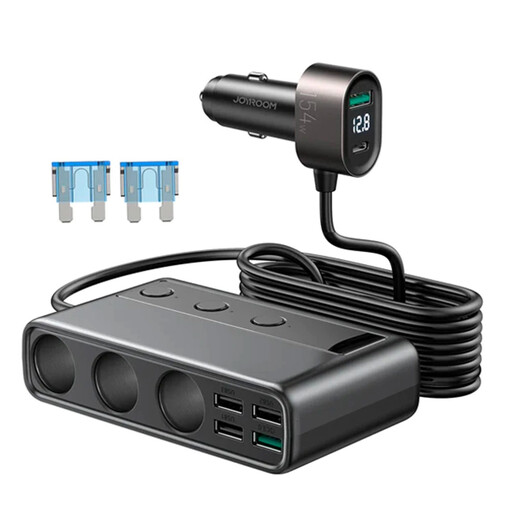
Why We Recommend This Product: The JR-CL06 model from Joyroom stands out with its exceptional port variety. With a total of nine outputs, including three additional cigarette lighter sockets, it offers a comprehensive solution for users who need to power traditional 12V appliances alongside their USB devices. The high total output of 154 watts ensures an adequate power supply, even when all ports are in use.
Pros:
Who It's For: This multi-USB car charger is ideal for families on long road trips, field service professionals with diverse equipment (e.g., a laptop and a portable cooler), and rideshare drivers who require maximum flexibility in their connection options.
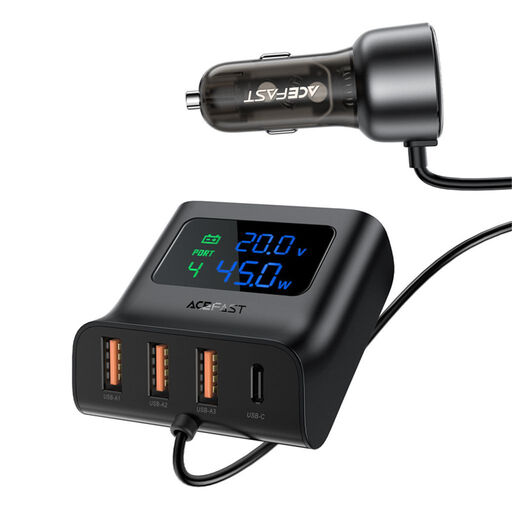
Why We Recommend This Product: The Acefast B11 focuses on high-performance USB charging and offers a unique technical feature: a digital display for real-time monitoring of voltage and power for each port. This gives the user precise control over the charging process. The combination of four USB-A and two USB-C ports covers the needs of modern device ecosystems.
Pros:
Who It's For: This charger is aimed at tech-savvy users, commuters, and anyone who primarily wants to charge multiple USB devices like smartphones, tablets, and laptops quickly and with full control. The monitoring function offers clear added value for users looking to optimise their charging process.
If the models presented here do not exactly match your requirements for design or specific port configurations, you can find an expanded selection of charging solutions for your vehicle in our Black Chargers category.
1. What is the difference between Power Delivery (PD) and Quick Charge (QC)? Both are fast-charging technologies, but they are based on different technical approaches. Power Delivery is a universal standard that primarily works via USB-C and allows for flexible voltage and current regulation for a wide range of devices, from smartphones to laptops. Quick Charge is a proprietary technology from Qualcomm, mainly found in Android devices with compatible processors, which also achieves high charging speeds via USB-A or USB-C. A charger that supports both protocols offers the broadest compatibility.
2. Can a high-wattage car charger drain my car battery? A car charger only draws power when the vehicle's ignition is on or if the cigarette lighter socket is continuously powered. When the engine is running, the battery is charged by the alternator, so the additional power consumption from the charger is not an issue. With the engine off, a charger can drain the battery over an extended period. However, many modern vehicles cut power to the cigarette lighter socket after a certain time to prevent a deep discharge of the battery. It is recommended to unplug the charger when the vehicle is parked for long periods.
3. Are cigarette lighter splitters safe? Modern, high-quality splitters are equipped with their own fuses and protection circuits to prevent overloading the vehicle's electrical system. It is important not to exceed the maximum load capacity of the splitter and the vehicle's socket (usually 10-15 amps). Products that comply with relevant safety standards can be considered safe as long as they are used according to the manufacturer's instructions.