
Lieferung heute & morgen

Qualitätsgarantie

Willkommens-Angebote freischalten: KOSTENLOSE Lieferung | Bis zu 80 % RABATT | Kostenlose 30-Tage-JoyPlus-Testphase
App herunterladen
A well-lit driveway, a bright garden path, or an illuminated entryway contributes to orientation and a sense of security on your property. An outdoor solar light with a motion sensor offers a practical solution: it operates off-grid, requires no complex wiring, and activates only when truly needed.
This guide explains the key technical features to consider when making your selection and presents a curated list of models for various applications. Our goal is to provide you with the information you need to make a confident decision and find the perfect outdoor motion sensor lighting for your needs.
The market is filled with a wide variety of solar lights. To find the right model for you, three technical aspects are particularly important.
A light's brightness is measured in lumens (lm). For simple pathway lighting, a lower lumen count may be sufficient. However, to brightly illuminate a larger area like a yard or a garage driveway, an outdoor solar spotlight with a higher output of 1000 lm or more is recommended. A wide beam angle, often achieved with adjustable heads, provides broad coverage, while a focused angle targets a specific spot. Models designed as solar floodlights with motion sensors typically offer very wide and intense illumination.
The performance of an outdoor LED light with a motion sensor depends heavily on its sensor. Two specifications are crucial here: the detection angle and the range. An angle between 120° and 180° is standard and effectively covers most areas in front of a wall. The range indicates the distance from which motion can be detected. A few metres are often enough for an entryway, but for a long driveway, a range of 10 metres or more is advisable to ensure the light activates early.
Since the light is exposed to the elements year-round, high durability is essential. The IP rating indicates how well a device is protected against the ingress of foreign objects (first digit) and water (second digit). An IP65 waterproof solar light is dust-tight and protected against water jets from any angle. This is a solid standard for year-round outdoor use, ensuring that rain, snow, and dust do not compromise its function. Robust materials like ABS plastic further contribute to its longevity.
Based on the criteria above, we have compiled a selection of models suited for different requirements and locations.
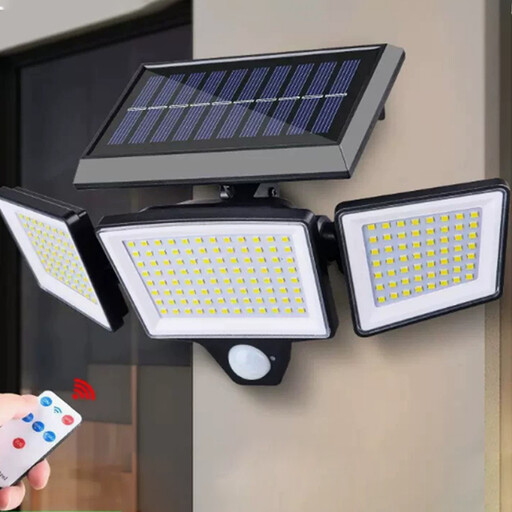
Why it stands out: This model combines high light output with maximum flexibility. Its three individually adjustable heads allow for very broad and targeted illumination up to 270°.
Who is it for? Ideal for homeowners who need a powerful solar-powered outdoor garage light or comprehensive illumination for large driveways, patios, or gardens. Its high brightness makes it an effective solar security light.
View Details for the ume Solar Spotlight
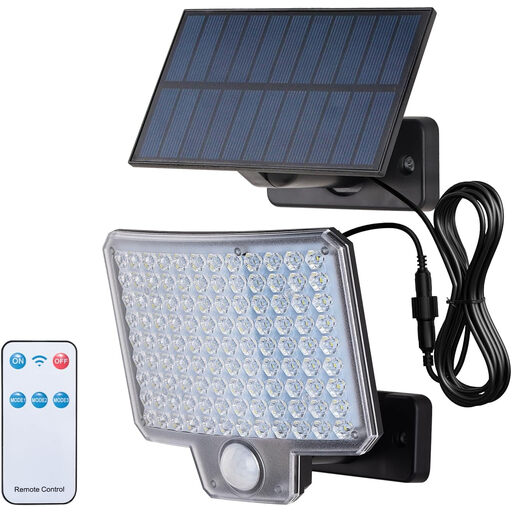
Why it stands out: The split design is its key advantage. The solar panel and the light are separated by a 5-metre cable, allowing the light to be mounted in shady spots—like under an eave or on a north-facing wall—while the panel is placed in a sunny location.
Who is it for? Perfect for users whose desired mounting location for the light doesn't receive enough direct sunlight. A great choice as an outdoor solar wall light for covered entrances, balconies, or carports.
View Details for the Grifema Garden Lamp
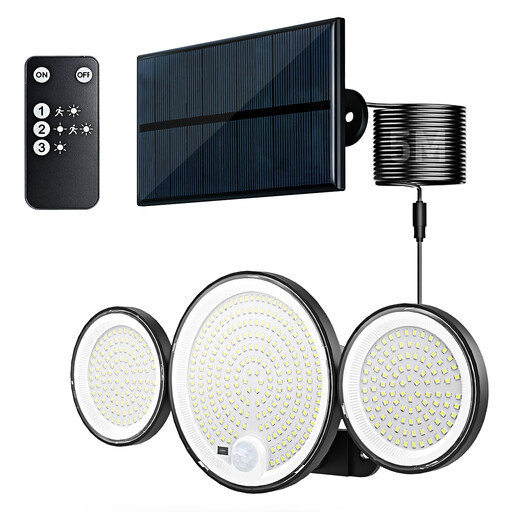
Why it stands out: With 446 LED units and a stated brightness of 3500 lumens, this model is engineered for maximum light output. It primarily serves as a deterrent through large-scale, ultra-bright illumination.
Who is it for? For users whose top priority is maximum brightness. It is especially suitable for securing remote areas of a property, large backyards, or commercial outdoor spaces.
View Details for the VIVREAL Security Light
The models featured here cover common use cases. However, if you are looking for a light with different specifications or for a more specialised purpose, you can find more alternatives in our broader product category.
Discover Our Full Range of Security Lights
1. Do solar lights work in winter or on cloudy days? Yes, modern solar lights can charge even in diffuse light, although at a reduced rate. On short winter days or during prolonged overcast weather, the runtime per night may be shorter than in summer. The efficiency of the solar panel and the battery capacity are the key factors here.
2. How long does a solar light stay on with a full charge? The runtime depends on the battery capacity, brightness, and selected mode. In motion-sensor-only mode, where the light activates briefly upon detection, a single charge can last for many nights. In continuous-on mode, the runtime after a sunny day is typically between 6 and 10 hours.
3. How do you install an outdoor solar light with a motion sensor? Installation is typically straightforward and requires no electrical expertise. The light is mounted to a wall, fence, or post using the included screws and anchors. It is important to choose a location where the solar panel will receive as much direct sunlight as possible to ensure optimal battery charging.