
Lieferung heute & morgen

Qualitätsgarantie

Willkommens-Angebote freischalten: KOSTENLOSE Lieferung | Bis zu 80 % RABATT | Kostenlose 30-Tage-JoyPlus-Testphase
App herunterladen
Choosing the right pacifier for your baby aged 6 to 18 months is an important decision. During this developmental stage, their teeth and jaw are forming, and their skin can be sensitive to different materials. This buying guide presents objective criteria and a selection of products to help you make an informed choice.
To select the most suitable pacifier for your child, you should consider a few key features. The following points provide a framework for your purchase.
An orthodontic pacifier is designed to support the natural development of the jaw and palate. Look for a thin, flat, and flexible teat neck that minimises pressure on the teeth and jaw. Symmetrical teats have the advantage of always being positioned correctly in the mouth.
When it comes to materials, the silicone pacifier has become a popular choice. Silicone is a hygienic, odourless, and taste-neutral material that is also very durable and easy to clean. All products featured here are made from BPA- and BPS-free silicone and comply with the European safety standard EN 1400.
The skin around a baby's mouth is particularly delicate. A pacifier for sensitive skin is distinguished by a shield with large air holes. These ensure good air circulation and help prevent skin irritation and redness.
Additional features can make daily life easier. A glow-in-the-dark pacifier helps you and your baby find it quickly in the dark without having to turn on the light. A pacifier with a steriliser box offers a convenient solution for hygienic cleaning and transport on the go. The box often allows for quick sterilisation in the microwave.
For environmentally conscious parents, sustainable options are now available. A sustainable pacifier is often made from bio-renewable materials and produced in a climate-neutral way. Manufacturers offset unavoidable CO₂ emissions by supporting climate protection projects. Regardless of sustainability, certified safety according to the EN 1400 standard is a fundamental quality benchmark.
Based on the criteria above, we have compiled a selection of pacifiers for the 6 to 18-month age group.
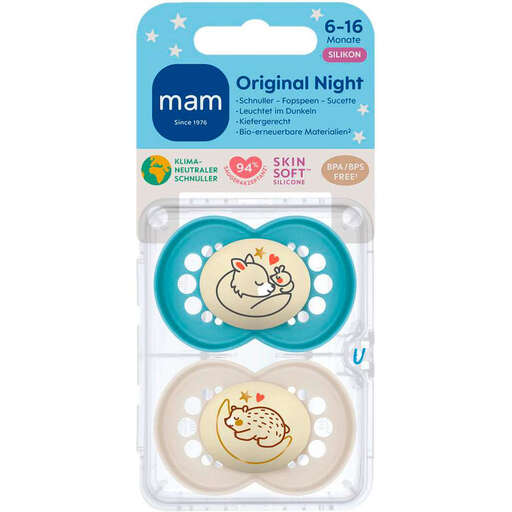
Why it stands out: The button's glow-in-the-dark feature makes this pacifier a practical helper at night. It's easy to find in the dark, which can reduce nighttime disruptions.
Pros:
Best for: Parents looking for a practical nighttime solution to minimise disruptions to their baby's sleep (and their own).
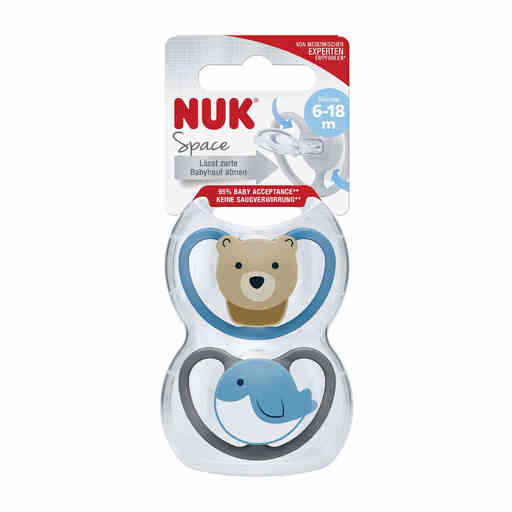
Why it stands out: The design is specifically tailored to the needs of babies with very sensitive skin. The extra-large openings in the shield ensure maximum air circulation.
Pros:
Best for: Parents whose babies are prone to skin irritation or rashes around the mouth and who are looking for an especially airy solution.
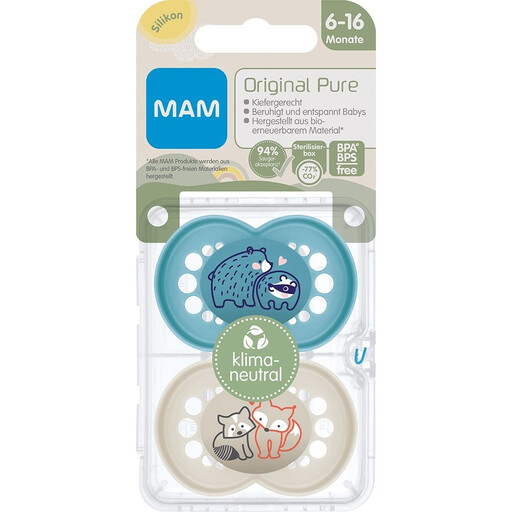
Why it stands out: This sustainable pacifier is MAM's first climate-neutral model. The shield and button are made from bio-renewable materials, which minimises the CO₂ footprint.
Pros:
Best for: Eco-conscious parents who value sustainable and climate-friendly products without compromising on quality and functionality.
If your baby is already teething or you're looking for a supplement to the pacifier, a teether can be a useful alternative for soothing and relieving teething discomfort.
Discover our selection of silicone teethers
For safety and hygiene reasons, it is recommended to replace a pacifier every one to two months. Inspect the pacifier before each use by pulling the teat in all directions. Dispose of it at the first sign of damage, cracks, or stickiness.
An orthodontic pacifier is shaped to interfere as little as possible with the natural development of the jaw, palate, and teeth. Features typically include a thin teat neck to keep the gap between the upper and lower rows of teeth small, as well as a flat teat section that allows the tongue sufficient space.
A silicone pacifier is made from a synthetic material known for its durability and heat resistance. It is odourless and taste-neutral, which can make it more readily accepted by babies. Furthermore, silicone is very hygienic because it is easy to clean and sterilise, and its smooth surface makes it difficult for germs to adhere.