
Lieferung heute & morgen

Qualitätsgarantie
App herunterladen
Kategorien
The video quality of modern smartphones has reached a level that delivers professional results for many use cases. However, image stabilization during movement remains a significant challenge. Shaky footage can diminish the impact of even the highest-resolution videos. A smartphone gimbal, also known as a phone stabilizer, addresses this problem with mechanical stabilization that far surpasses the capabilities of digital image stabilization. This article analyzes the technical parameters relevant for selecting the right model for 2026.
The choice of a gimbal should be based on an analysis of specific technical features tailored to your individual use case.
A gimbal's effectiveness is primarily determined by its number of stabilization axes.
Before purchasing, you must verify compatibility with your smartphone. Relevant parameters include the phone's dimensions (width, thickness) and weight. The gimbal's maximum payload, specified in grams, must not be exceeded. This is especially critical if you plan to use additional accessories like external microphones or add-on lenses, as they increase the total weight and put a strain on the gimbal's motors.
Battery life, typically specified in hours, defines the maximum continuous operating time. For vloggers or travel enthusiasts who film all day, models with a runtime of 10 hours or more are recommended. A USB-C port has become the standard, allowing for charging with common power adapters and power banks. Some models also offer a reverse-charging feature to supply power to the smartphone during operation.
For on-the-go use, weight and form factor are crucial factors. A foldable gimbal can be reduced to a compact size, making it easy to fit into a bag or backpack. The gimbal's own weight also affects handling during long shoots. Lighter models under 500 grams are generally more comfortable to operate.
Modern gimbals often offer more than just stabilization.
Based on the technical criteria above, we present two models that stand out for their specific feature sets.
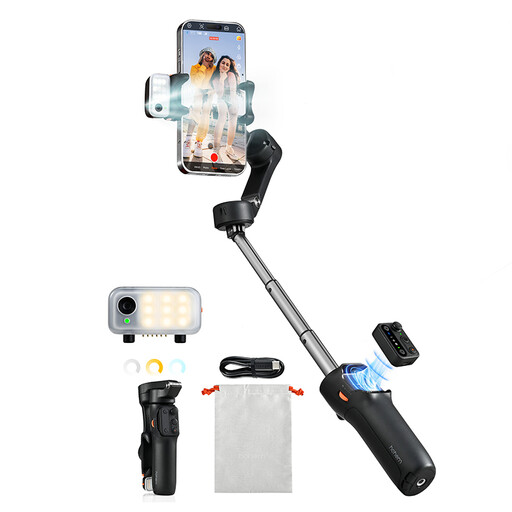
Why We Recommend This Product This model integrates several key features into a single device. The magnetic AI tracking module operates independently of any apps or Bluetooth connections and is activated via gesture control. This enables straightforward and reliable subject tracking. According to the manufacturer, the integrated, three-level fill light is 11 times brighter and enhances illumination for night shots. The combination of a tripod, an extendable extension rod, and a detachable remote control offers maximum flexibility for various shooting scenarios.
Pros
Who It's For This vlogging gimbal is ideal for content creators and solo filmmakers looking for an all-in-one solution. The combination of AI tracking, integrated light, and flexible setup options (tripod, extension rod) often makes external accessories redundant.
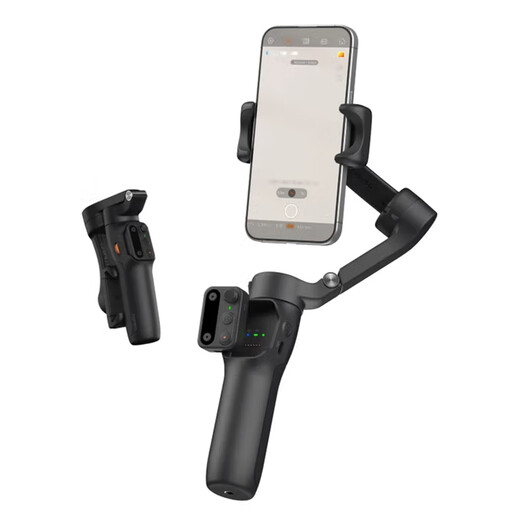
Why We Recommend This Product This model focuses on a gimbal's core competencies: excellent stabilization and high portability. Weighing just 361 grams and featuring a foldable design, it is engineered for on-the-go use. The iSteady 8.0 stabilization system and the extended roll arm ensure that the motors do not appear in the shot, even during wide-angle filming. The detachable remote control, with a range of up to 10 meters, offers additional creative freedom.
Pros
Who It's For This foldable gimbal is aimed at travel enthusiasts and mobile content creators who prioritize low weight and a compact form factor. It offers robust stabilization performance without complex extra features, making it a pragmatic choice for high-quality footage on the move.
The market for mobile stabilization solutions is diverse. In addition to the models featured, other devices are available with different specializations. For a broader overview of related products and accessories, please visit our portable camera category.
1. What is the difference between a smartphone gimbal and a selfie stick with a stabilizer? A smartphone gimbal uses motorized joints to actively compensate for movement on three axes, ensuring fluid video footage. In contrast, a simple selfie stick with a "stabilizer" often relies on only electronic image stabilization (EIS) or a basic 1-axis mechanism, which is severely limited in its effectiveness and cannot deliver comparably smooth results.
2. Do I need a special app to use a smartphone gimbal? Many gimbals offer advanced features like time-lapse, panorama, or object tracking through a manufacturer's app. However, the core stabilization function is usually usable without any app. Some models, like the featured hohem gimbal with an AI module, even implement complex functions like tracking without being tied to an app.
3. How do I properly balance my smartphone on a gimbal? Proper balancing is crucial for the performance and lifespan of the motors. First, clamp the smartphone in the center of the mount. Then, with the gimbal turned off, adjust the phone along the horizontal and vertical axes until it remains in a level position on its own. Only after this manual balancing should the gimbal be powered on.