
Lieferung heute & morgen

Qualitätsgarantie

Willkommens-Angebote freischalten: KOSTENLOSE Lieferung | Bis zu 80 % RABATT | Kostenlose 30-Tage-JoyPlus-Testphase
App herunterladen
Rising summer temperatures make effective room cooling increasingly essential. A portable air conditioner offers a flexible solution that requires no complex installation. Unlike permanently installed split systems, these units can be moved between different rooms as needed. Selecting the right model depends on specific technical parameters and the intended application. This article analyses the key criteria and presents a selection of units for various needs.
The decision to purchase a portable air conditioner should be based on an objective evaluation of technical specifications. The following parameters are crucial for making the right choice.
Cooling capacity is the most important indicator of a unit's effectiveness. It is measured in BTU (British Thermal Unit) per hour or in Kilowatts (kW). A higher BTU number signifies greater cooling power, which is necessary for larger rooms. As a general guide:
The exact capacity needed also depends on factors like ceiling height, sun exposure, and the number of people in the room.
Energy efficiency indicates how economically a unit operates. It is displayed on the EU energy label in classes from G (least efficient) to A+++ (most efficient). A key metric is the SEER (Seasonal Energy Efficiency Ratio), which describes the ratio of cooling output to power consumption over an entire season. Units with a high energy efficiency class (e.g., A+ or A++) result in lower running costs.
A low noise level is crucial, especially in bedrooms or home offices. The sound pressure level is measured in decibels (dB(A)). Levels below 50 dB(A) are considered relatively quiet during operation. Some models offer special silent or night modes that reduce fan speed and, consequently, noise levels. Operating a quiet air conditioner is often a primary purchasing criterion.
Most portable air conditioners are monobloc units, where all components are housed in a single casing, and warm air is expelled outside through an exhaust hose. Less common are portable split units, where the compressor is located in an external unit, making indoor operation quieter.
Many units offer additional functions:
Modern units often include convenience features like an air conditioner with app control, allowing for remote operation and scheduling via a smartphone. For maximum flexibility, such as for camping, there are models like a battery-powered air conditioner, which can operate off-grid for several hours.
Based on the technical criteria mentioned, we have compiled a selection of units for different use cases.
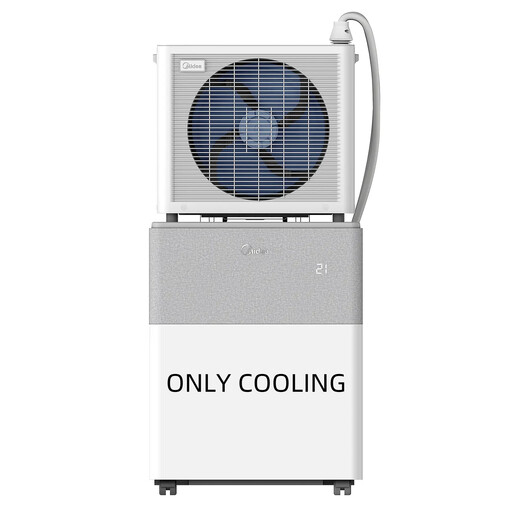
Why We Recommend This Product The Midea PortaSplit Cool stands out with its portable split design. By housing the compressor in a separate outdoor unit, the noise level indoors is significantly reduced. In silent mode, the unit reaches a level of just 38 dB(A) according to the manufacturer, making it ideal for use in noise-sensitive environments.
Pros:
Best For:
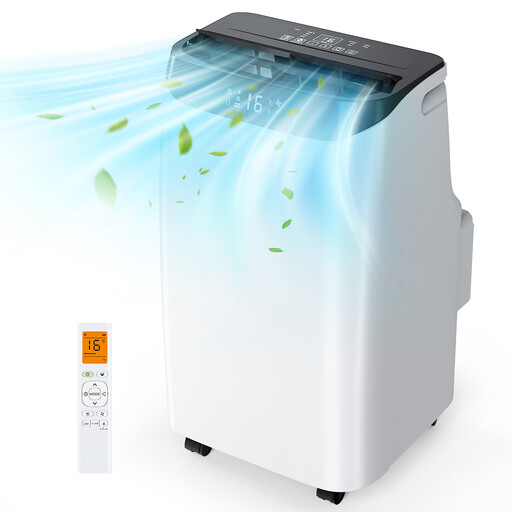
Why We Recommend This Product With a cooling capacity of 12,000 BTU (3.5 kW), this monobloc unit from Humhold is designed to effectively cool larger rooms up to 45 m? (approx. 485 sq ft). The auto-swing function ensures even distribution of cool air. The integrated self-evaporative technology reduces the need to manually empty the water tank.
Pros:
Best For:
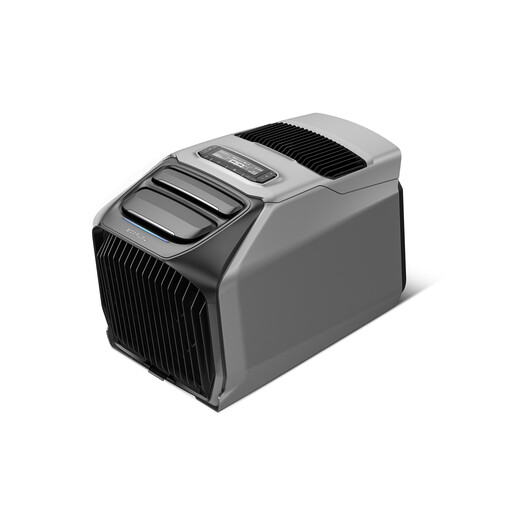
Why We Recommend This Product The ECOFLOW WAVE 3 is engineered for maximum portability and off-grid operation. With an optional add-on battery, it provides up to 8 hours of wireless use. In addition to its cooling function (6100 BTU), the unit also features a powerful heating function (6800 BTU). Its versatile charging options (AC outlet, solar, car) make it an all-purpose air conditioner for RVs, tents, or other off-grid applications.
Pros:
Best For:
If none of the featured models perfectly match your requirements, you can find a broader selection of units with different specifications in our main category. There, you can filter specifically by capacity, price, and features.
Discover more portable air conditioners
1. Is there a portable air conditioner without an exhaust hose? A portable air conditioner without an exhaust hose is typically an evaporative cooler (or "swamp cooler"), not a true air conditioner. Evaporative coolers cool the air through the evaporation of water, which can only lower the room temperature by a few degrees while also increasing humidity. A true portable air conditioner removes heat from the room and must expel it outside via an exhaust hose to provide effective cooling.
2. How quiet is a portable air conditioner really? The noise level varies depending on the model and design. Monobloc units typically produce a sound pressure level between 50 and 65 dB(A), which is comparable to a normal conversation. Portable split units, like the Midea PortaSplit, are significantly quieter because the loud compressor is located in the outdoor unit. Models with a special night or silent mode can reduce the noise level to below 50 dB(A).
3. Can I use a portable air conditioner in an RV? Yes, using an air conditioner for an RV is a common application. Compact and energy-efficient models are particularly suitable. Units with battery power or flexible charging options, like the ECOFLOW WAVE 3, are designed for this purpose as they can operate independently of a 230V power grid. You just need to ensure that the exhaust hose can be safely routed outside, for example, through a window or a roof vent.