
Lieferung heute & morgen

Qualitätsgarantie

Willkommens-Angebote freischalten: KOSTENLOSE Lieferung | Bis zu 80 % RABATT | Kostenlose 30-Tage-JoyPlus-Testphase
App herunterladen
As an owner of an electric car or plug-in hybrid, you might face the challenge of finding a suitable charging option, especially if installing a fixed wallbox isn't possible in your rented or owned apartment. A portable wallbox, often called a charging brick or portable EV charger, offers a practical and cost-effective solution. It allows you to safely charge your vehicle from a conventional household socket (Schuko)—at home, at a friend's house, or while travelling.
This article serves as your guide. We'll explain the technical features you should look for and present a selection of devices designed for various needs.
By: Joybuy Product Recommendation Officer
Choosing the right device depends on technical details that ensure safety and functionality. Here are three key points to consider.
The charging power, measured in kilowatts (kW), determines how quickly your vehicle's battery charges. For charging from a standard Schuko socket, devices with a power output of up to 3.7 kW are common. This power is achieved at a voltage of 230V and a current of 16 amps (A).
Many portable chargers offer the ability to manually adjust the current (e.g., to 8A, 10A, 13A, or 16A). This is a crucial feature to avoid overloading your home's electrical system, especially in older buildings where the wiring isn't designed for a sustained high load. This makes charging an EV from a standard socket safely possible, provided the charger allows for adjustment to the local conditions.
Safety is the top priority during the charging process. A high-quality portable EV charger should have multiple protective features. Look for the following:
In Europe, the Type 2 connector is the standard for most electric vehicles. Ensure the charger has a Type 2 charging cable that is compatible with your vehicle.
Cable length is an often-underestimated but crucial factor for everyday practicality. Measure the distance from the socket to your usual parking spot. A length of 5 metres is often sufficient, but depending on your parking situation, 8, 10, or even 20 metres may be necessary to ensure flexibility. A longer cable eliminates the need for unapproved extension cords, which pose a significant safety risk.
Based on the criteria above, we have compiled a selection of portable chargers that stand out for their functionality and safety features.
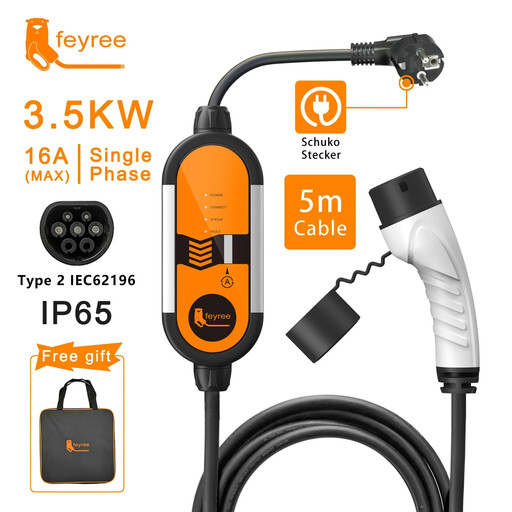
Why it stands out: This charger combines solid core functionality with useful convenience features. The ability to adjust the charging current between 8A, 10A, 13A, and 16A offers great flexibility. The memory function remembers the last selected setting for the next charging session. The OLED display clearly shows the charging status.
Advantages:
Who is it for? For EV drivers looking for a straightforward and reliable portable wallbox for regular charging at home or on the go, who also want to maintain control over the current to protect their home's electrical system.
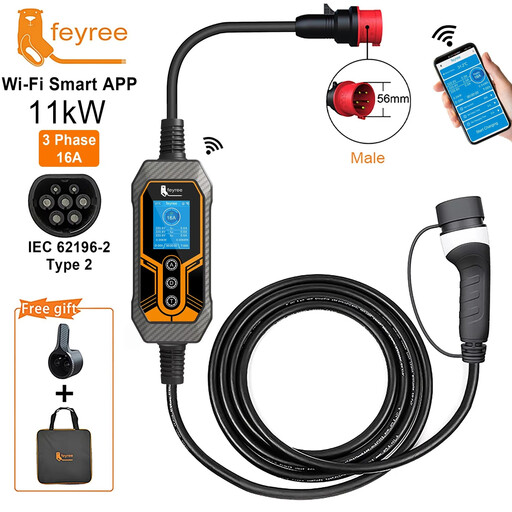
Why it stands out: This model is aimed at tech-savvy users who want more control and scheduling capabilities. The integrated Wi-Fi and Bluetooth functionality allows for control and monitoring of the charging process via a smartphone app. This enables scheduled charging during off-peak hours with cheaper electricity tariffs. With a CEE plug, it can achieve up to 11 kW of charging power from a three-phase socket.
Advantages:
Who is it for? For users who have access to a CEE three-phase socket and want to take advantage of app control, charge scheduling, and faster charging. It's an advanced alternative to a basic Schuko charging cable.
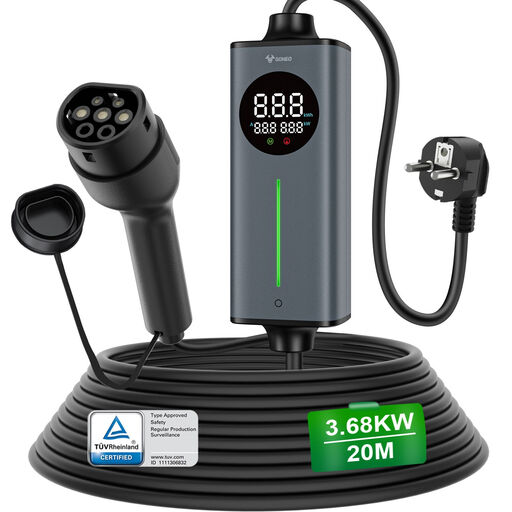
Why it stands out: The standout feature of the GONEO charger is the optional cable length of up to 20 metres. This solves the problem of distant sockets and difficult parking situations. Additionally, the manufacturer places a strong emphasis on documented safety features, including automatic grounding detection and precise temperature protection.
Advantages:
Who is it for? Ideal for EV owners whose parking space is far from the nearest socket. This model is also an excellent choice for users who place a high value on comprehensive and certified safety mechanisms.
If the models presented here don't exactly meet your needs, or if you're looking for other charging solutions, you can find a wider selection in our Power Connectors & Wire Cables category. There, we offer various charging cables and adapters for different use cases.
Yes, charging from a household socket is safe, provided you use a high-quality portable charger with all the necessary safety features (like RCD and overheating protection). Additionally, the building's electrical installation should be in perfect condition and checked by a professional if you are unsure. The use of simple extension cords or power strips is strongly discouraged as they pose a fire risk.
The charging speed depends on the device's power output and the vehicle's battery capacity. With a 3.7 kW wallbox connected to a Schuko socket, you can add about 15 to 20 kilometres of range per hour. This is ideal for fully charging the vehicle overnight or during a workday.
The terms charging brick, emergency charging cable, and portable wallbox are often used interchangeably in common language. They all refer to a portable charger that allows an electric vehicle to be charged from a standard socket (Schuko) or sometimes a CEE socket. Originally, the emergency charging cable was intended as a backup solution, but modern devices are so safe and powerful that for many users, they represent the primary charging solution at home.