
Lieferung heute & morgen

Qualitätsgarantie

Willkommens-Angebote freischalten: KOSTENLOSE Lieferung | Bis zu 80 % RABATT | Kostenlose 30-Tage-JoyPlus-Testphase
App herunterladen
Purchasing a portable wallbox promises flexibility: charge at home without expensive installation, on holiday, or at a friend's house. But the market is confusing and full of pitfalls that can quickly lead to a costly mistake. Many users invest in devices that either don't match their home's electrical setup or skimp on crucial safety features.
Before you make a decision, you should know the two most common errors:
This guide will help you navigate these and other challenges to make an informed decision.
To find the right portable charging station for your electric car, three technical aspects are of central importance. These determine not only the charging speed but also safety and compatibility.
The plug that connects the charger to the power grid is the most important distinguishing feature.
The charging power, specified in kilowatts (kW), determines how quickly your vehicle's battery is charged. While a 3.7 kW charger is sufficient for overnight charging, an 11 kW portable wallbox offers much more flexibility for quick top-ups.
Regardless of the power, integrated protection mechanisms are essential. Look for the following features:
The practicality of a portable charger depends heavily on its features.
Based on the criteria mentioned, we have selected a few products that are suitable for different requirement profiles.

Why This Fits Their Persona: Ideal for renters or EV owners looking for a straightforward charging solution without installation hassle. The 3.68 kW charging power is sufficient for overnight charging and is compatible with any standard household socket in Germany.
This device is designed for the Schuko socket, preventing the mistaken purchase of an incompatible CEE charger. According to the manufacturer, it has an integrated RCD (30mA AC + 6mA DC) and temperature monitoring.
Plug-and-play solution for any Schuko socket. The timer function enables scheduled charging to save costs. The 8-metre cable length offers good flexibility.

Why This Fits Their Persona: For users with access to a CEE 16A socket who want to combine fast 11 kW charging with smart features. The app control allows for scheduling charging sessions to use off-peak tariffs and provides full control over the charging process.
This model goes beyond simple charging and addresses the desire for cost control through smart features. According to the manufacturer, comprehensive protection mechanisms such as leakage protection (Type B: AC30mA + DC6mA) are integrated.
Combination of high charging power (11 kW) and intelligent control via app. Adjustable charging current and scheduled charging to optimise electricity costs.
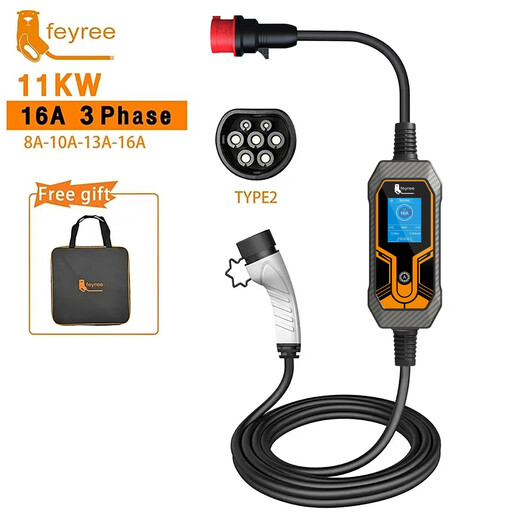
Why This Fits Their Persona: Perfect for EV drivers who are often on the road and need a robust, powerful, and uncomplicated charging solution. The device focuses on the essentials: fast and safe charging at any available CEE 16A socket, without being dependent on an app or Wi-Fi connection.
This charger focuses on reliability and safety for mobile use. According to the manufacturer, it has all the necessary safety functions and deliberately omits app features that could be a source of error on the go.
High charging power of 11 kW for rapid charging on trips. The LCD display provides all important charging data at a glance. The robust design is built for transport in the car.
We have compiled a complete, up-to-date list of products that fully meet these strict selection criteria and German safety regulations.
1. Can I use a portable wallbox with a normal socket? Yes, portable chargers with a Schuko plug are specifically designed for use with a standard household socket (230V). The charging power is limited to about 2.3 kW to 3.7 kW. It is recommended to have the socket checked by an electrician if it will be regularly used for multi-hour charging sessions at high load.
2. How important is the cable length for a portable charger? Cable length is very important for everyday usability. Measure the distance from the most frequently used socket to your vehicle's charging port and plan for some extra slack. A cable that is too short can make parking difficult, while an excessively long cable can be unwieldy. Lengths between 5 and 8 metres are a good compromise for most scenarios.
3. Does an 11 kW portable wallbox require a permit? In Germany, charging equipment for electric vehicles with a power rating of more than 3.7 kW must be registered with the responsible grid operator. This also applies to an 11 kW portable wallbox. Charging equipment with more than 11 kW is not only subject to registration but also requires a permit. Registration is usually a simple process done via a form provided by the grid operator.