
Lieferung heute & morgen

Qualitätsgarantie

Willkommens-Angebote freischalten: KOSTENLOSE Lieferung | Bis zu 80 % RABATT | Kostenlose 30-Tage-JoyPlus-Testphase
App herunterladen
A dead car battery is more than just a nuisance—it usually happens at the worst possible time: on a cold morning, on your way to an important appointment, or on a remote country road. A portable jump starter, often called a jump starter power bank or car battery booster, promises a quick and easy solution. But the market is flooded with devices making grandiose promises. Before you make a decision, it's crucial to understand the most common pitfalls that can lead to a bad purchase.
Author: Joybuy Product Recommendation Officer
Date: July 28, 2026
Many devices look convincing at first glance, but prove to be unreliable in practice. Watch out for these three typical problems:
To make an informed decision, focus on the technical specs that are relevant for its function as an emergency starter for your car.
The peak current is the maximum amperage the device can deliver for a short burst to start the engine. The power you need depends on your vehicle:
The capacity in milliampere-hours (mAh) is primarily relevant to its function as a power bank—i.e., how many times you can charge your smartphone. More important for jump-starting is the specification of how many start attempts are possible on a full charge.
Integrated safety mechanisms are also essential. A good device should offer at least the following protections:
A power bank with a jump starter and compressor is particularly useful for long trips or for vehicle owners who want to be prepared for any eventuality. Pay attention to two key metrics here:
Here are some models that are suitable for different user profiles based on their objective specifications.
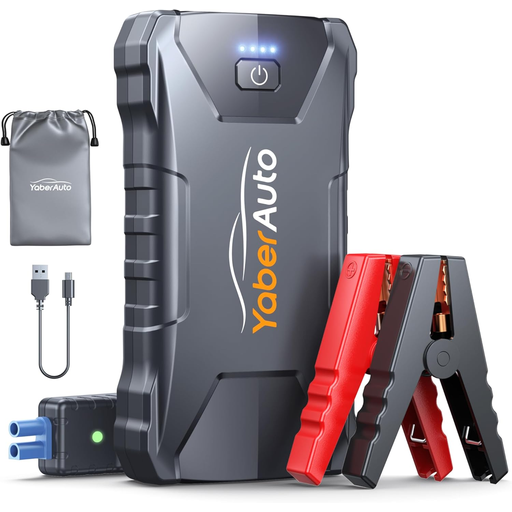
Why It's a Good Fit: Ideal for drivers of standard passenger cars (petrol or smaller diesels) looking for a compact and straightforward solution for the glove box. It provides a reliable baseline of security for daily use.
It focuses on the core function of jump-starting with a realistic 2000 A peak current, without advertising exaggerated specs that are unnecessary for common vehicles.
Extremely compact design and low weight (0.340 kg), allowing it to fit easily in almost any storage compartment.

Why It's a Good Fit: An all-in-one device for holiday travel, camping, or as a safety kit in the family van. It combines very high starting power with a full-featured air compressor.
Unlike many multi-function devices, both the jump starter (4500 A) and the compressor (150 PSI) are powerful and designed for demanding tasks like starting large engines or inflating SUV tyres.
Combines five functions (jump starter, compressor, power bank, LED light, pressure gauge) in a rugged housing without compromising on its core features.
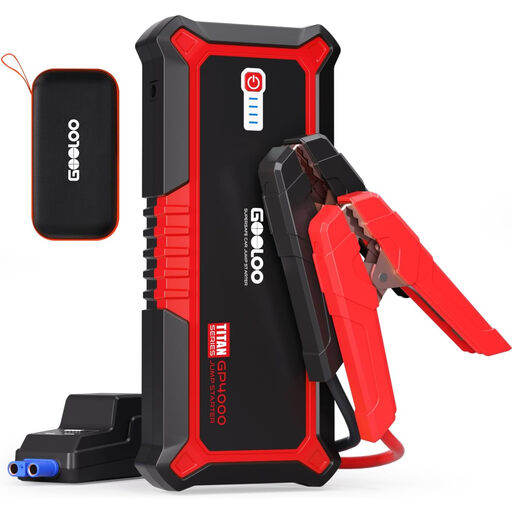
Why It's a Good Fit: Designed for demanding tasks. With 4000 A of peak current, it delivers the power needed to reliably start even large-displacement petrol and diesel engines (up to 10.0L), even in low temperatures.
This device actually delivers the high power required for large engines. Where weaker models would hit their limits, the GP4000 provides the necessary reserves for a successful start.
High peak current and a rugged build make it a dependable choice for owners of vans, RVs, SUVs, and powerful diesel vehicles.
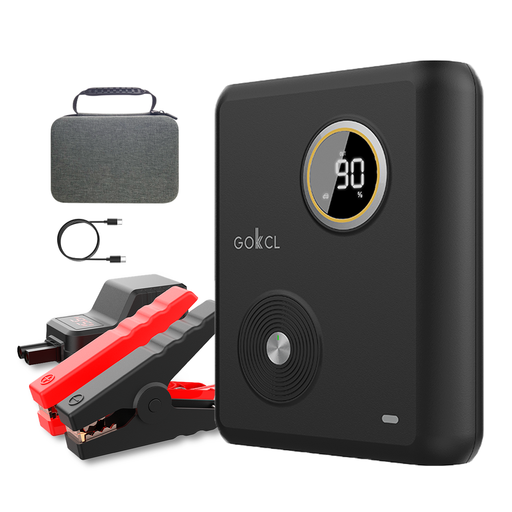
Why It's a Good Fit: Perfect for vehicles that are rarely driven (e.g., classic cars, RVs in winter storage) or need to function reliably in extreme temperatures. The sodium-ion technology is a key advantage.
It solves the self-discharge problem. According to the manufacturer, the battery retains its charge for years, not just months. This means it's ready to use even after long-term storage in the car, without needing constant recharging.
Extremely low self-discharge and a very wide operating temperature range (-40°C to 80°C) thanks to its sodium-ion battery technology.
We have compiled a complete, up-to-date list of products that fully meet these strict selection criteria and all relevant safety regulations.
For conventional lithium-ion models, it is recommended to fully charge the device every 3 to 6 months to ensure it's ready for use and to preserve the battery's lifespan. Models with newer technologies like sodium-ion have significantly lower self-discharge and require less frequent charging. Always refer to the manufacturer's specifications.
A deeply discharged but otherwise intact battery can usually be jump-started. Some devices feature a "Boost" or "Force Start" function to override safety measures for batteries with very low residual voltage (below 9V). However, a mechanically or chemically defective battery cannot be brought back to life, even with the most powerful jump starter. In that case, replacing the car battery is unavoidable.