
Lieferung heute & morgen

Qualitätsgarantie

Willkommens-Angebote freischalten: KOSTENLOSE Lieferung | Bis zu 80 % RABATT | Kostenlose 30-Tage-JoyPlus-Testphase
App herunterladen
A power station, also known as a mobile solar generator or portable power supply, is a rechargeable, battery-powered energy storage device. These units are designed to power electronic appliances independently of the public grid. Their applications range from emergency power during outages and use during camping trips to supplying energy on construction sites or for digital nomads. Selecting the right model depends on specific technical requirements.
The decision to purchase a power station should be based on an analysis of objective parameters. The following criteria are relevant for your selection.
Capacity indicates how much energy the battery can store. It is measured in watt-hours (Wh). To determine your needs, you can multiply a device's power consumption (in watts) by the desired operating time (in hours). For example, a laptop that consumes 50 watts can theoretically run for up to 10 hours on a 500 Wh power station, although conversion losses must be taken into account.
The output power defines the maximum power that the power station with an AC outlet can deliver. A distinction is made between rated power (continuous) and peak power (short-term). The rated power must be higher than the power consumption of the devices you intend to run. Appliances with a high inrush current, such as refrigerators or power tools, require a sufficiently high peak power.
Modern power stations predominantly use lithium-ion batteries. The cell chemistry is a crucial factor:
For long-term and intensive use, a LiFePO4 battery is often the more robust technical choice.
A versatile portable power station features a variety of outputs:
The charging options are also a factor: recharging via a wall adapter, in the car using a 12V connection, or off-grid via a compatible solar panel (solar generator).
The following models have been selected based on their technical specifications and practical utility.
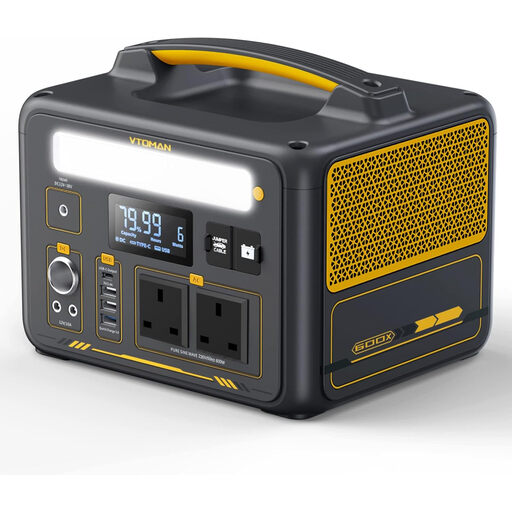
Why We Highlight This Product The VTOMAN Jump 600X stands out for its expandable capacity and constant power feature. While most units shut down when overloaded, the manufacturer states this model can supply devices rated over 600W with a constant 600W output, providing a workaround for more power-hungry appliances.
Technical Specifications
Who It's For This model is suitable for users seeking a flexible and safe entry-level solution for camping or occasional power outages, who also value the option to expand capacity as needed.
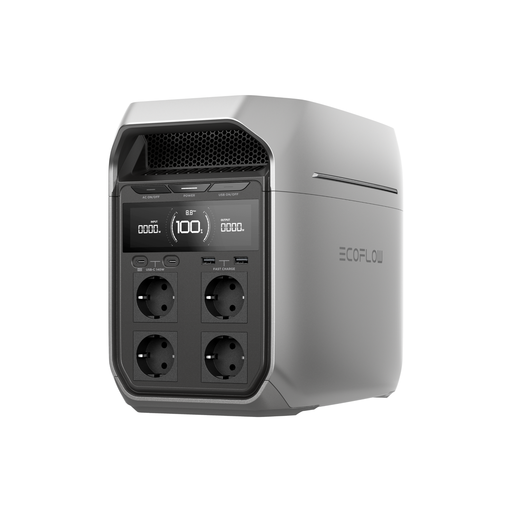
Why We Highlight This Product The EF ECOFLOW Delta 3 Plus focuses on high performance and extremely fast charging times. According to the manufacturer, the battery can be fully recharged from an AC outlet in just 56 minutes. Its X-Boost technology allows it to power devices up to 2,400W, significantly expanding its range of applications. The UPS power station function, with a switchover time of under 10 ms, is another key technical feature.
Technical Specifications
Who It's For Ideal for demanding users, homeowners needing emergency power, and tradespeople who require high continuous power, rapid recharging, and a reliable UPS function.
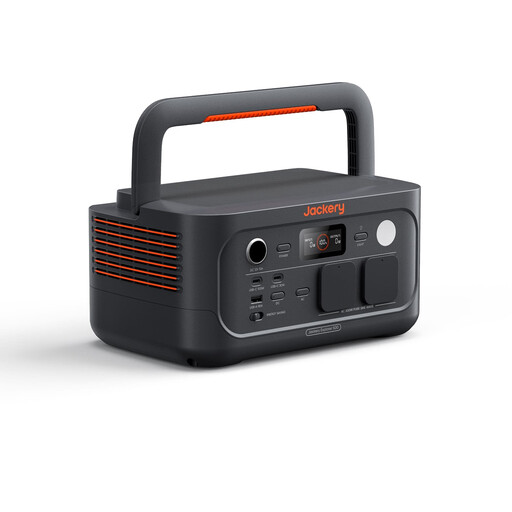
Why We Highlight This Product The Jackery Explorer 500 V2 combines solid capacity with high portability and an exceptionally long lifespan. With 6,000 charge cycles according to the manufacturer, it is built for durability. Its low weight of 5.7 kg and compact dimensions make it a practical power station for camping and travel.
Technical Specifications
Who It's For This device is aimed at outdoor enthusiasts and travellers who need a lightweight, durable, and easy-to-transport mobile power supply for devices with moderate power needs.
The models presented here cover common requirement profiles. However, the market offers a wide variety of other configurations for different power and capacity classes. For a broader overview of units designed specifically for outdoor use, you can consult our Camping Battery category.
1. What is the difference between a power station and a gas-powered generator? A power station is a battery-based energy storage device that operates silently, is emission-free, and requires little maintenance. It can be used indoors. A conventional generator burns fuel, produces exhaust fumes and noise, and is therefore only suitable for outdoor use. Power stations are typically lighter and more portable, while generators often offer higher continuous power output.
2. What size power station do I need for camping? For a weekend trip to charge smartphones, lights, and a small portable cooler, a capacity of 300 to 500 Wh is often sufficient. If you also plan to power laptops or other larger devices, models from 500 Wh to 1,000 Wh are a sensible choice. The exact size depends on your individual power consumption.
3. What are the advantages of a LiFePO4 battery in a power station? A LiFePO4 battery offers two primary advantages: a significantly higher number of charge cycles (longevity) and greater thermal and chemical stability (safety). Although they have a slightly lower energy density than NCM batteries, their robustness makes them the preferred technology for high-quality, long-lasting power stations.